Why Most Beginners Fail at Boxing Defense Early On (And the Fix in 2026)
Tuesday nights at the gym are usually when the new guys try to spar for the first time. You watch them on the heavy bag for twenty minutes before the bell rings. They look great. Snapping jabs, loud pops, good combinations. Then they step through the ropes for light sparring.
They freeze.
The first jab comes in, and they blink, turn their head, and get tapped right on the nose. It happens almost every week. Most beginners lose balance because they rush the second punch, or they get hit because they forget that the person across from them is actually trying to touch them.
Boxing defense isn’t about having fast reflexes right away. It’s about breaking a few very specific, very awkward habits that every new fighter develops in their first three months.
Quick Answer: Why Beginners Fail at Defense
- The Heavy Bag Illusion: You practice hitting a stationary target, not avoiding a moving one.
- The Post-Punch Drop: Hands fall to the waist immediately after throwing a punch.
- Glued Feet: People usually stop moving their feet once they get tired or nervous.
- Tunnel Vision: Staring at the incoming glove instead of watching the opponent’s center line.
The Fix: Stop trying to win the exchange. Focus entirely on returning your hands to your face and taking one small step backward after every single combination.
Educational Disclaimer: Boxing is a contact sport with inherent risks, including head trauma and joint injuries. This guide is for educational purposes based on standard amateur gym practices. Always consult a physician before starting combat sports. USA Boxing strongly recommends that beginners focus on defensive fundamentals and light, controlled sparring before engaging in hard contact.
The Heavy Bag Illusion
The heavy bag is a liar. It doesn’t counter. It doesn’t feint. It doesn’t step on your lead foot to trap you.
Most beginners practice offense, not survival. They memorize a six-punch combination and drill it until it sounds like a machine gun. But you can usually tell who only trains on heavy bags because they freeze once movement starts. They are waiting for the target to stay still.
When a real person steps in front of them, the brain gets overloaded. The beginner tries to remember the six-punch combination while simultaneously trying to figure out why the other person is moving to the left. The brain picks one task. Usually, it picks punching. And because the hands are busy punching, they aren’t blocking.
Defense fails early on because beginners treat sparring like a heavy bag routine. They think the goal is to land punches. The actual goal in your first few months of sparring is simply to see the punch coming and not be where it lands.
The 5 Reasons Beginners Get Hit (And How to Fix Them)
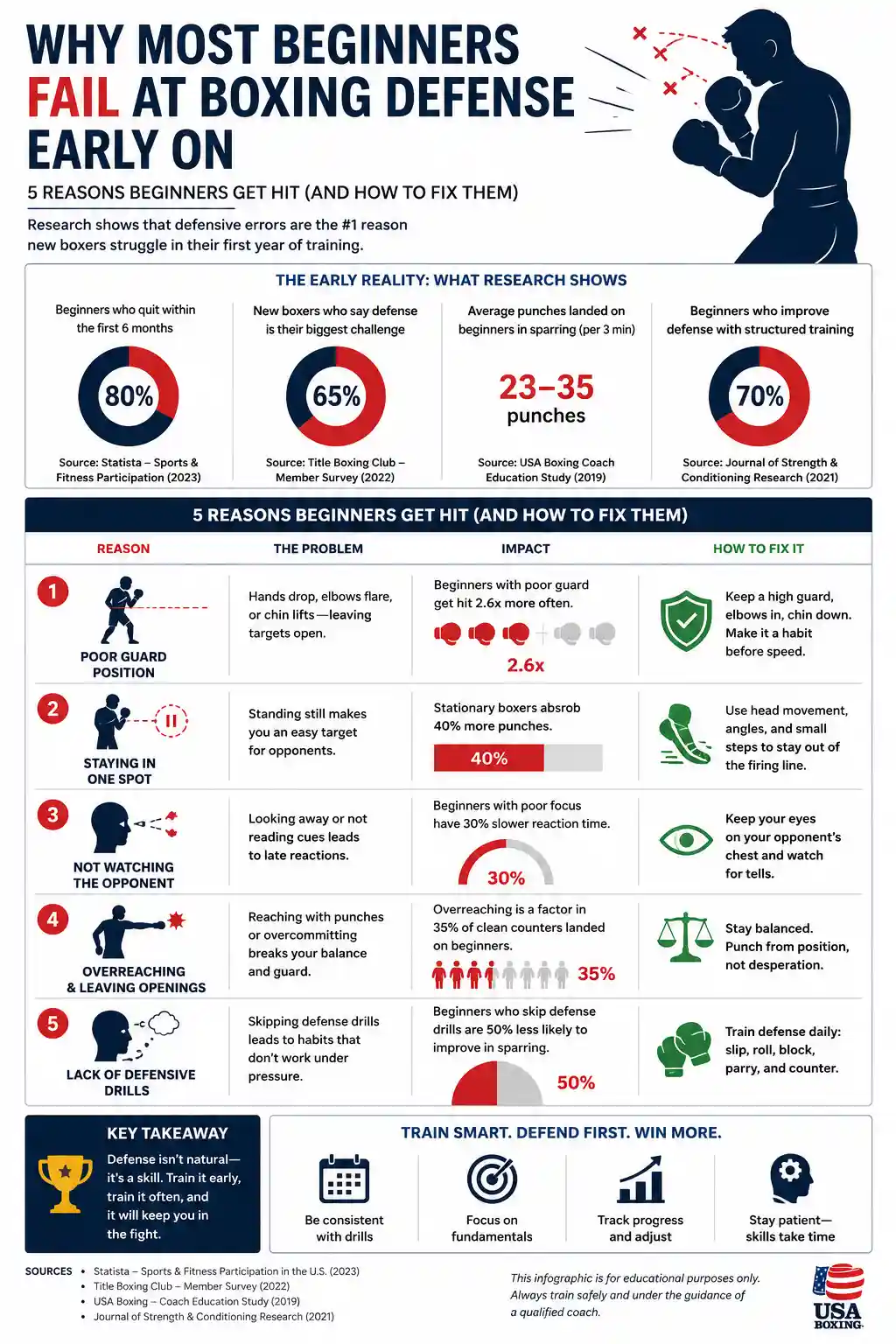
If you are getting tagged cleanly in the gym, you are likely doing one of these five things. Coaches spot these from across the room before the bell even rings.
1. The Post-Punch Drop
Beginners often throw a jab, and their hand drops all the way to their hip on the way back to their face. Or they throw a 1-2 and admire the work for a half-second.
The second the punch leaves, the guard is gone. If your opponent is fast, they will slip your punch and hit you while your hand is still traveling back to your chin. I tell guys all day: punch and return, not punch and admire. The return trip of the punch needs to be twice as fast as the way out.
2. Tunnel Vision (Staring at the Glove)
New boxers almost always stare at the incoming glove. If I fake a jab low, their eyes drop to follow my hand, and I tap them on the forehead with the cross.
Beginners often stare at their own punches instead of watching reactions. You shouldn’t look at the hands. The hands are too fast. Look at the upper chest or the collarbone. The chest and shoulders have to move before the arm does. If you watch the center line, you will see the punch coming before it actually leaves.
3. The Statue Syndrome (Glued Feet)
When pressure starts, beginners plant their feet flat or cross them. People usually stop moving their feet once they get tired or nervous.
Defense isn’t just hands; it’s distance. If your feet are glued to the canvas, your head is a stationary target. You don’t need to bounce around like a track star. You just need to take one half-step back when someone rushes you. A missed punch tires out the attacker more than it tires out the defender.
4. Panic Breathing and Jaw Tension
Beginners often hold their breath without realizing it. They clinch their jaw, hold their breath, and tense their shoulders up to their ears.
You can hear panic breathing before you see defensive mistakes. When you hold your breath, you burn through your oxygen in about forty seconds. Once the oxygen is gone, your arms get heavy. When your arms get heavy, your hands drop. Exhale sharply on every punch, and breathe in through your nose when your hands are touching your face.
5. Squaring Up Under Pressure
The natural human reaction to a threat is to face it squarely. Most beginners square up once the combinations speed up. They turn their chest to the opponent to see better.
This exposes your center line and makes you a wider target. It also puts your weight on both feet evenly, meaning you can’t pivot or move backward quickly. Stay bladed. Keep your lead shoulder pointed at the other guy’s lead shoulder.
Coaching Tip: If you find yourself getting hit by counters, stop throwing the third punch in your combination. Stick to a jab and a cross. Get your hands back to your face. Once you stop getting hit on the third punch, you can start adding the hook back in.
Common Beginner Defensive Mistakes
| The Mistake | What It Looks Like | The Gym Fix |
|---|---|---|
| Chin Pointing Up | Looking up at the opponent’s eyes, exposing the point of the chin. | Tuck your chin to your lead collarbone. Look through your eyebrows. |
| Elbows Flaring | Arms sticking out like chicken wings to block hooks. | Pinch your elbows to your ribs. Let the punches hit your gloves and arms, not your body. |
| Leaning Back | Bending at the waist to avoid a jab, weight on the back heel. | Keep your weight centered. Move your feet backward instead of bending your spine. |
| Blinking | Shutting eyes tightly when a punch comes near the face. | Desensitize the flinch reflex. Have a coach throw a very light, slow towel at your face to practice keeping your eyes open. |
Building a Real Defense: Technique
You don’t need to learn shoulder rolls or matrix-style slips in your first year. Those look good on video but usually result in beginners getting knocked out in the gym. You just need a basic shell and simple head movement.
The High Guard (The Shell)
Keep your gloves touching your cheekbones. Not your forehead, not your chin. Your cheekbones. Your elbows should be tucked tight against your ribs.
When a body shot comes, you don’t drop your hands to block it. You drop your elbow. The arm acts like a shield. If your hands drop to catch a body shot, the other guy will just punch you in the face.
Visual Recommendation: A side-profile diagram showing a boxer in a high guard. Arrows indicate the elbows pinned to the lats, and gloves glued to the cheekbones. A secondary visual shows the elbow dropping to block a hook to the body while the glove stays on the cheek.
Basic Slipping
Slipping is just moving your head off the center line. You don’t need to bend your knees and duck. You just shift your weight slightly to the lead leg or the back leg.
Most beginners slip way too far. They bend over and put their head on the outside of their own knee. If you slip too far, you are off balance. If the guy misses, he will just hit you while you are trying to stand back up. Slip just enough so the punch brushes your ear.
Visual Recommendation: A front-facing graphic showing the “Center Line” (a vertical red line down the boxer’s nose). Green arrows show the head moving two inches left or right, demonstrating the minimum movement required to slip a jab.
The Pre-Sparring Beginner Checklist
Before you touch gloves with anyone, run through this mental list. If you miss one, you are going to have a bad time.
- Did I wrap my hands? Not just a quick loop. Wrists need support, or you’ll tweak a tendon catching a block.
- Is my mouthpiece in? Don’t just bite down on it. Suck the air out of it so it molds to your teeth. If you get hit in the jaw with a loose mouthpiece, you’re biting your own tongue.
- Are my laces tucked? Untied shoes or exposed laces catch on the canvas and roll ankles.
- Did I touch gloves? Touch gloves at the start of the round. It sets the tone. We are training, not fighting in a parking lot.
- Am I breathing? Take three deep breaths before the coach says “time.” Shake out your shoulders.
Equipment for Defensive Training
You don’t need to buy the most expensive gear, but you do need the right tools to practice not getting hit.
The Double-End Bag
The heavy bag teaches you to hit hard. The double-end bag teaches you to hit a moving target and get your hands back up. It snaps back at your face if you don’t move your head after you punch. It is the best defensive tool in the gym for a beginner.
16oz Gloves
Do not spar in 10oz or 12oz bag gloves. You need the extra padding of a 16oz glove to protect your sparring partner’s brain and your own knuckles. If you show up to sparring with small gloves, the coach will likely send you back to the heavy bag.
Proper Headgear
Headgear doesn’t stop concussions. It stops cuts. It stops the little cheekbone bruises that make you look like you got in a bar fight. Wear it to protect your skin, but don’t let it give you a false sense of security regarding brain health.
Safety First: Sparring Rules for Beginners
Gym culture varies, but a good gym protects its beginners. If a gym throws a 19-year-old novice in with a seasoned amateur who is cutting weight for a pro fight, that is a bad gym. Leave.
USA Boxing guidelines and standard amateur practices dictate that sparring should be conditional and controlled. For your first six months, you should only be doing “situational sparring.”
This means the coach sets a rule. For example: “Boxer A can only throw jabs. Boxer B can only defend and move.” Or, “50% power only to the body, touch the head.”
New boxers almost always throw harder than necessary because they don’t know how to gauge distance. They swing wild and land heavy. If you feel like you are in a real fight during your first month of sparring, you are doing it wrong. Sparring is a conversation, not an argument.
Gym Observation: You can always tell who has been sparring too hard. They flinch when someone just raises a hand to scratch their nose. If you develop a flinch outside of the ring, you need to take a week off from sparring and hit the mitts.
Real Gym FAQs
Will I get a black eye my first time sparring?
Probably not, if you are in a gym that enforces light contact. You might get a bloody nose or a fat lip if you keep your mouth open or forget to tuck your chin. But a black eye usually comes from a hard, bare-knuckle style impact or a thumb in the eye. Wear headgear with good cheek protection and keep your eyes open.
Why do I feel so clumsy compared to the heavy bag?
Because the heavy bag doesn’t interrupt you. When you hit the bag, you dictate the rhythm. In sparring, the other person is trying to break your rhythm. Your brain is processing threat detection, which overrides your motor skills. It feels clumsy because you are thinking too much. It takes about three months for the brain to stop panicking and start reacting.
How long until my defense feels natural?
Most beginners need a few months before movement starts feeling natural. The first month is pure survival and awkwardness. By month three, you will stop holding your breath. By month six, you will actually start to see punches coming before they land. Don’t rush it.
What if I just want to box for fitness and never spar?
That is completely fine. A lot of people just hit the bags and do mitt work. But understand that without sparring, you aren’t really learning boxing defense. You are learning fitness boxing. If someone grabs you or swings at you outside the gym, the heavy bag won’t have prepared you for the adrenaline dump or the erratic movement of a real person.
Is it bad that I close my eyes when punches come at me?
It’s a normal human reflex, but it’s a bad boxing habit. You have to train it out of your system. Have a friend or coach throw a soft foam ball at your face, or slap a pool noodle at your guard. Practice keeping your eyes open while something harmless invades your space. The flinch reflex fades with repetition.
Final Thoughts
Defense is boring to learn. It doesn’t make a loud noise like a heavy bag, and it doesn’t look flashy on camera. But it is the only thing that keeps you in the sport long enough to actually get good at it.
Stop worrying about your knockout power. Worry about your balance. Worry about your breathing. Keep your hands glued to your face, take a step back when you feel overwhelmed, and remember to exhale. The offense will come later. Just survive the first few months.
About the Author
Personal Trainer and USA-Based Coach
Neil Stephens is a National Academy of Sports Medicine (NASM) Certified Personal Trainer and a Certified USA Boxing Coach based in Los Angeles. With hands-on experience in boxing training, conditioning, and athletic performance, he focuses on helping readers understand practical boxing techniques, fitness strategies, and combat sports conditioning.
Neil is the author of Boxinges, also known as “Boxinges USA,” where he shares expert-backed content about boxing training, workouts, recovery, and sports performance. His content is built around accuracy, real-world coaching knowledge, and athlete-focused guidance to support beginners and experienced fighters alike.