How to Punch Harder Without Losing Speed in Boxing: Stop Sacrificing Speed!
Every boxing gym has that one new guy. He steps up to the heavy bag, squares his shoulders, winds up like he’s swinging a baseball bat, and absolutely mauls the leather. The bag swings wildly. It sounds loud. He looks at the mirror, pretty proud of himself.
Then his coach puts him in the ring for light sparring. Suddenly, that massive power is gone. He’s throwing the exact same heavy, committed punches, but his opponent is just taking half a step back. The new guy misses, stumbles forward off-balance, and gets tapped on the nose with a fast, light jab. He tries to punch harder to make up for it, but his punches just get slower, wider, and easier to see coming.
This is the most common trap for beginner boxers. People think punching harder means flexing more muscles and swinging wider. In reality, trying to force power is exactly what kills your speed, ruins your balance, and leaves you completely open to counter-punches.
Real knockout power doesn’t look like a struggle. It looks effortless. It’s a snap, not a shove. If you want to hit harder without turning into a slow, flat-footed target, you have to change how you think about generating force.
The Quick Answer
How do you punch harder without losing speed?
- Relax until impact. Tension acts like a brake on your muscles. You only clench your fist in the last two inches of the punch.
- Use the floor. Power starts at your feet and travels through your hips, not your biceps.
- Stop telegraphing. Loading up your shoulder before you throw a punch gives your opponent time to react, making your “fast” punch feel slow.
- Breathe out on impact. Holding your breath to brace for power kills your stamina and slows down your follow-up shots.
The Big Misunderstanding About Power
Walk into any gym on a Tuesday night and watch the beginners on the heavy bags. You will almost always see the same thing: they are trying to push the bag away. They tense their shoulders, lock their elbows, and try to drive their fist through the target using upper-body strength.
When you push a heavy bag, it swings away from you. It looks powerful because the bag is moving. But if that bag were a human head, and it slipped or rolled with the punch, you would end up falling forward. More importantly, because your muscles are completely tensed up from your shoulder to your knuckles, your arm moves slowly.
Think about a whip. A whip doesn’t have thick, heavy muscles. It generates devastating speed and a loud crack at the end because it is entirely relaxed until the exact moment of impact.
Gym Observation: You can always hear the difference between a beginner and an experienced amateur on the heavy bag. A beginner’s punch sounds like a loud, smacking slap. A good amateur’s punch sounds like a heavy book dropping flat onto a carpet. It’s a deep, dull thud. That thud is the sound of energy transferring into the target, not slapping the surface.
To punch harder, you have to stop trying to muscle the punch. Relax your arm. Let your shoulder drop. Keep your hands open inside your gloves until the very last fraction of a second before you make contact. Speed comes from relaxation; power comes from the sudden, violent transfer of that speed into a solid structure at the moment of impact.
Where Force Actually Comes From
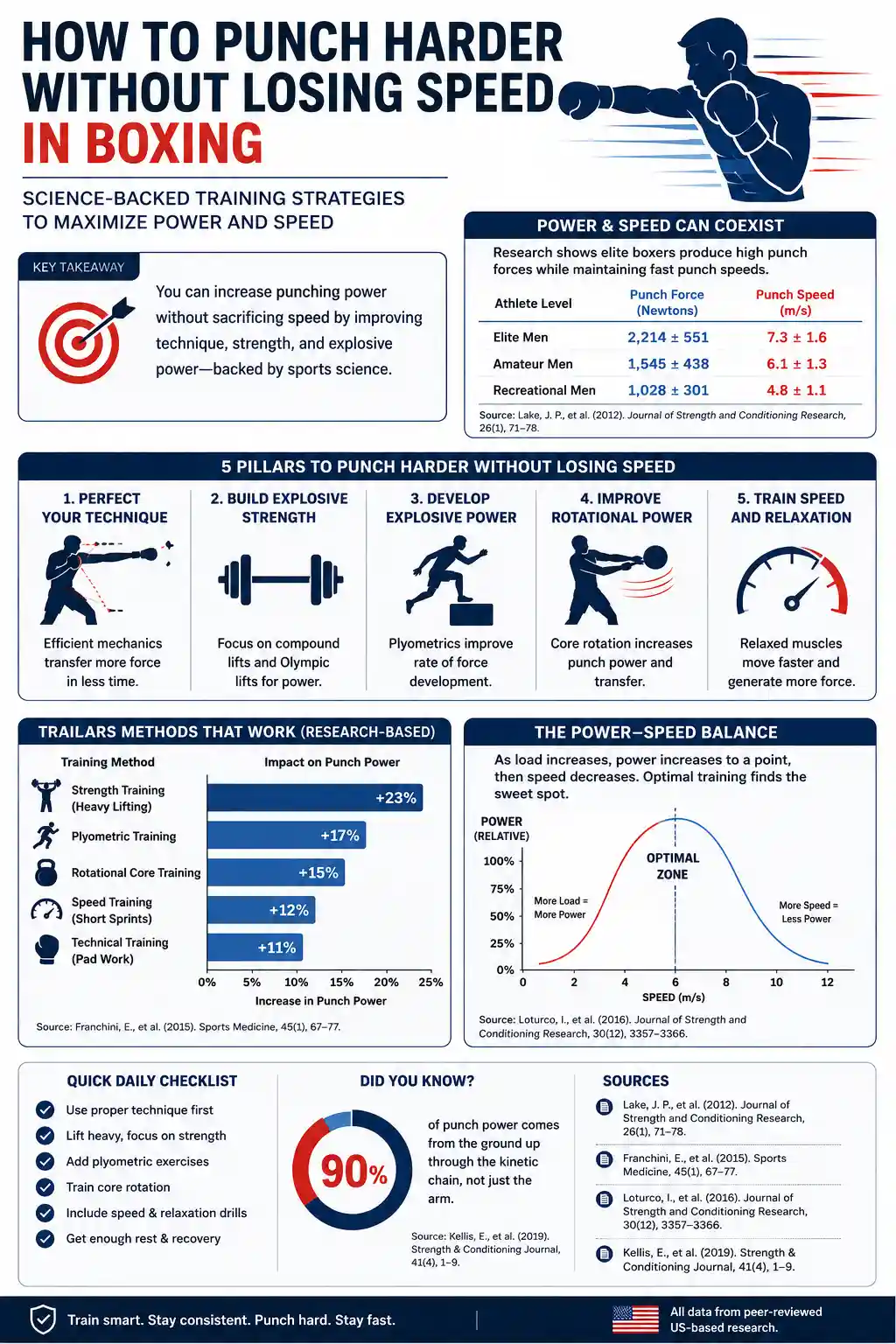
If your arm is just the whip, what is the handle? The handle is your lower body. Beginners usually think punching power comes from the chest and shoulders. They spend hours doing bench presses and push-ups, wondering why their right cross still doesn’t feel heavy in sparring.
Real power is generated by moving your body weight into the target. You weigh a lot more than your arm does. If you can figure out how to put your body weight behind your fist, you will hit significantly harder without having to swing any faster.
The Ground Connection
Every powerful punch starts with the foot on the same side. If you are throwing a rear cross (a right hand for an orthodox boxer), the power starts by driving off your right foot.
Visual Recommendation: Stance diagram showing the pivot of the rear heel, the rotation of the knee inward, and the alignment of the hip during a rear cross.
When you throw that right hand, your right heel should come off the floor. Imagine you are trying to squash a cigarette butt with the ball of your foot. As the foot pivots, the knee turns inward. That turns your hip.
The Car Door Analogy
Turning your hip is where the real weight transfer happens. A good way to think about it is like closing a heavy car door when your hands are full of groceries. You don’t use your arm to push it shut; you bump it closed with your hip. When you throw a cross, your hip should snap forward just like that.
The sequence happens incredibly fast, but it always goes in order: Foot pushes, hip snaps, shoulder turns, arm extends, fist clenches. If your shoulder turns before your hip, you lose 50% of your power. If your arm extends before your shoulder turns, you are just arm-punching.
Common Mistakes That Kill Speed and Power
You can usually tell who only trains on heavy bags because they freeze once movement starts. When beginners try to increase their power in sparring, they almost always make a few specific errors that destroy their speed and leave them vulnerable.
1. Telegraphing (Loading Up)
When a beginner decides they are going to throw a “hard” punch, they subconsciously prepare for it. They pull their hand back a few inches. They hike their shoulder up toward their ear. They take a sudden, deep breath.
You can literally see their brain working before the punch leaves. To a trained opponent, this “loading up” acts as a giant flashing neon sign. It doesn’t matter how fast your arm moves if your opponent knows the punch is coming a half-second early. A fast punch is a punch that arrives without any warning. Throw it directly from your guard. No wind-up.
2. Over-Committing and Losing Balance
People usually stop moving their feet once they get tired, but they also stop moving their feet when they try to punch hard. They plant both feet flat on the canvas to get “leverage.”
If you throw a 100% power hook and your opponent slips it, your momentum will carry you forward. Because your feet are planted and you over-rotated your hips, you end up twisting your spine and staring at the ring post. You are now completely off-balance. You cannot throw a fast follow-up punch, and you cannot move your head to defend.
Gym Observation: Most beginners square up and cross their feet once pressure starts or when they try to load up a big shot. Keep your feet wide and your weight centered. If you miss a power shot, you should still be in a position to immediately throw a fast jab.
3. Holding the Breath
Beginners often hold their breath without realizing it. They think bracing their core and holding their breath will make them stronger. What it actually does is spike your heart rate, burn out your muscles, and make your movements rigid. You will hear panic breathing before you see defensive mistakes. Exhale sharply on every single punch. That sharp hiss sound you hear pros make isn’t just for show; it forces the core to tighten at the exact moment of impact while keeping the respiratory system working.
Gym Drills to Fix Your Mechanics
You don’t need fancy equipment to fix these issues. You just need to pay attention to how your body feels during standard gym work.
The Shadowboxing Reset
Shadowboxing is where you build speed. But most beginners shadowbox incorrectly. They throw light, lazy punches, or they throw hard punches that pull their shoulders out of alignment.
The Drill: Shadowbox in front of a mirror. Throw a one-two combination at 30% power. Focus entirely on the pivot of your back foot and the snap of your hip. Do not let your lead hand drop when you throw with your right hand. Once your mechanics look perfect at 30% power, bump it to 50%. Then 70%. If you notice your shoulder hiking up or your face tensing at 70%, drop back down to 50%. Speed is built in the relaxed reps.
The Heavy Bag Burnout
The heavy bag is great for power, but it can teach you to push your punches.
The Drill: Hit the heavy bag with a focus on “snapping” your punches back to your face faster than you threw them. Imagine the bag is covered in wet paint. You want to touch it and pull your hand back immediately. If you hear a loud slapping sound, you are leaving your fist on the bag too long. Aim for that deep, heavy thud, and immediately retract the glove to your chin.
The Double-End Bag Reality Check
The double-end bag is the most honest piece of equipment in the gym. It punishes you for bad mechanics.
If you try to muscle a punch on the double-end bag, or if you over-commit and lose your balance, the bag will swing wildly off its axis and hit you in the forehead. It forces you to stay balanced, keep your punches tight, and rely on timing and snap rather than brute force. Spend ten minutes on this after your heavy bag work to recalibrate your speed.
Visual Recommendation: Graphic illustrating the trajectory of a straight punch vs. a looping punch on a double-end bag, showing how looping punches miss the target and disrupt rhythm.
Equipment That Actually Helps
You don’t need to buy expensive gadgets to hit harder, but using the wrong basic gear will drain your power and risk injury.
Hand Wraps are Non-Negotiable
Power transfers through your wrist. If your wrist is loose or bends backward when your glove makes contact with the heavy bag, you lose a massive amount of force. Worse, you will eventually sprain your wrist or fracture a metacarpal. A proper 180-inch semi-elastic hand wrap locks the small bones in your hand together and creates a solid cast for your wrist. If your wrist bends on impact, your mechanics are failing before the punch even lands.
Choosing the Right Glove Weight
Many beginners buy 10oz or 12oz gloves because they are lighter, thinking it will help them train for speed. But hitting a dense, heavy bag with light gloves often causes boxers to tense up their hands to protect their knuckles, which ruins their speed and snap.
| Glove Size | Best Used For | Effect on Speed/Power Training |
|---|---|---|
| 10oz – 12oz | Competition, Mitt works with a coach | Good for feeling speed, but bad for heavy bag power mechanics due to lack of padding. |
| 14oz | General training, Light sparring | A good middle ground. Allows for a snap while protecting the hands on the bag. |
| 16oz | Heavy bag work, Hard sparring | Forces you to use proper hip rotation to move the weight of the glove. Builds endurance. |
Train mostly in 14oz or 16oz gloves on the heavy bag. When you eventually put on 10oz competition gloves, your hands will feel incredibly light and fast, but the heavy hip rotation you learned with the heavier gloves will still be there.
Safety and Sparring Realities
There is a massive difference between hitting a heavy bag and throwing power shots at another human being. Beginners often assume that hard sparring is how you get better. It isn’t. Hard sparring is for professionals who have spent years learning how to take a punch and control their distance.
USA Boxing strongly recommends that beginners focus on defense, footwork, and light technical sparring. When you try to knock out your sparring partner in your third month of boxing, two things happen:
- You abandon your technique, widen your stance, and throw looping, predictable punches.
- You get countered by someone who has better emotional control, which usually results in you taking unnecessary damage to the brain.
If you want to test your power, hit the mitts with your coach. Your coach knows how to brace for your shots and will tell you when your weight transfer is actually working. In the ring with your teammates, focus on speed, accuracy, and timing. A fast, perfectly timed jab that lands cleanly on the nose is infinitely more useful than a massive overhand right that misses and leaves you staring at the canvas.
Visual Recommendation: Diagram showing proper defensive shell positioning and distance management to avoid getting caught while throwing combinations.
Beginner Power & Speed Checklist
Print this out or keep it in your gym bag. Run through this mental checklist every time you step up to the heavy bag or start a shadowboxing round.
- Am I breathing? (Exhale sharply on every single punch).
- Are my shoulders relaxed? (Drop them away from your ears; don’t hike them up).
- Is my fist relaxed? (Keep the hand open inside the glove until the moment of impact.
- Am I pivoting? (Rear heel off the floor for crosses and rear hooks).
- Am I returning to guard? (The punch isn’t finished until the glove is back touching your cheek.
- Did I load up? (Throw directly from your chin, no pulling back first.
Frequently Asked Questions
Why do my wrists hurt when I try to punch hard?
Your wrists are likely bending on impact. This happens if you punch with a “pushing” motion instead of a snapping motion, or if your hand wraps aren’t supporting your wrist joint properly. It also happens if you hit the heavy bag slightly off-angle. Stop hitting the bag for a few days, check your wrap technique, and focus on landing with your first two knuckles perfectly straight.
Should I lift heavy weights to punch harder?
Lifting heavy weights like a bodybuilder won’t necessarily make you punch harder, and it can make you stiff and slow if you don’t stretch and do mobility work. Combat sports conditioning tends to work better with explosive interval rounds, medicine ball throws, and plyometrics. You need your muscles to fire quickly, not just be large.
How long until my punching power feels natural?
Most beginners need a few months before the weight transfer and hip rotation start feeling natural. At first, you have to consciously think about pivoting your foot and turning your hip. Eventually, your brain maps the movement, and it becomes automatic. Don’t rush it. If you try to force the power before the mechanics are ingrained, you will just develop bad habits that a coach will have to beat out of you later.
Why do I get so tired when I try to punch hard?
You are likely holding your breath and tensing your entire upper body. Flexing your chest, shoulders, and arms burns an enormous amount of oxygen. Furthermore, if you throw a heavy punch and miss, your body has to use a lot of energy to stop your momentum and pull you back into balance. Relax your muscles and remember to exhale.
My coach keeps telling me to “sit down” on my punches. What does that mean?
“Sitting down” on your punches means bending your knees slightly and dropping your weight into the floor when you strike. It lowers your center of gravity, connects you to the canvas, and allows you to drive upward and forward through the target. If your legs are completely straight and locked, you are just arm-punching, no matter how hard you try to swing.
Final Thoughts
Boxing is an exercise in controlled violence. The guys who look like they are trying the hardest are usually the ones doing it wrong. Real power is quiet. It’s hidden in the pivot of a foot, the snap of a hip, and the relaxation of a shoulder.
Stop trying to break the heavy bag. Focus on your mechanics, stay relaxed, and let the speed generate the force. When you finally put it all together, you won’t even feel the impact in your arm. You’ll just hear that deep, heavy thud, and you’ll know you did it right.