Boxing for Weight Loss: Does It Really Work in 2026?
Many people walk into a boxing gym or buy a heavy bag for their garage with a specific goal: they want to lose weight. The idea seems simple. Boxing looks exhausting; the pros are always lean, and hitting a heavy bag feels like it should burn a massive amount of calories. But when beginners actually try it, they often hit a wall very quickly.
The reality of boxing conditioning is a bit more complicated than just swinging at a bag until you sweat. While boxing can definitely support weight management, the way most beginners approach it usually leads to frustration, extreme fatigue, and early burnout. Understanding how your body actually responds to the stop-and-go nature of boxing is usually the first step toward making it work.
Quick Answer
- Focus: Basic footwork, fundamental punching mechanics, and interval-style round pacing.
- Beginner Difficulty: Moderate to high cardiovascular demand, often surprising for those with general gym fitness.
- Conditioning Challenge: Managing muscle tension and breathing during three-minute rounds.
- Recovery Importance: Very high. Muscles and joints need time to adapt to repetitive impact.
- Realistic Results Timeline: Noticeable improvements in endurance and work capacity within 4 to 6 weeks of consistent, paced training.
Educational Disclaimer: This article is for educational boxing and fitness information only and should not replace professional coaching, medical advice, or supervised combat sports training. Always consult a physician before starting a new high-intensity exercise routine.
The Reality of Boxing for Weight Loss
When people think about weight loss, they often picture steady-state cardio, like jogging on a treadmill for forty-five minutes. Boxing does not work like that. It is inherently an interval sport. You work hard for a set period, usually two or three minutes, and then you rest for one minute. This stop-and-go pattern changes how your body uses energy.
Many beginners are surprised by how quickly boxing conditioning becomes exhausting. You might be able to run three miles without much issue, but throw punches at a heavy bag for three minutes, and your arms might feel like lead. This happens because boxing requires you to stabilize your core, rotate your hips, and tense your shoulders while moving your feet. It is a full-body demand.
Does it actually help with weight loss? Yes, it can. A structured boxing workout burns a significant number of calories, often ranging between 400 and 600 per hour, depending on intensity and body weight. However, the actual weight loss comes from the overall calorie deficit you create throughout the week, not just the calories burned during the hour you are punching. Many people make the mistake of thinking they can eat whatever they want because they “burned it off” hitting the bag. In reality, boxing makes you very hungry. Without paying attention to nutrition outside the gym, the weight loss results can be slow to appear.
Interval-style training also creates a metabolic demand that lasts for a few hours after the workout ends. This means your body continues to use energy to repair muscles and restore oxygen levels. Furthermore, unlike staring at a screen on an elliptical, boxing requires deep mental focus. You have to think about your combinations, your distance, and your defense. This engagement often makes the time pass faster, even when the physical effort is high.
Beginner Workout Structure
If you want to use boxing for fitness without completely burning out in the first week, pacing is everything. In many beginner boxing gyms, coaches usually notice new members coming in too hot. They try to throw power punches from the very first bell.
A practical beginner workout focuses on time, not just punch count. Using a standard interval timer set to three-minute rounds with one minute of rest is a good starting point.
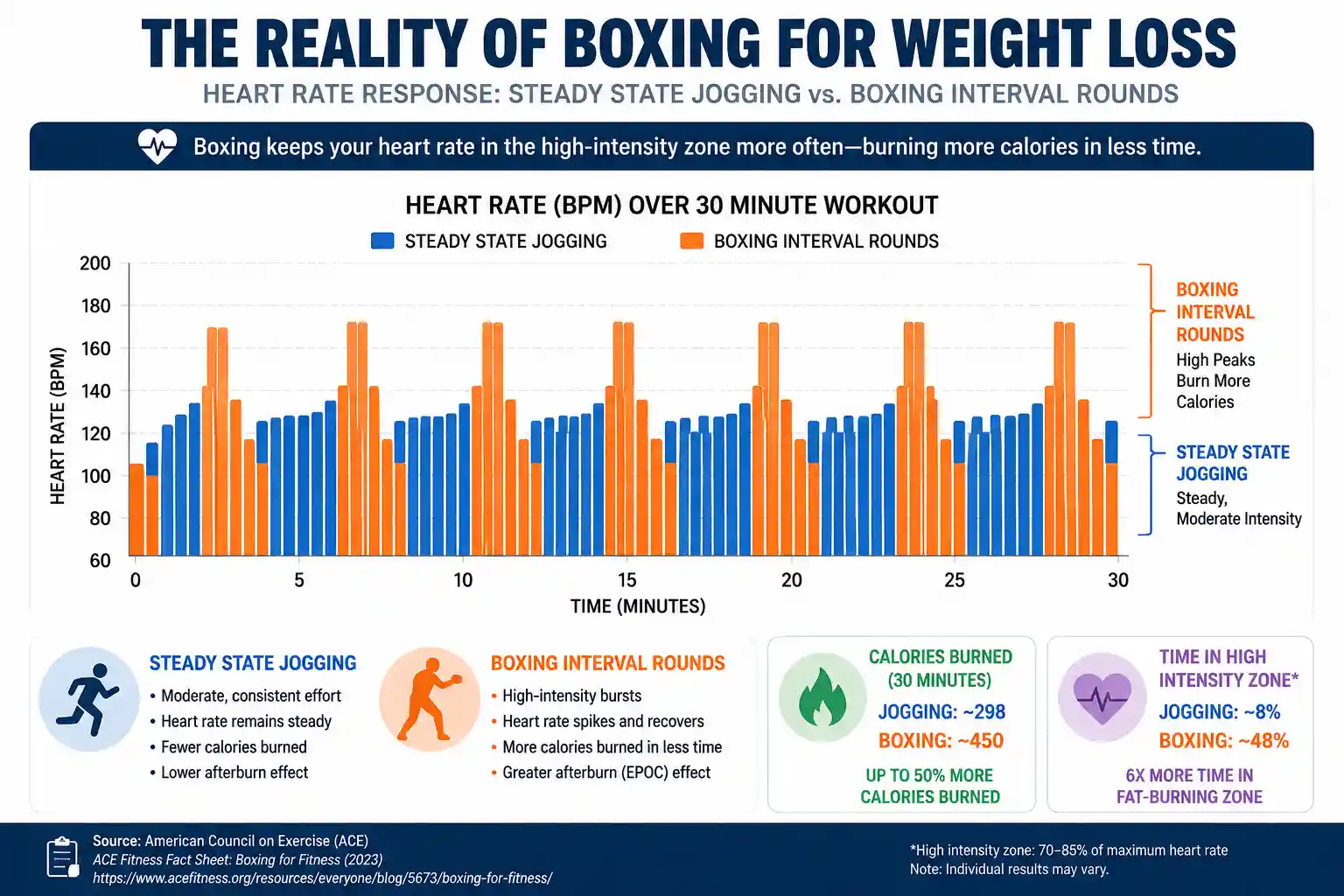
(Visual Recommendation: A simple bar chart comparing “Steady State Jogging” vs. “Boxing Interval Rounds” showing heart rate spikes and recovery dips.)
Here is a standard, manageable structure for a beginner looking to build conditioning and support weight management.
| Phase | Activity | Duration / Rounds | Intensity Focus |
|---|---|---|---|
| Warm-up | Jump rope or light jogging, dynamic stretching | 10 minutes | Light, getting the joints moving |
| Round 1 & 2 | Shadowboxing (no bag) | 2 x 3-minute rounds | Focus on balance and breathing |
| Round 3 & 4 | Heavy Bag or Pad Work | 2 x 3-minute rounds | Moderate pace, basic 1-2 combinations |
| Round 5 | Defensive movement and footwork | 1 x 3-minute round | Low intensity, staying on the toes |
| Cool-down | Static stretching and deep breathing | 5-10 minutes | Lowering heart rate safely |
This structure gives you about 15 minutes of actual work, plus the warm-up and cool-down. For a beginner, this is usually plenty to elevate the heart rate and challenge the muscles. As conditioning improves over a few months, gyms will often increase the number of rounds or decrease the rest periods.
Shadowboxing is often the most neglected part of a beginner’s routine. Many people skip it because it feels awkward to punch the air. However, shadowboxing allows you to practice full extension and footwork without the jarring impact of the heavy bag. It is an excellent way to warm up the joints and build the coordination required for heavy bag work.
It is also helpful to use a visual timer. Many boxing timer apps flash green for work and red for rest. Having a visual cue helps beginners stop looking at the clock and focus on their breathing.
Beginner Gym Bag Checklist
- 180-inch hand wraps
- 12 oz or 14 oz training gloves
- Water bottle with electrolytes
- Small towel for sweat management
- Flat-soled shoes (wrestling or boxing specific)
- Interval timer app downloaded and set
Common Conditioning Mistakes Beginners Make
Watching new people train reveals a few very common habits that make boxing much harder than it needs to be. These mistakes usually drain energy fast and make the workout feel miserable.
Holding the Breath
People usually forget to breathe properly once the combination speeds up. You will often see a beginner throw a four-punch combination, and they hold their breath for the entire sequence. By the second round, they are gasping for air. Exhaling sharply with every punch is a fundamental rule in boxing. It forces a breathing rhythm and helps engage the core.
Shoulder Tension
Many beginners tense their shoulders too early and burn energy fast. They keep their gloves glued to their cheekbones with maximum effort, squeezing their neck and traps. After two minutes, the shoulder muscles fatigue completely, and the hands start to drop. Learning to keep the shoulders relatively relaxed until the moment of impact takes time, but it saves a massive amount of energy.
Pacing the Heavy Bag
Most beginners throw hard for thirty seconds and completely lose rhythm. They treat the heavy bag like it owes them money. Boxing is about rhythm and weight transfer. Throwing at 100% power constantly is a quick way to spike the heart rate into an unsustainable zone. A better approach is to mix light, snappy punches with occasional power shots.
Gripping the Gloves
Beginners often clench their fists inside their gloves the entire round. This constant gripping creates unnecessary tension in the forearms and hands. Learning to keep the hand relatively relaxed and only clenching the fist at the very moment of impact saves a surprising amount of grip strength and forearm endurance.
Ignoring the Lower Body
You can usually spot exhaustion in the footwork before punches slow down. When the legs get tired, beginners start standing flat-footed and reaching for the bag with their arms. This removes the power from the hips and puts all the strain on the shoulder joints. Keeping a slight bend in the knees and staying on the balls of the feet is tiring, but it is necessary for proper mechanics.
The Role of Recovery in Weight Loss and Conditioning
There is a common misconception in fitness culture that more is always better. In boxing conditioning, doing too much too soon often leads to stalled progress. When you hit a heavy bag, your wrists, elbows, and shoulders absorb a lot of repetitive shock. The muscles in your back and core also work hard to decelerate your punches when you miss or hit the bag.
Sports medicine organizations and fitness groups like the National Academy of Sports Medicine (NASM) generally recommend balancing intense conditioning with adequate recovery. If you jump into boxing five days a week as a total beginner, your joints will likely start to ache. This discomfort often leads to missed workouts, which breaks consistency.
Recovery is also closely tied to weight management. Long periods of poor recovery can make training harder and slow progress. When the body is constantly fatigued, non-exercise activity thermogenesis (NEAT), the calories you burn just moving around during the day, tends to drop. You might crush a hard boxing session on Tuesday, but then spend the rest of the day sitting on the couch because your legs and back are too sore to do anything else.
Practical recovery for boxing includes:
- Sleep: This is when the body actually repairs the micro-tears in the muscles.
- Hydration: Sweating heavily during rounds depletes water and electrolytes, which can lead to early fatigue in the next session.
- Active Rest: On off days, doing light activities like walking or gentle yoga helps keep the blood flowing without adding impact to the joints.
Essential Equipment for Home and Gym
You do not need a massive budget to start boxing for fitness, but having the right basic gear makes a big difference in comfort and safety.
Hand Wraps: This is non-negotiable. Wraps support the small bones and ligaments in the wrists and hands. Many beginners skip them and end up with wrist pain after a few heavy bag sessions.
Gloves: For heavy bag work, 12 oz to 14 oz gloves are generally standard. Bag gloves are denser and designed to protect your hands against the hard impact of the heavy bag. Sparring gloves are softer and more pillowy, designed to protect your training partners. Using sparring gloves on a heavy bag will compress the foam quickly and leave your knuckles vulnerable.
Footwear: Running shoes are usually designed for forward motion and have thick, squishy heels. Boxing requires lateral movement and pivoting. A flat-soled shoe, like a basic wrestling shoe or a dedicated boxing shoe, provides much better stability and connection to the floor.
Interval Timer: A simple digital timer or a smartphone app set to standard boxing rounds removes the guesswork from the workout.
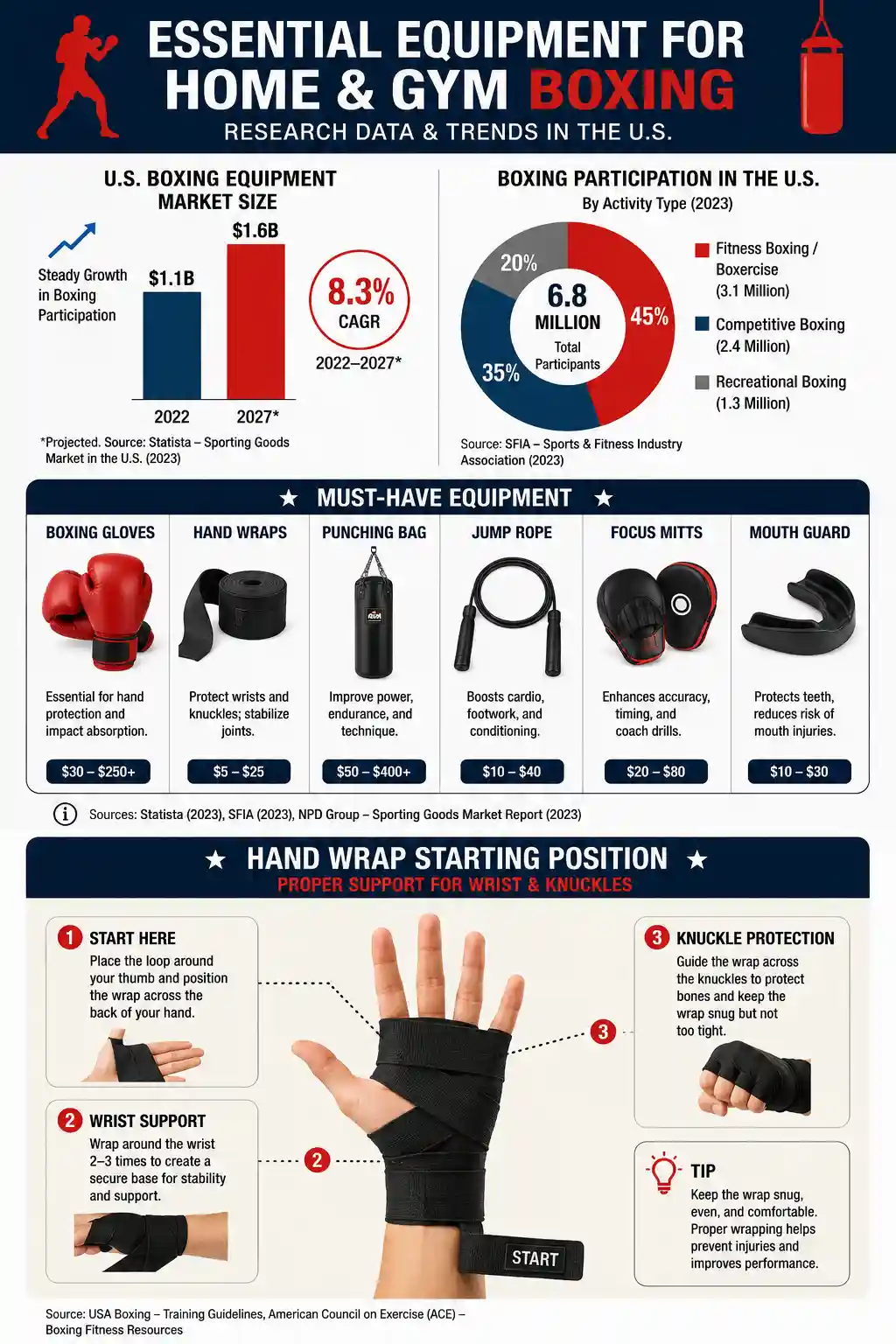
Visual Recommendation: An infographic showing the proper starting position of a hand wrap, highlighting the support around the wrist and the knuckles.
Safety and Injury Prevention
Boxing is generally safe for fitness when approached with patience, but the repetitive nature of punching does carry some injury risks if form breaks down.
USA Boxing and various amateur organizations emphasize the importance of proper wrist alignment. When a punch lands, the wrist should be straight, and the first two knuckles should make contact. Hitting the heavy bag with a bent wrist is a common way beginners sprain their joints.
It is not enough to just own hand wraps; you need to wrap them correctly. The wrap should create a cast-like support across the wrist joint while padding the knuckles. Many gyms have diagrams on the wall showing the basic cross-wrap pattern, and watching a quick video tutorial can save you weeks of wrist discomfort.
Shoulder health is another frequent concern. Throwing wide, looping punches puts a lot of strain on the rotator cuff. Keeping the elbows tucked in and throwing straight punches is much safer for the shoulder joint, especially when fatigue sets in and form naturally degrades.
If you feel sharp pain in the joints—as opposed to the general burning sensation of muscle fatigue—it is usually a signal to stop and rest. Pushing through joint pain in boxing rarely works out well.
Frequently Asked Questions
Will boxing make me bulky?
Generally, no. Boxing is primarily a cardiovascular and muscular endurance activity. It builds lean, conditioned muscle rather than large, bulky mass. Most of the physical changes people notice in the first few months are related to improved muscle tone and a reduction in body fat, provided their nutrition is aligned with their goals.
How long does it take to get used to the exhaustion?
Most beginners are surprised by how exhausting even short heavy bag rounds feel. It usually takes about four to six weeks of consistent, two-to-three-day-a-week training for the body to adapt. The shoulder burn decreases, and your breathing becomes more automatic.
Do I need to spar to lose weight?
No. Sparring is an advanced skill that requires months of fundamental training and defensive awareness. For weight loss and general fitness, hitting the heavy bag, working with focus mitts, and doing shadowboxing provide all the cardiovascular benefits without the risk of head impacts.
Why do my shins and calves hurt?
Boxing requires you to stay on the balls of your feet, which keeps the calf muscles engaged almost constantly. Beginners who are used to flat-footed exercises often experience delayed onset muscle soreness in the lower legs. Stretching the calves and rolling them out after training usually helps.
Is it better to train in the morning or evening?
This mostly comes down to personal preference and schedule. Some people find that morning boxing wakes them up and sets a good tone for the day, while others prefer evening sessions to burn off stress. The most effective time to train is simply the time you can stick to consistently.
Final Thoughts
Boxing for weight loss works because it is engaging, challenging, and requires a lot of full-body coordination. It is not a magic fix, and the first few weeks can feel incredibly awkward and tiring. The key is to manage expectations. Treat the heavy bag with respect, focus on breathing rather than power, and allow your body time to recover between sessions. If you can build a consistent routine and pair it with sensible eating habits, the conditioning benefits and physical changes will follow naturally.
About the Author
Neil Stephens is a National Academy of Sports Medicine (NASM) Certified Personal Trainer and a Certified USA Boxing Coach based in Los Angeles. With hands-on experience in boxing training, conditioning, and athletic performance, he focuses on helping readers understand practical boxing techniques, fitness strategies, and combat sports conditioning.
Neil is the author of Boxinges, also known as “Boxinges USA,” where he shares expert-backed content about boxing training, workouts, recovery, and sports performance. His content is built around accuracy, real-world coaching knowledge, and athlete-focused guidance to support beginners and experienced fighters alike.