
10 Best Boxing Exercises for Beginners (Burn Fat Fast in 2026)
Walk into almost any boxing gym during the beginner hour, and you will usually notice the exact same pattern. A new student steps up to the heavy bag, throws a flurry of hard punches for about thirty seconds, and then completely runs out of gas. They lean on the bag, shoulders heaving, wondering why they feel so exhausted so quickly.
Boxing is a stop-and-go sport. It requires short bursts of high energy followed by active recovery. However, many beginners treat it like a continuous sprint. This mismatch in pacing is usually why boxing conditioning feels so overwhelming at first. The good news is that once you understand how to pace yourself and use the right movements, boxing becomes one of the most practical and efficient ways to build stamina and burn calories.
This guide breaks down ten practical boxing exercises for beginners. It focuses on realistic pacing, full-body movement, and the common hurdles most people face when they first start hitting the bags.
Quick Answer: Beginner Boxing Conditioning
- What it focuses on: Full-body coordination, interval pacing, and shoulder endurance.
- Realistic difficulty: High cardiovascular demand, but low technical barrier to start.
- Expected challenge: Keeping your hands up and remembering to breathe when your shoulders get tired.
- Recovery importance: High. Shoulders and calves need 24 to 48 hours to recover between heavy sessions.
- Results timeline: Most beginners notice a significant improvement in their breathing and stamina within 3 to 4 weeks of consistent practice.
Educational Disclaimer: This article is for educational boxing and fitness information only and should not replace professional coaching, medical advice, or supervised combat sports training. Always consult with a healthcare provider before starting a new high-intensity exercise routine.
The Reality of Boxing Conditioning
Many combat sports conditioning programs rely heavily on interval-style rounds because boxing is naturally stop-and-go. You move, you punch, you defend, you reset.
When beginners try to mimic professional fighters by throwing non-stop combinations, they usually burn out their shoulder muscles before their cardiovascular system actually gets a good workout. The goal of these ten exercises is not to see how hard you can hit. The goal is to keep moving efficiently, manage your breathing, and engage your entire body to increase your daily energy expenditure.
10 Practical Boxing Exercises for Beginners
1. The Basic Boxer’s Skip (Jump Rope)
The Movement: A simple, rhythmic bounce on the balls of your feet, alternating weight slightly from one foot to the other.
The Beginner Struggle: Many beginners try to jump too high or swing the rope using their entire arms. This wastes energy and causes the calves to cramp quickly.
The Practical Fix: Keep your elbows tucked near your ribs and use your wrists to turn the rope. You only need to jump about an inch off the ground. If you lose the rhythm, just stop, reset, and start again. It is completely normal to trip over the rope for the first few weeks.
2. Rhythmic Shadowboxing (Focus on Exhales)
The Movement: Throwing punches in the air while moving around your stance, without a bag or target.
The Beginner Struggle: People usually forget to breathe properly once the combinations speed up. Holding your breath while punching causes a rapid spike in heart rate and early fatigue.
The Practical Fix: Make a sharp “shh” sound every time you throw a punch. This forces you to exhale on the exertion. Keep the punches at about 50% power and focus entirely on snapping them back to your face quickly.
3. Paced Heavy Bag Intervals
The Movement: Working on a heavy bag using a structured timer, rather than just hitting it until you are tired.
The Beginner Struggle: Most beginners throw hard for thirty seconds and completely lose rhythm. They end up pushing the bag rather than snapping their punches.
The Practical Fix: Use a standard boxing interval: 2 minutes of light, continuous movement and tapping, followed by 1 minute of faster, sharper combinations. This teaches your body how to recover while still moving.
4. Defensive Slips and Rolls
The Movement: Moving your head off the center line to avoid imaginary punches, usually slipping left and right or rolling under hooks.
The Beginner Struggle: Beginners often bend at the waist, looking down at the floor. This throws off their balance and makes them vulnerable.
The Practical Fix: Keep your eyes looking straight ahead at a fixed point on the wall. Bend your knees to change levels, not your spine. Imagine a pole running straight down through your head and torso.
5. Pivot and Angle Stepping
The Movement: Turning your body 45 to 90 degrees by pivoting on the ball of your lead or rear foot.
The Beginner Struggle: People tend to pick their feet up and step across themselves, which crosses their legs and ruins their balance.
The Practical Fix: Think about “squashing a bug” with the ball of your foot. Keep your feet the same distance apart. Pivoting is how boxers create new angles without expending the energy of a full sprint.
6. The Sprawl (Defensive Drop)
The Movement: Dropping your hips to the floor and kicking your legs back to defend against a takedown, then quickly returning to your boxing stance.
The Beginner Struggle: Letting the hips sag completely to the mat and using the lower back to pull back up.
The Practical Fix: Keep your chest up and use your hands to push off the floor as you bring your knees back under you. It is a highly effective full-body movement that spikes the heart rate quickly.
7. Medicine Ball Rotational Throws
The Movement: Standing perpendicular to a wall and twisting the torso to throw a medicine ball against it.
The Beginner Struggle: Throwing the ball using only the arms and shoulders, which limits power and tires the joints out fast.
The Practical Fix: Pivot the back foot and turn the hips first. The arms just follow the rotation of the torso. This mimics the mechanics of a hook or cross and builds core endurance.
8. Plank to Push-Up (Commandos)
The Movement: Starting in a forearm plank, pressing up one hand at a time into a high push-up position, and lowering back down.
The Beginner Struggle: Rocking the hips wildly from side to side to make the movement easier.
The Practical Fix: Widen your feet slightly to create a more stable base. Keep your core tight. This builds the shoulder stability required to keep your guard up in the later rounds of a workout.
9. Focus Mitt Mimicry (Speed and Reaction)
The Movement: If you don’t have a partner, use a wall target or a double-end bag. Throw 3 to 4 punch combinations focusing on speed rather than power.
The Beginner Struggle: Over-committing to every punch and leaving the face exposed while the hand travels back.
The Practical Fix: Focus on the retraction. The punch should snap back to your chin faster than it went out. This builds fast-twitch muscle endurance.
10. Active Recovery Shadowboxing
The Movement: Very slow, deliberate shadowboxing performed between intense rounds or at the end of a session.
The Beginner Struggle: Stopping completely and sitting down between rounds, which causes the muscles to stiffen and the heart rate to crash too quickly.
The Practical Fix: Keep moving. Shake out the arms, practice slow footwork, and take deep, controlled breaths. This helps clear fatigue from the muscles and prepares you for the next interval.
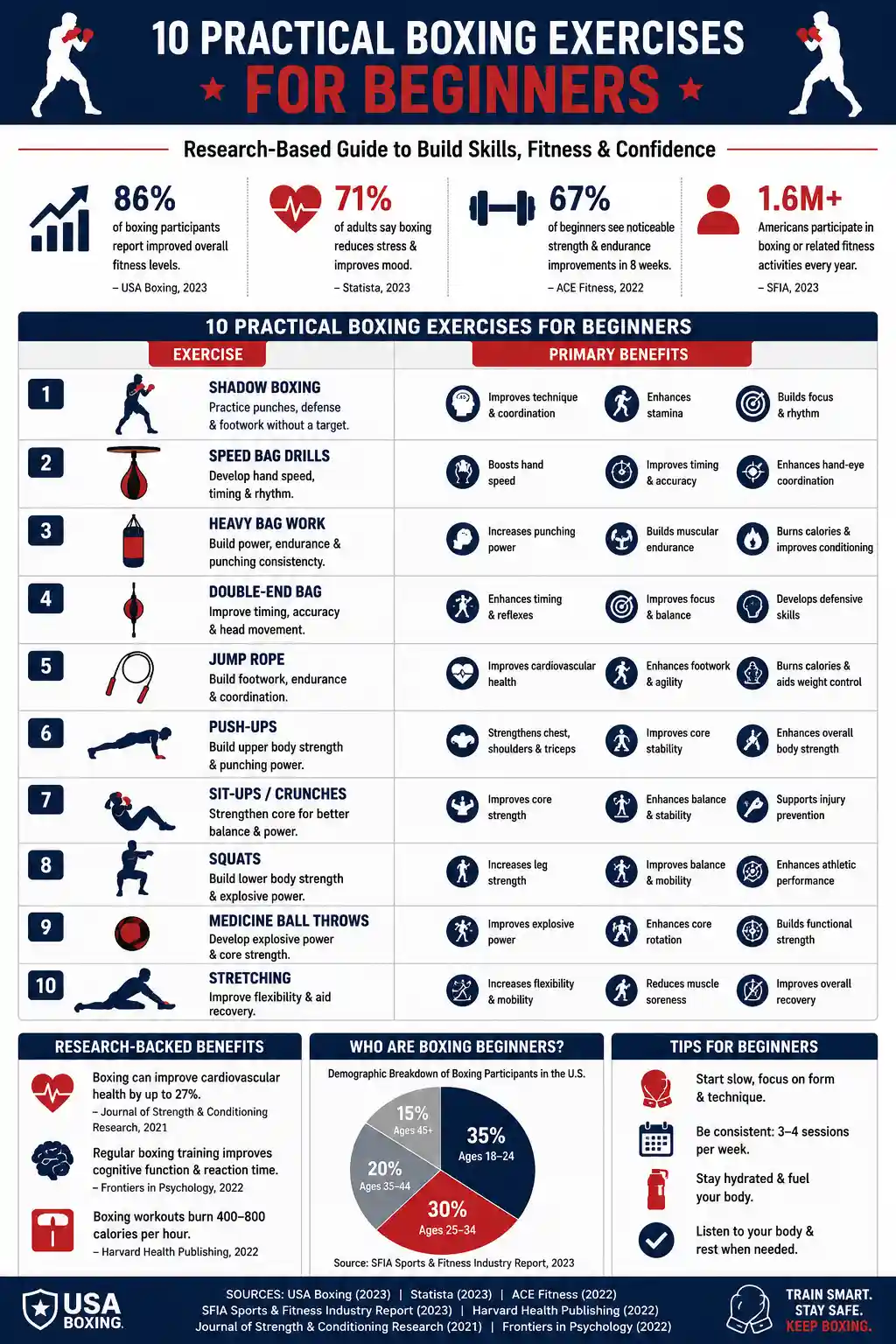
Structuring a Beginner Boxing Workout
You can usually spot exhaustion in a beginner’s footwork before their punches even slow down. To prevent this, a well-structured workout is essential. You do not need to do all ten exercises in one day. A practical 45-minute session often looks like this:
- Warm-up (10 mins): Jump rope (Exercise 1) and dynamic stretching.
- Skill & Shadowboxing (10 mins): Rhythmic shadowboxing (Exercise 2) and defensive slips (Exercise 4).
- Conditioning Block (15 mins): Heavy bag intervals (Exercise 3) mixed with sprawls (Exercise 6).
- Core & Burnout (10 mins): Plank to push-ups (Exercise 8) and medicine ball throws (Exercise 7).
Using a standard interval timer app set to 3-minute rounds with 1-minute rest periods is the most common way gyms organize this time. It forces you to pace yourself.
Common Conditioning Mistakes Beginners Make
Even with the right exercises, certain habits can make boxing feel much harder than it needs to be. In many beginner boxing gyms, coaches often notice the same recurring issues:
Tensing the Shoulders
Many beginners tense their shoulders too early and burn energy fast. They hold their hands tight to their face with rigid arms. The arms should be relatively relaxed, only tensing for the split second a punch lands. Keeping the shoulders relaxed saves a massive amount of cardiovascular energy.
Arm Punching
Power and endurance in boxing come from the floor up. If you are only using your arms to throw punches, your shoulders will fail in minutes. Engaging the legs and hips distributes the workload across the largest muscles in the body, which is why boxing is such an effective calorie-burning activity.
Ignoring the Rest Period
During the one-minute rest between rounds, some beginners stand completely still with their hands on their knees, while others pace frantically. A better approach is to walk slowly, keep the hands near the face, and focus entirely on deep nasal breathing.
Visualizing Your Training
Boxing relies heavily on visual cues. If you are setting up a home gym or trying to understand gym culture, visual aids are often more helpful than written descriptions. When planning your routines, consider looking for or creating the following visual tools:
Heavy Bag Interval Charts: A simple grid taped to the wall showing when to throw light punches (stick and move) and when to throw power combinations. This prevents the common mistake of going 100% intensity for the whole round.
Jump Rope Pacing Visuals: Diagrams showing the “boxer skip” weight transfer. Seeing how the weight shifts from the left foot to the right foot helps beginners stop jumping with both feet simultaneously.
Stance-Position Visuals: Footprint diagrams on the floor or on paper showing where your lead and rear feet should land after a pivot or a slip. This helps correct the habit of crossing the feet.
Punch Output Comparison Charts: Graphs showing the difference in calorie burn and heart rate between steady-state jogging and boxing interval training. This helps set realistic expectations for fatigue.
Recovery and Pacing
Long periods of poor recovery can make training harder and slow progress. Boxing places unique demands on the body, particularly the rotator cuffs, the calves, and the central nervous system.
Coordination and reaction speed usually decline once fatigue builds. If you find yourself missing the heavy bag entirely or constantly tripping over your jump rope, it is usually a sign that your nervous system needs a break, not that you need to push harder.
Sports medicine organizations like ACSM generally recommend balancing intense conditioning with adequate recovery. For beginners, this usually means taking at least one full rest day or doing very light active recovery (like walking or gentle stretching) between heavy boxing sessions. Hydration and sleep are where the actual stamina adaptations happen.
Basic Equipment for These Exercises
You do not need a lot of gear to start, but a few items make the conditioning much safer and more effective.
Hand Wraps: Essential for protecting the small bones in the hands and stabilizing the wrists when hitting the heavy bag.
16oz Boxing Gloves: Heavier gloves provide more padding for your hands and add a slight resistance factor, which builds shoulder endurance over time.
Speed Rope: A simple PVC or light wire jump rope. Weighted ropes are generally not recommended for beginners as they can strain the forearms and alter timing.
Interval Timer: A dedicated gym timer or a smartphone app that loudly signals the start and end of 3-minute rounds and 1-minute rests.
Safety and Form First
USA Boxing and other amateur organizations heavily emphasize the importance of hand wrapping and proper glove sizing for beginners. The repetitive impact of the heavy bag can cause stress injuries in the wrists if they are not kept perfectly straight upon impact.
Additionally, when performing defensive movements like slips and rolls, beginners should avoid dropping their head below their waist level. Bending too far forward can cause dizziness when standing back up, especially during high-intensity intervals where blood pressure is fluctuating. Keep the movements compact and controlled.
Frequently Asked Questions
Why do my shoulders burn so fast, even when I’m not hitting the bag?
Most beginners are surprised by how exhausting even short heavy bag rounds feel, but shadowboxing can be just as tiring. Holding your arms up in a guard position requires constant isometric contraction of the deltoids. It usually takes about four to six weeks for the shoulder muscles to adapt to this specific demand. Relaxing your shoulders between combinations helps immensely.
Is it normal to feel completely clumsy and off-balance?
Yes. Boxing requires moving the upper body and lower body independently while maintaining a specific stance. People usually look awkward for the first few months. The brain is simply trying to map new coordination pathways. Focusing on slow, deliberate footwork drills will smooth this out over time.
Can I do this routine every day to burn fat faster?
Generally, no. High-impact conditioning, especially jumping rope and hitting heavy bags, creates a lot of repetitive stress on the joints and connective tissues. Many people notice their form breaks down when exhaustion hits, which leads to wrist or shoulder injuries. Three to four days a week is usually the sweet spot for beginners to see stamina improvements without overtraining.
Why do I feel out of breath when I’m barely moving my legs?
People usually forget to breathe properly once the combination speeds up. If you are holding your breath while throwing a four-punch combination, you are essentially doing a Valsalva maneuver, which spikes blood pressure and starves the muscles of oxygen. Focus on exhaling sharply with every single punch.
Final Thoughts
Boxing conditioning is rarely about who can hit the hardest; it is usually about who can stay relaxed the longest while under physical stress. The ten exercises listed here are staples in almost every boxing gym because they address the specific physical demands of the sport: shoulder endurance, rotational core power, and interval cardiovascular recovery.
It takes time to stop fighting your own body. Be patient with the awkward footwork, accept that you will trip over the jump rope, and focus on breathing through the fatigue. The stamina and the physical changes will follow naturally as your body adapts to the rhythm of the rounds.
About the Author
Written by Neil Stephens
Neil Stephens is a National Academy of Sports Medicine (NASM) Certified Personal Trainer and a Certified USA Boxing Coach based in Los Angeles. With hands-on experience in boxing training, conditioning, and athletic performance, he focuses on helping readers understand practical boxing techniques, fitness strategies, and combat sports conditioning.
Neil is the author of Boxinges, also known as “Boxinges USA,” where he shares expert-backed content about boxing training, workouts, recovery, and sports performance. His content is built around accuracy, real-world coaching knowledge, and athlete-focused guidance to support beginners and experienced fighters alike.