Shadow Boxing Explained: Benefits, Mistakes, and Best Routines
I can usually tell who is going to struggle in sparring before they ever get in the ring. I just watched them shadow box in the corner of the gym.
Beginners almost always look like they are swatting bees. They throw a stiff arm into the empty air, freeze for a split second, reset their feet, and throw again. There is no rhythm, no head movement, and no reaction. They are just punching the space in front of them.
Good amateur fighters look completely different. Even when they are just warming up, their shoulders are rolling, their feet are micro-adjusting, and their eyes are tracking something you can’t see. They aren’t just throwing punches; they are reacting to an imaginary opponent who is actively trying to hit them back.
Shadow boxing is the most honest drill in the gym. There is no heavy bag to lean on. There is no mitt to stop your punch. If your balance is bad, you will fall over. If your hands are low, you will notice. This guide breaks down what we actually look for when you shadow box, the mistakes you are probably making without realizing it, and routines that will actually translate to the ring.
Quick Answer
What is shadow boxing? It is the practice of throwing punches, moving, and defending without a partner or equipment.
Why do it? It builds muscle memory, fixes balance issues, and develops timing without the risk of getting hit. It forces you to generate your own momentum and control your own deceleration.
Educational Disclaimer
Boxing is a high-impact combat sport. USA Boxing and general sports medicine guidelines strongly recommend getting a physical examination before beginning any combat sports training. Always prioritize joint health and wrap your hands to build proper habits, even when hitting the air.
The Beginner Checklist: What Coaches Look For
When a new boxer steps onto the mats to shadow box, I don’t look at how hard they punch. I look at how they stand. Most balance issues in the ring start with a bad foundation on the floor.
Before you throw a single punch, run through this mental checklist. If you can’t do these standing still, you definitely won’t do them while moving.
Stance Width: Your feet should be roughly shoulder-width apart. If your feet are too close together, you will get pushed backward the moment someone touches you. If they are too wide, you will be stuck in the mud.
Weight Distribution: Keep your weight mostly centered, maybe slightly favoring the back leg (about 55/45). If you lean too far forward, you eat jabs. If you lean back, you can’t reach with your cross.
Hand Placement: Your rear hand should be glued to your cheekbone. Your lead hand should be slightly out, eye-level. Beginners love to drop their lead hand to their chest. Keep it up.
Chin Position: Tuck your chin down toward your lead shoulder. You should be looking up through your eyebrows, not staring straight ahead with your neck exposed.
Shoulders: Relax them. Beginners tend to hike their shoulders up to their ears out of tension. This burns energy and slows down your punches.
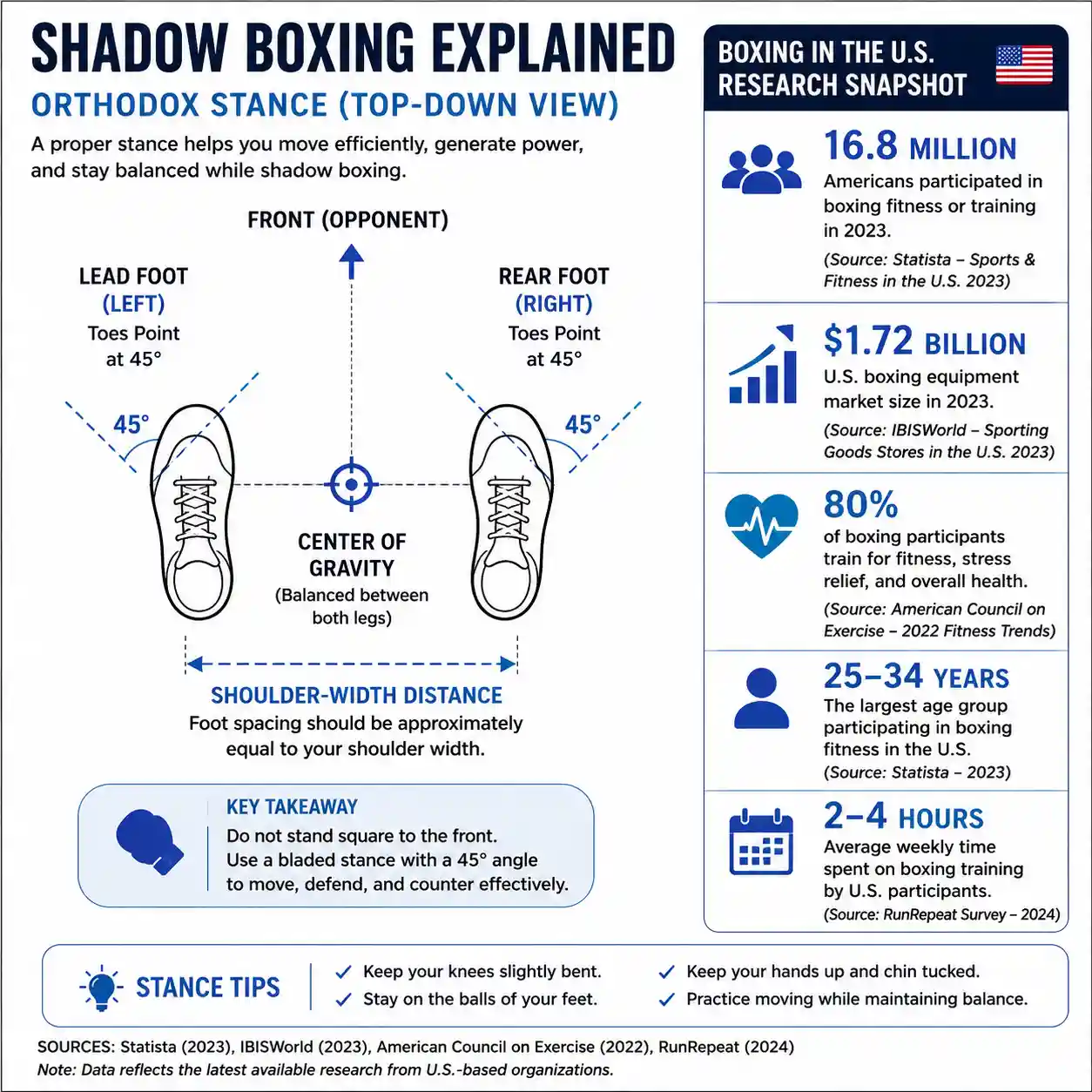
Visual Recommendation: A simple line-art diagram showing the orthodox boxing stance from a top-down view. The diagram should highlight the shoulder-width distance between the feet, the 45-degree angle of the toes, and the center of gravity marked between the legs. This helps beginners understand they shouldn’t stand square to the front.
The Mechanics: How to Actually Shadow Box
Shadow boxing is not just throwing punches into the void. It is a rehearsal. You are programming your nervous system to react correctly under pressure.
Here is how we break down the mechanics in the gym.
1. Connect the Floor to the Fist
Beginners almost always punch with their arms. They load up their shoulder and shove their fist forward. Real power comes from the floor. When you throw a rear cross, your back heel should pivot toward the ceiling. Your hip turns. Your shoulder turns. The arm is just the whip at the end of the chain. If your back foot is flat on the mat when you throw a cross, you are just pushing air.
2. Control the Deceleration
This is the biggest difference between bag work and shadow boxing. The heavy bag stops your punch for you. When you shadow box, you have to stop your own punch. If you throw a jab at 100% power and try to stop it at full extension, you will hyperextend your elbow. Throw your shadow punches at about 80% speed and 90% extension. Snap it, pull it back, and protect your joints.
3. Breathe on the Punch
I can hear beginners from across the gym. They hold their breath, throw a four-punch combination, and then gasp for air. You need to exhale sharply on every single punch. It tightens your core, it protects you if you happen to get countered, and it keeps your oxygen flowing. If you aren’t making a sharp “shh” or “tss” sound with every strike, you are holding your breath.
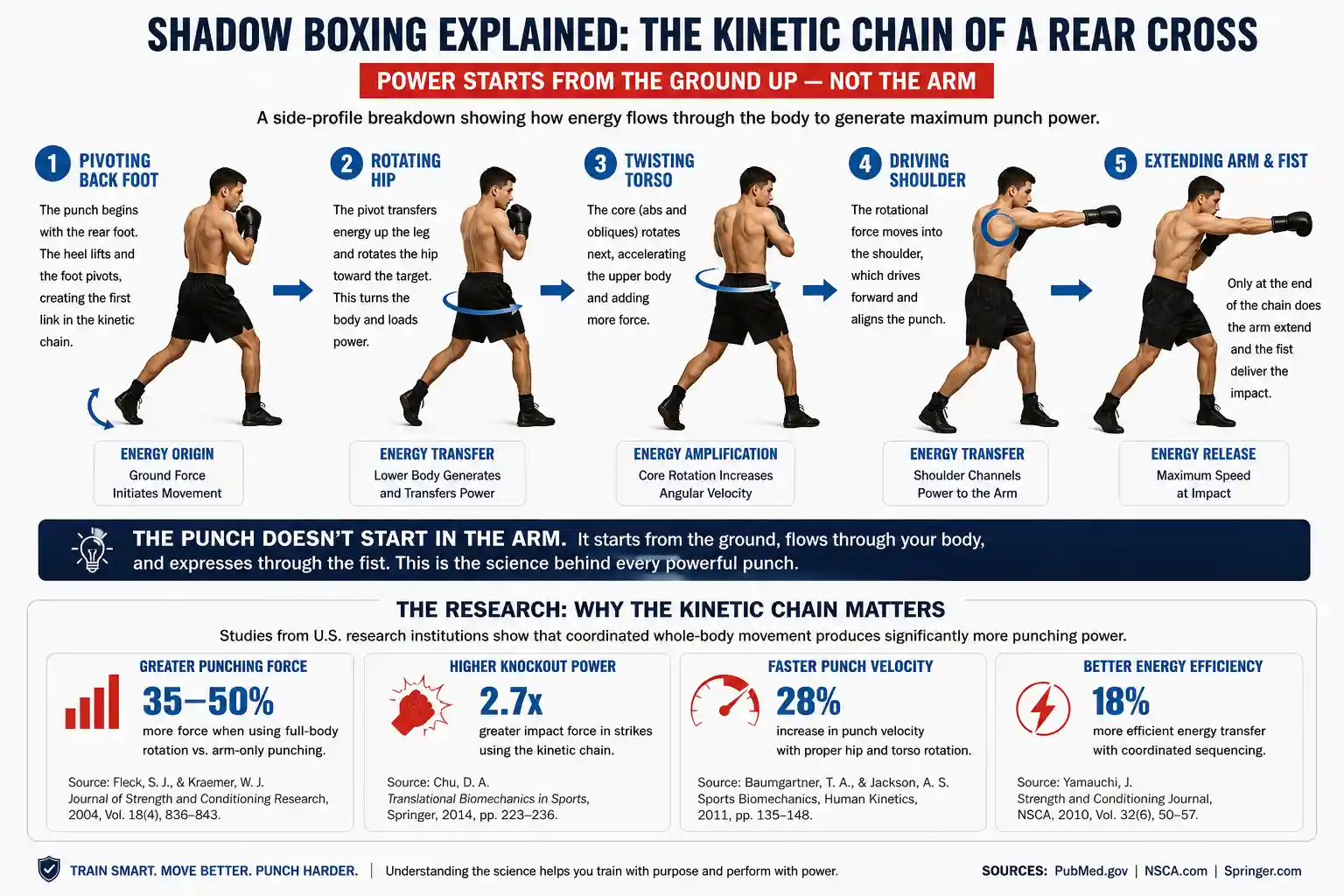
Visual Recommendation: A side-profile graphic showing the kinetic chain of a rear cross. Arrows should start at the pivoting back foot, move up through the rotating hip, twist through the torso, and end at the extending shoulder and fist. This proves the punch doesn’t start in the arm.
Common Mistakes I See Every Week
Everyone goes through an awkward phase. But some habits stick around for years if nobody corrects them. Watch out for these common breakdowns.
The “Tightrope Walker” (Crossing Feet)
When beginners move laterally, they tend to cross their feet. They step their left foot over their rear foot, or vice versa. The second you cross your feet, your base is gone. If someone sweeps your lead leg or pushes your shoulder while your feet are crossed, you will fall over. Always step and drag. Step left with the left foot, drag the right foot. Never cross them.
The Windmill (Dropping the Off-Hand)
Watch a beginner throw a hard right hand. As the right hand goes forward, the left hand drops to the waist to counterbalance the weight. This is a massive problem. If you throw a cross and your lead hand drops, a simple left hook will knock you out. Force your non-punching hand to stay glued to your cheek, even if it feels awkward and restrictive at first.
Fighting a Ghost (Predictable Rhythm)
Most people shadow box in a steady, robotic rhythm. Jab, cross, pause. Jab, cross, pause. Real fights are broken, erratic, and explosive. You need to change your tempo. Throw a fast double jab, pause, slip, and throw a slow, heavy hook. Mix up the timing. If your shadow boxing looks like a metronome, your sparring will be too predictable.
Staring at the Floor
When people get tired or when they are thinking hard about their footwork, they look down. They stare at their own shoes. In the ring, if you look at the floor, you can’t see the hook coming at your ear. Keep your eyes up. Pick a spot on the wall or a heavy bag across the gym and keep your eyes locked on it while your feet move.
Over-Committing on Defense
Beginners love to do massive, exaggerated slips and rolls. They duck so low they practically touch the floor, or they lean so far back they lose their balance. Defense should be tight and efficient. Move your head just enough to let the imaginary punch slide past your ear. Big, dramatic movements just leave you out of position to counter.
Best Shadow Boxing Routines for Beginners
Don’t just get in front of a mirror and wing it for nine minutes. You will just practice your bad habits. Break your shadow boxing into specific rounds with a specific focus.
Set a timer for standard boxing rounds: 3 minutes of work, 1 minute of rest.
| Round | Focus | The Drill |
|---|---|---|
| Round 1 | Footwork Only | Keep your hands up, but do not throw a single punch. Just move. Step forward, step back, pivot, circle left, circle right. Focus entirely on keeping your base and not crossing your feet. |
| Round 2 | The Jab & Move | Only throw the jab. Throw it high, throw it low, throw it to the body. Every time you throw a jab, move your feet immediately after. Jab, step back. Jab, pivot left. Never throw and stand still. |
| Round 3 | Defense & Counters | Imagine the opponent is attacking you. Slip left, throw a cross. Roll under, throw a hook to the body. Block high, throw an uppercut. Focus on the reaction, not just the punch. |
| Round 4 | Freestyle / Burnout | Put it all together. Move, punch, defend. For the last 30 seconds of the round, plant your feet and throw non-stop straight punches to empty the gas tank. |
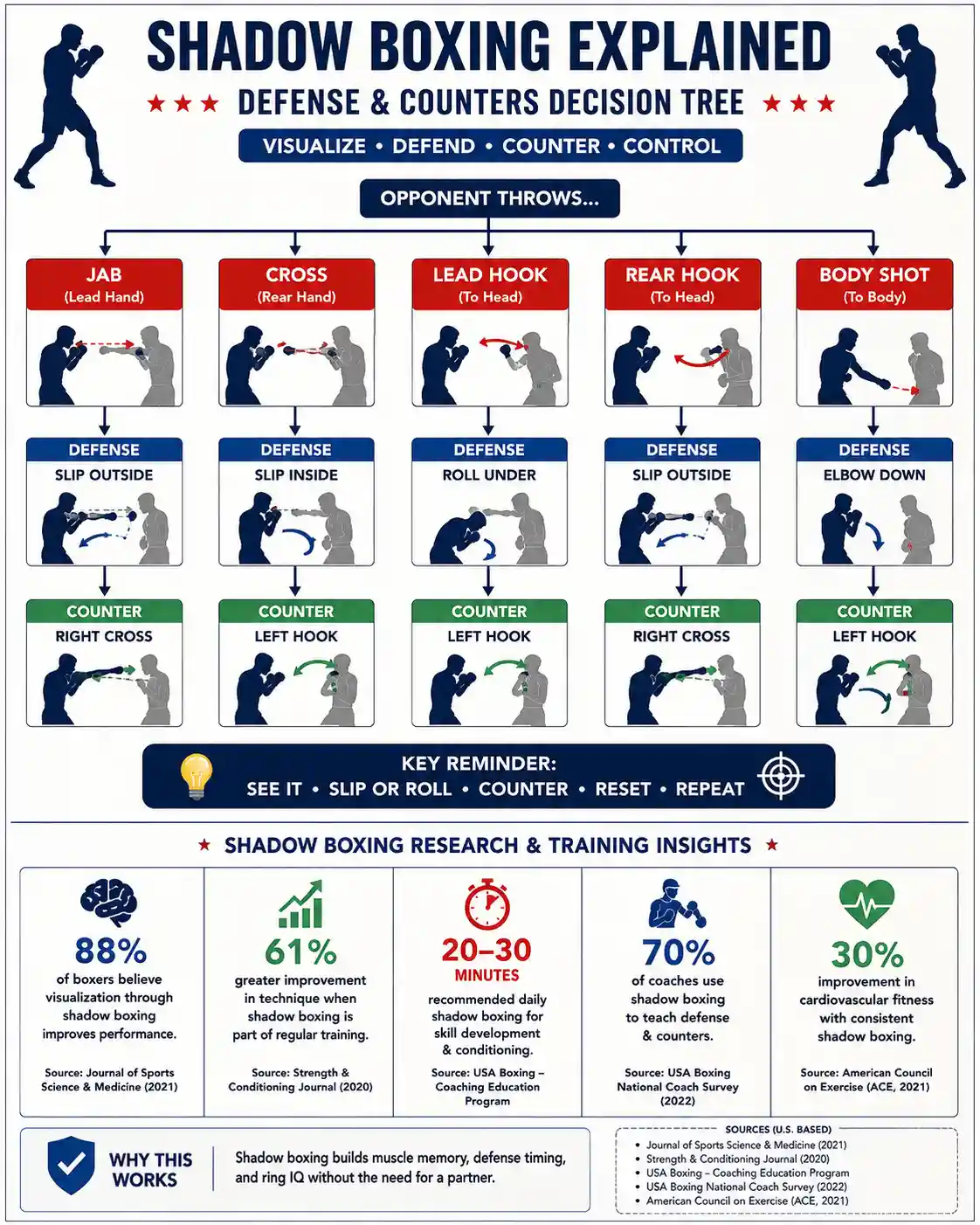
Visual Recommendation: A flow-chart style graphic showing a “Decision Tree” for the Defense & Counters round. (e.g., Opponent throws Jab -> Slip Outside -> Counter with Right Cross. Opponent throws Hook -> Roll Under -> Counter with Left Hook to the Body. This helps beginners visualize the “imaginary opponent” concept.
Do You Need Equipment? (Mirrors and Dumbbells)
Walk into any commercial gym, and you will see people shadow boxing with tiny, 2-pound hex dumbbells. Walk into a real boxing gym, and you will almost never see this.
The Problem with Dumbbells
Boxing is about speed, snap, and kinetic transfer. Holding light weights while you punch changes the mechanics of your arm. It forces you to push the punch rather than snap it, and it puts unnecessary, grinding torque on your rotator cuff and elbow joints. If you want to build shoulder endurance, do shoulder presses or lateral raises after your boxing session. Keep your shadow boxing strictly bodyweight.
The Trap of the Mirror
Mirrors are great tools, but they can lie to you. When you shadow box in front of a mirror, you naturally square your shoulders up so you can see yourself. You also tend to stop moving your head because you want to keep your eyes locked on your reflection.
Use the mirror for the first round to check your hand placement and make sure your chin is tucked. For the rest of your workout, turn sideways or face away from the mirror. You need to learn what good technique feels like, not just what it looks like. In a real fight, you won’t have a mirror to check your form.
Safety and Joint Health
It sounds strange to get injured punching the air, but it happens all the time. Most shadow boxing injuries come from ego and fatigue.
Protect the Elbows: As mentioned earlier, never lock your elbows out at full speed. Stop the punch an inch before full extension. The snapping motion happens at the end of the punch, but the joint shouldn’t bear the brunt of the deceleration.
Warm Up the Wrists: Even though you aren’t hitting a heavy bag, you are still clenching your fist and rotating your wrists at high speeds. Spend three minutes doing wrist circles and gentle stretches before you start.
Wrap Your Hands: USA Boxing guidelines emphasize building good habits early. Wrapping your hands before shadow boxing puts you in the right mindset. It also provides light compression that keeps the small bones in your hands warm and aligned, even if you aren’t making impact.
Listen to Your Shoulders: If you feel a sharp, pinching sensation in the front or side of your shoulder, stop. You are likely over-rotating or throwing with a dropped elbow. Rest, ice, and evaluate your mechanics.
Frequently Asked Questions
These are the questions I hear most often from new boxers sitting on the bench between rounds.
Why do I feel so off-balance when I punch and move?
Because you are probably moving your upper body and your lower body at the exact same time. In boxing, power and balance require separation. If you step forward with your left foot while simultaneously throwing your left jab, your weight shifts too far forward. Step first, plant the foot, and then throw the punch. Or, throw the punch, and use the retraction of the arm to pull your body into the next step. It feels disjointed at first, but it keeps your center of gravity stable.
Is it okay to shadow box every day?
Yes. Unlike heavy bag work or sparring, shadow boxing is very low impact on your joints and central nervous system. You can shadow box every day as a warm-up, a cool-down, or an active recovery session. Just keep the intensity moderate if you are doing it on your rest days.
Should I shadow box before or after the heavy bag?
Always before. Shadow boxing is your physical and mental warm-up. It raises your core temperature, lubricates your joints, and primes your nervous system for the coordination required on the bags. If you wait until after the heavy bag, your muscles will be fatigued, your form will break down, and you will just be practicing sloppy technique.
How long until I stop looking awkward?
Usually, about three to four months of consistent training. The “swatting bees” phase lasts until your brain stops having to consciously think about where your hands are. Once your stance and basic punches become subconscious muscle memory, you will finally have the mental bandwidth to start working on head movement, footwork angles, and combinations. Be patient with the awkward phase.
My shoulders burn out after one round. Am I out of shape?
You might have good cardio for running, but boxing uses completely different muscles. Keeping your hands at eye level for three minutes while rapidly contracting your deltoids is exhausting for beginners. This is normal. Don’t drop your hands when they burn. Push through it for 30 seconds, then take a brief reset. Your shoulder endurance will catch up to your cardiovascular endurance within a few weeks.
Should I visualize a specific opponent?
Eventually, yes. But as a beginner, don’t worry about visualizing a specific fighter. Just visualize the geometry. Visualize a shoulder coming at you so you know when to slip. Visualize a chest opening up so you know when to throw the uppercut. Keep the visualization simple until your basic reflexes are sharp.
Final Thoughts
Shadow boxing is the ultimate lie detector. You can look tough, hitting the heavy bag because the bag doesn’t hit back. You can look busy on the mitts because the coach is feeding you targets and controlling the distance.
But when you are alone in front of the mirror, the truth comes out. If you are stiff, you look stiff. If you are off-balance, you will stumble.
Don’t rush through it just to get to the heavy bags. Treat your shadow boxing like a moving meditation. Focus on the small things: the pivot of the heel, the tightness of the guard, the sharp exhale on the punch. If you can master the empty space in the gym, the ring will feel a lot less crowded when you finally step inside it.
About the Author
By The Editorial Training Staff
Neil Stephens is a National Academy of Sports Medicine (NASM) Certified Personal Trainer and a Certified USA Boxing Coach based in Los Angeles. With hands-on experience in boxing training, conditioning, and athletic performance, he focuses on helping readers understand practical boxing techniques, fitness strategies, and combat sports conditioning.
Neil is the author of Boxinges, also known as “Boxinges USA,” where he shares expert-backed content about boxing training, workouts, recovery, and sports performance. His content is built around accuracy, real-world coaching knowledge, and athlete-focused guidance to support beginners and experienced fighters alike.