How to Improve Punch Speed With Simple Boxing Drills (2026 In-Depth Guides)
Walk into any boxing gym on a Tuesday night, and you will see the exact same thing happen. A beginner steps up to the heavy bag, takes a deep breath, and tries to punch as fast as they can. Their face turns red. Their shoulders hike up to their ears. Their feet get glued to the mat. And the bag just kind of wobbles.
They think speed means moving your arms frantically. But if you watch the amateurs and pros in the same gym, their speed looks almost lazy. They aren’t muscling the punches. They are whipping them.
Speed in boxing doesn’t come from trying harder. It comes from removing the things that are slowing you down. Most beginners are fighting their own tension, their own footwork, and their own breathing. Once you fix the awkward habits, the speed shows up on its own.
The Quick Answer
The fastest way to improve your punch speed is to relax your shoulders and focus on the “snap” at the end of the punch rather than pushing the target. Tense muscles are slow muscles. Speed comes from breathing, snapping the wrist, and bringing the hand back to your face faster than it went out.
Why Beginners Actually Punch Slow
When a coach yells “Speed it up!” during pad work, you can physically see the beginner panic. They immediately tense up. This is the biggest killer of speed in the gym.
The Tension Problem
Muscles work in pairs. To throw a punch, your triceps extend the arm while your biceps relax. If you are tense, your biceps are fighting your triceps the entire way to the target. It’s like driving a car with the emergency brake on. You can usually tell who only trains on heavy bags because they freeze once movement starts, and they try to muscle through combinations.
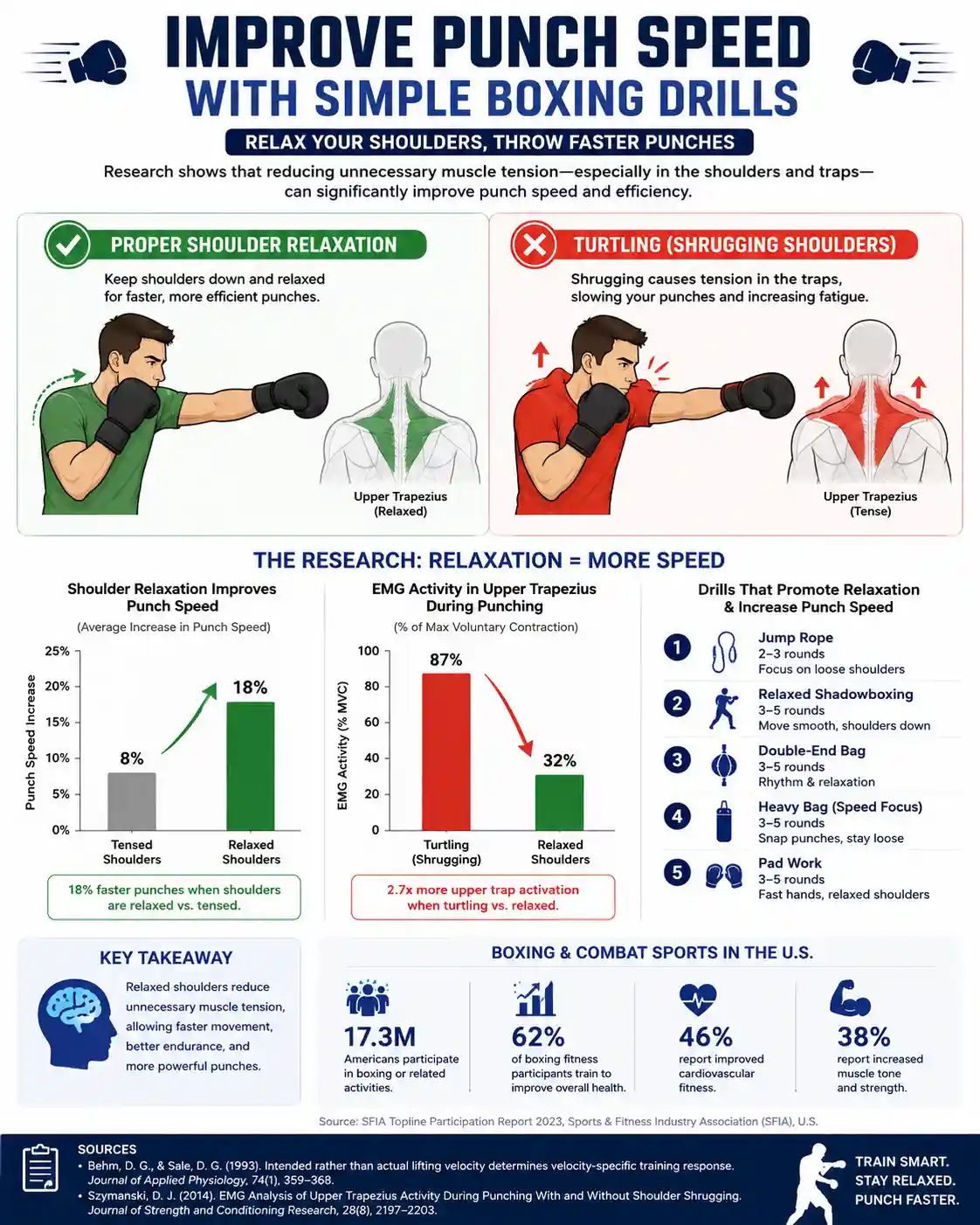
Visual Recommendation: Illustration of proper shoulder relaxation vs. “turtling” (shrugging shoulders up to the ears) during a combination, highlighting the tension in the trapezius muscles.
Loading Up the Punch
Watch a new boxer throw a right cross. Right before they punch, they pull their right hand back toward their hip, or they drop their shoulder, or they widen their stance. They are “loading” the punch like a baseball pitcher. In a real fight, or even just fast pad work, that loading phase takes a fraction of a second, which gives away your speed and your intentions. Fast punches start exactly where your hands already are.
Holding the Breath
You can hear panic breathing before you see defensive mistakes. Most beginners hold their breath when they try to throw a fast four-punch combination. Without oxygen, your muscles flood with lactic acid. By the third punch, your arms feel like lead. Fast boxers exhale sharply on every single strike. That hissing sound you hear in the gym isn’t just for show; it forces the core to tighten and keeps oxygen flowing to the shoulders.
Stuck Feet
Beginners often cross their feet or stand flat-footed once pressure starts. If your feet are stuck to the canvas, you can only punch with your arms. Real speed comes from the floor. A slight bounce or a quick weight transfer from the back foot to the front foot adds massive acceleration to the punch without requiring any extra arm strength.
The Snap vs. The Push
This is the most common heavy bag observation in any gym. A beginner will walk up to a 100-pound heavy bag and throw a straight right hand. The bag folds in half, swings wildly across the gym, and the beginner feels proud because they “moved the bag.”
But they didn’t punch fast. They pushed.
Pushing happens when you follow through the target too slowly. It’s a shove. It relies on heavy body weight and slow momentum.
A fast punch is a snap. When an experienced fighter hits that same heavy bag, the bag barely swings. Instead, it dents inward violently at the point of impact, and you hear a loud, sharp crack. The fighter’s hand snaps back to their chin before the bag even finishes denting.
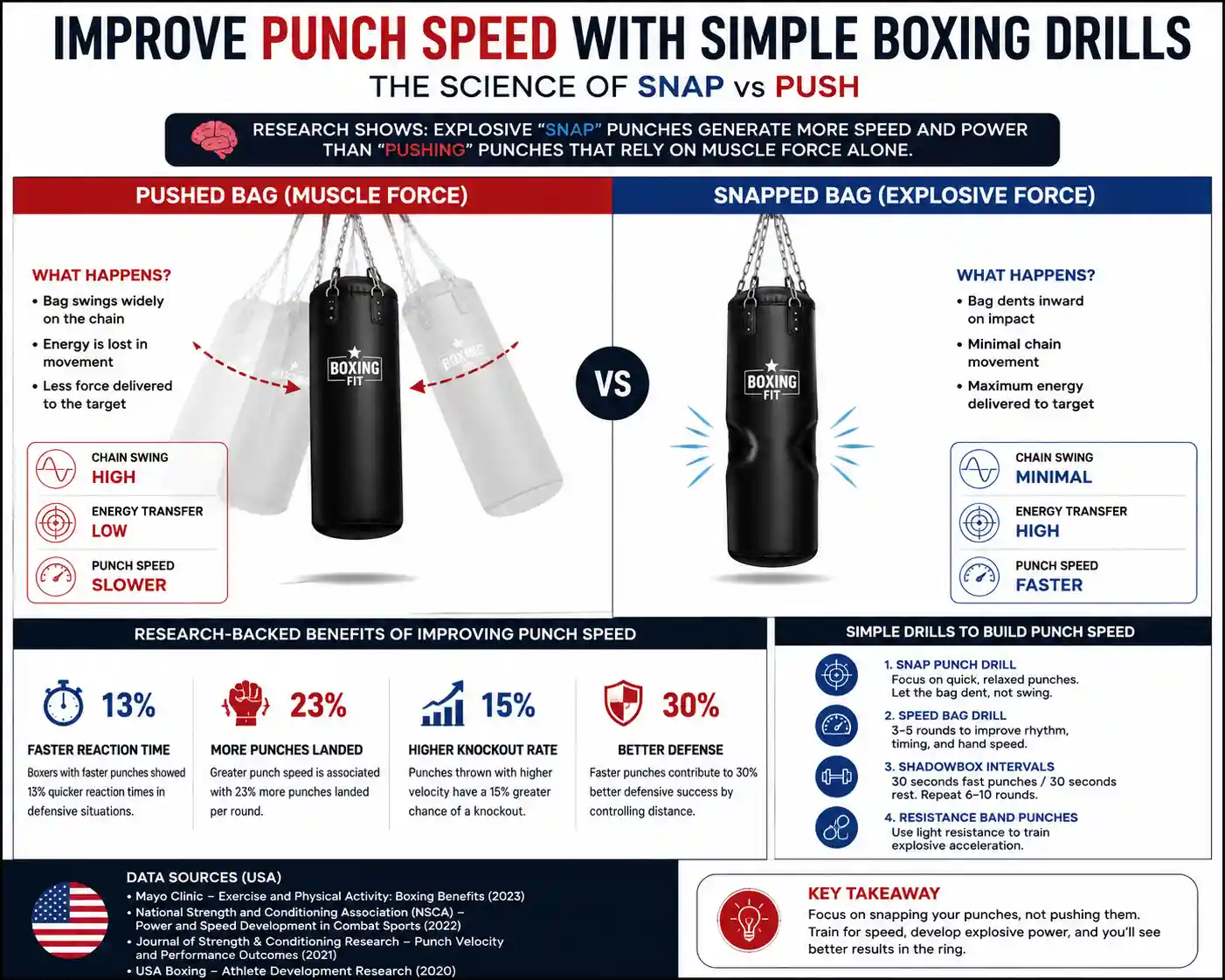
Visual Recommendation: Side-by-side diagram showing a “pushed” heavy bag swinging wildly on its chain versus a “snapped” heavy bag denting inward sharply with minimal chain swing.
To get that snap, you have to accelerate through the target and immediately reverse the muscle contraction to bring the hand home. The speed isn’t just in the outward journey; it’s in the sudden stop and return. If your hand stays out there for even a half-second too long, you aren’t punching fast. You’re just reaching.
Simple Drills to Build Real Speed
You don’t need fancy gadgets or complicated agility ladders to get faster hands. You just need to train your nervous system to fire quickly and relax immediately. Here are the drills we actually use on the gym floor.
1. The Double-End Bag (The Truth Teller)
The double-end bag is the most humbling piece of equipment in the gym. It is attached to the floor and the ceiling with bungee cords. If you push your punches, the bag will just bounce away from you. If you don’t bring your hand back to your face immediately, the bag will snap back and hit you in the forehead.
The Drill: Throw simple one-two combinations. Focus entirely on the sound. You want a sharp pop-pop. If the rhythm gets messy, you are pushing the bag. Keep your punches short, tight, and snappy. This bag forces you to retract your punches quickly, which is half the battle of punch speed.
2. Shadowboxing Sprints (Interval Speed)
Shadowboxing is usually done for form, but you can use it for pure speed conditioning. The problem with throwing fast at the heavy bag is that the resistance can tire your shoulders out before your nervous system actually adapts to the speed.
The Drill: Set a timer. Shadowbox at a normal, relaxed pace for 45 seconds. When the interval hits, sprint. Throw straight punches (ones and twos) as fast as physically possible for 15 seconds. Do not worry about power. Do not worry about hooks or uppercuts. Just focus on the blur of the gloves and the speed of the retraction. Rest for 30 seconds. Repeat five times.
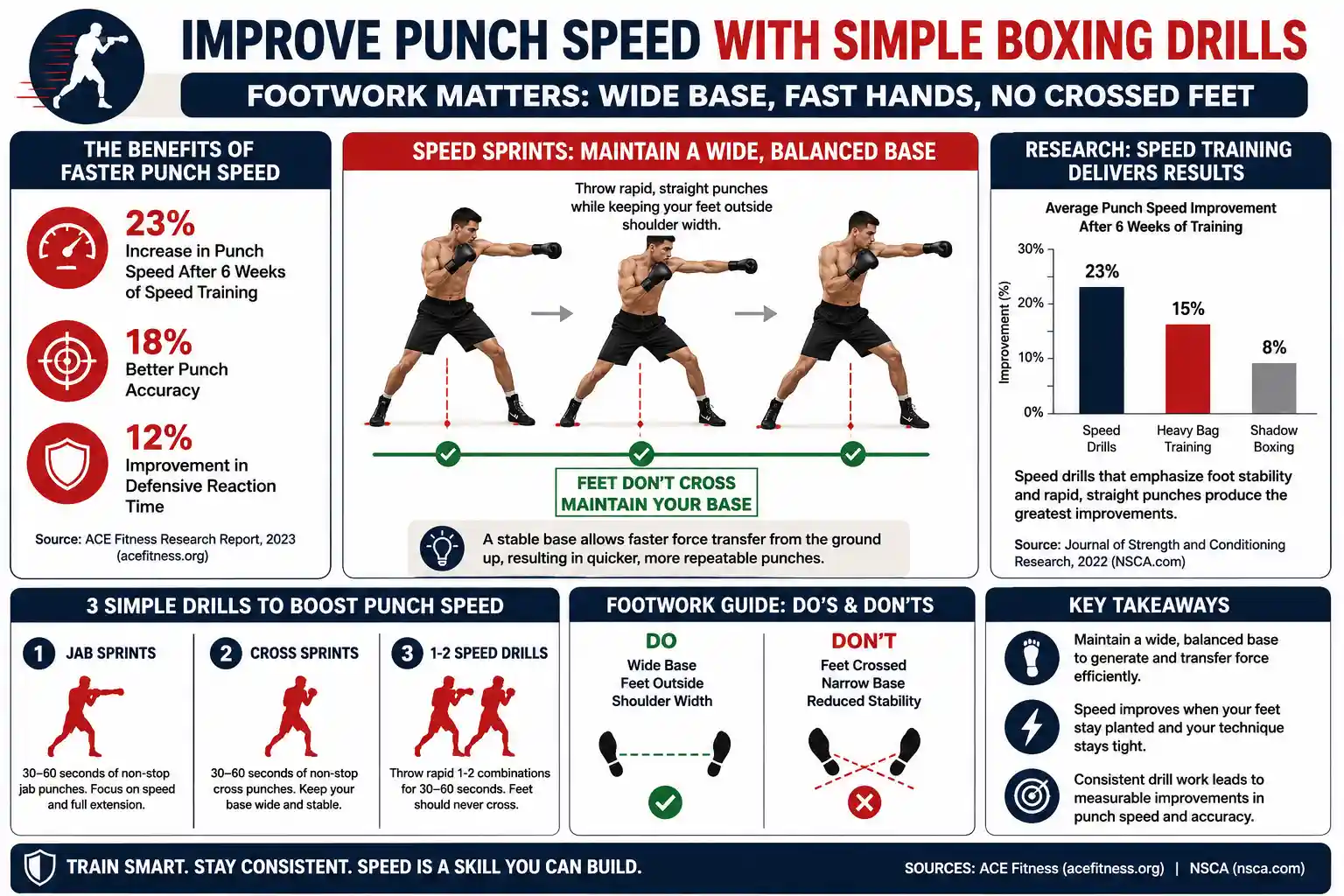
Visual Recommendation: Footwork arrow diagram showing a boxer maintaining a wide, balanced base while throwing rapid straight punches, emphasizing that the feet don’t cross during speed sprints.
3. The Towel Snap
This is an old-school drill that costs nothing and works incredibly well for teaching the “whip” effect. Grab a standard hand towel or a small gym towel. Hold it by one corner.
The Drill: Mimic your jab and cross motions with the towel. Try to make the end of the towel snap loudly in the air. You cannot do this if your arm is stiff. You have to relax your shoulder, whip the arm forward, and stop the hand abruptly to make the towel crack. This translates directly to the feeling of snapping a punch on the heavy bag or pads.
4. The “Shoe Shine” Finisher
When a combination is ending, beginners tend to slow down on the last punch. They throw a one-two-three, and the three is just a lazy tap.
The Drill: End every pad or bag combination with three or four rapid-fire uppercuts (often called the shoe shine). Because uppercuts have a shorter range of motion, you can throw them much faster. Forcing yourself to accelerate at the very end of a combo trains your brain to finish strong rather than trailing off.
Common Speed Mistakes We See Every Day
Speed is often about what you stop doing. Here is a breakdown of the awkward habits that kill hand speed.
| The Mistake | What It Looks Like in the Gym | The Practical Fix |
|---|---|---|
| Dropping the Off-Hand | Beginners drop their left hand to their waist every time they throw a hard right cross. They have to bring it all the way back up before they can punch again. | Keep the off-hand glued to your cheek. A punch that starts from the cheek is twice as fast as a punch that starts from the waist. |
| Over-Rotating the Hips | Throwing a hook with so much hip rotation that the boxer spins off balance and takes a full second to reset their stance. | Keep combinations tight. Save the massive, full-body rotations for single power shots, not fast combinations. |
| Staring at the Gloves | Beginners stare at their own punches instead of watching the target. This disconnects the brain from the target and slows down reaction time. | Keep your eyes locked on the mirror or the heavy bag’s “chin” level. Look through the punch, not at your own wrist. |
| Clenching the Fist Early | Walking around the gym with tight fists. By the time they hit the bag, their forearms are already exhausted. | Keep your hands open and relaxed inside the glove. Only clench the fist at the exact millisecond before impact. |
Equipment That Actually Helps
Walk into a sporting goods store, and you will see a wall of “speed training” gadgets. Most of them are useless for beginners, and some will actually ruin your mechanics.
What to Use:
The Speed Bag: People misunderstand the speed bag. It doesn’t teach you how to punch fast in a fight. It teaches shoulder endurance and rhythm. If your shoulders burn out in round one, your speed drops to zero. The speed bag keeps the deltoids conditioned for high-volume output.
Light Hand Wraps: Sometimes, bulky 180-inch wraps make beginners feel restricted. Standard 120-inch wraps offer plenty of wrist support without making your gloves feel like cement blocks.
12oz to 14oz Gloves: If you are strictly doing speed work on the mats or the double-end bag, lighter gloves allow you to feel the snap better than heavy 16oz sparring gloves.
What to Avoid:
Weighted Shadowboxing Gloves: You will see people shadowboxing with 2-pound or 3-pound dumbbells. Unless you have perfect form and elite shoulder stability, this is a fast track to rotator cuff impingements. It also teaches you to drop your hands because the weight pulls your guard down. Shadowbox with empty hands. It’s safer and faster.
Resistance Bands for Punching: Punching against a heavy resistance band alters your kinetic chain. You end up pushing the band rather than snapping. Save the bands for pull-aparts and shoulder rehab, not for mimicking punches.
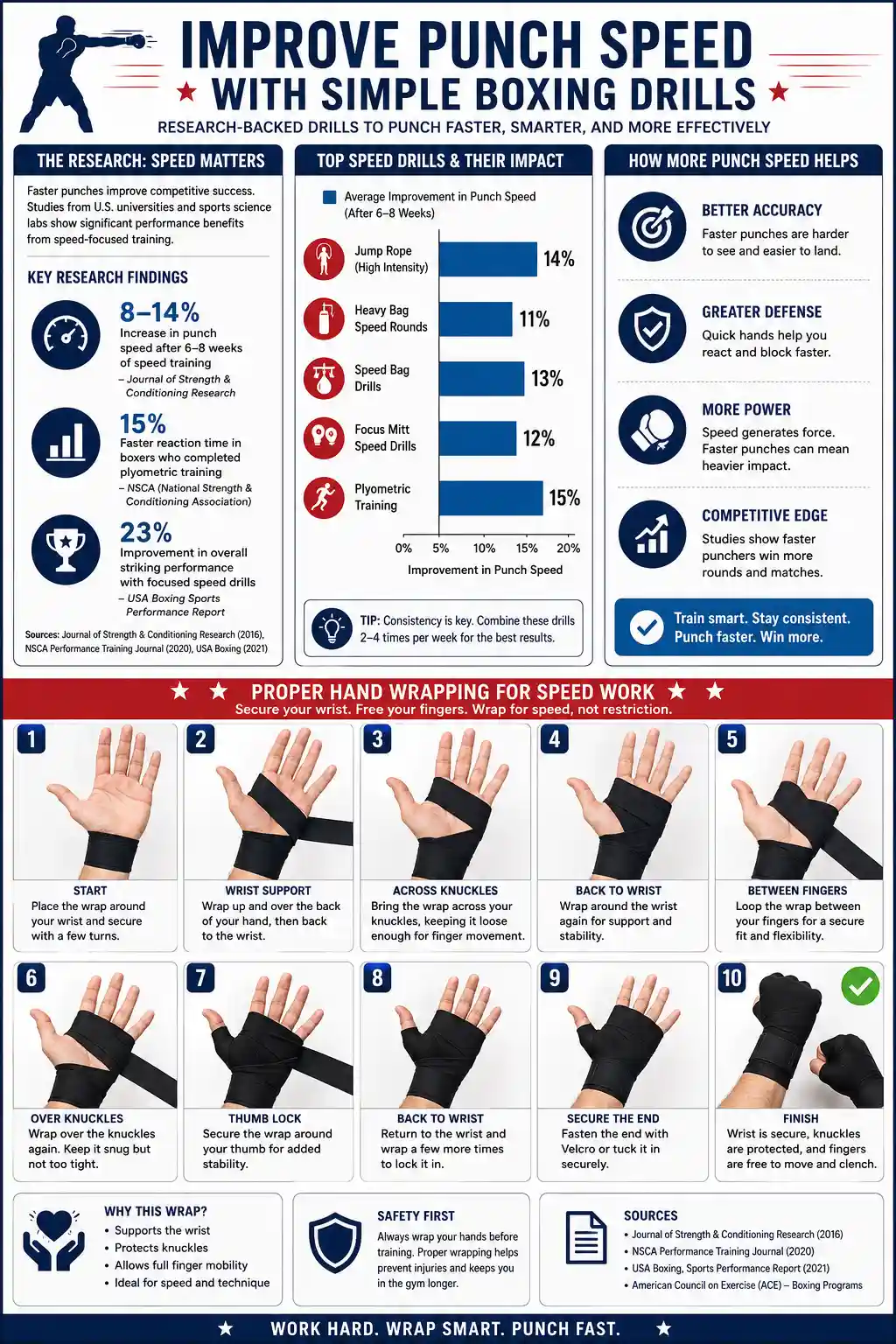
Visual Recommendation: Photo sequence of proper hand wrapping for speed work, highlighting a secure wrist but leaving the knuckles and fingers relatively unencumbered for clenching.
Safety & Conditioning for Speed
You cannot train speed if your joints are inflamed. Fast-twitch muscle fibers require explosive movements, which put a high amount of stress on the elbow and shoulder joints.
Combat sports conditioning tends to work better with explosive interval rounds than long steady-state cardio. According to general guidelines from organizations like the National Academy of Sports Medicine (NASM), power and speed adaptations require adequate rest between high-intensity sets. If you are doing speed sprints on the bag, you need to rest long enough for your nervous system to recover. If you are gasping for air, you are doing conditioning, not speed work.
Protecting the Rotator Cuff
The shoulder is a ball-and-socket joint held together by small, fragile muscles. When you throw a fast punch and miss the heavy bag, or if you snap the punch too hard without hitting a target, the shoulder joint takes all the braking force.
The Gym Rule: Never throw 100% maximum speed in the empty air. When shadowboxing, go 80% speed and focus on the stop. When you are on the heavy bag or pads, you can go 100% because the target absorbs the shock.
Also, incorporate face-pulls and band pull-aparts into your routine. Boxers tend to have overdeveloped chests and front deltoids from keeping their guard up and punching forward. This pulls the shoulders forward, creating impingement. You need a strong upper back to keep the shoulder joint healthy enough to handle fast punching.
Beginner Speed Checklist
Before you start your next heavy bag session, run through this quick mental checklist. If you catch yourself doing any of these, stop, reset, and start the round over.
- Are my shoulders touching my ears? (Drop them. Shake your arms out.)
- Am I holding my breath? (Force a sharp exhale on every impact.)
- Is my off-hand on my chin? (Don’t drop it to reload.)
- Am I pushing the bag or snapping it? (Listen for the crack, not the thud.)
- Are my feet crossing? (Step, don’t cross. Keep the base wide.)
- Is my fist clenched the whole time? (Relax the hand inside the glove.)
Realistic Gym FAQs
Q: Will lifting heavy weights make me slow and muscle-bound?
A: This is an old boxing myth. Lifting weights doesn’t make you slow; training only for slow, heavy lifts without doing explosive movements makes you slow. A strong posterior chain (glutes, hamstrings, back) actually helps transfer power from the floor to your fists faster. Just make sure you are also doing plyometrics, sprints, and bag work to keep the fast-twitch fibers active.
Q: Why do my shoulders burn out after 30 seconds of fast punching?
A: Because you are keeping your muscles tense the entire time. Holding your guard up requires static contraction. Throwing punches requires dynamic contraction. If you never relax your shoulders between combos, the lactic acid builds up immediately. Practice dropping your hands for a microsecond to shake them out, then bring them right back up.
Q: Do I need those ladder agility drills to get faster hands?
A: Agility ladders are great for footwork coordination and getting a sweat going, but they won’t directly make your hands faster. Hand speed comes from the kinetic chain of the hips and torso, and the relaxation of the arm. Spend your time on the double-end bag and shadowboxing sprints instead of dancing on a plastic ladder.
Q: How long does it take for speed to feel natural?
A: Most beginners need a few months before movement starts feeling natural. The first few weeks are just about learning where your limbs are in space. You will feel awkward. You will cross your feet. You will punch your own gloves together. Once the basic coordination is hardwired into your brain (usually around month three or four), you can finally stop thinking about your feet and start focusing purely on hand speed.
Q: My coach keeps telling me to “sit down” on my punches. Doesn’t that make me slower?
A: “Sitting down” on a punch means bending your knees slightly and dropping your weight into the floor to generate leverage. It is essential for power, but you don’t do it for every punch in a fast combination. A fast one-two is usually thrown slightly more upright to allow for quick retraction. You sit down on the final, finishing punch of the combo to do the damage.
Final Thoughts
Speed is the byproduct of efficiency. The guys in the gym who look like they are moving in slow motion are usually the ones landing the fastest, cleanest shots. They aren’t fighting the air, they aren’t fighting their own muscles, and they aren’t fighting their own bad habits.
Stop trying to muscle the heavy bag. Relax your shoulders, breathe out on the impact, and focus on bringing your hand back to your face faster than you threw it out. The speed will follow.
About the Author
Neil Stephens is a National Academy of Sports Medicine (NASM) Certified Personal Trainer and a Certified USA Boxing Coach based in Los Angeles. With hands-on experience in boxing training, conditioning, and athletic performance, he focuses on helping readers understand practical boxing techniques, fitness strategies, and combat sports conditioning.
Neil is the author of Boxinges, also known as “Boxinges USA,” where he shares expert-backed content about boxing training, workouts, recovery, and sports performance. His content is built around accuracy, real-world coaching knowledge, and athlete-focused guidance to support beginners and experienced fighters alike.