
How Long Does It Take to Build Boxing Stamina? Get Fight-Ready Fast!
Most people who walk into a boxing gym for the first time think they are in decent shape. They might jog a few times a week, lift weights, or play weekend sports. Then the coach points to the heavy bag and says, “Give me three minutes.”
By minute two, their shoulders are burning, they are holding their breath, and the clock seems to have completely stopped. Boxing stamina is a very specific type of fatigue. It is not just about having a strong heart and lungs; it is about keeping your arms up, your feet moving, and your mind sharp while your muscles are flooded with exhaustion.
Quick Answer: Building Boxing Stamina
- What it focuses on: Anaerobic bursts (punching/moving) combined with aerobic recovery (bouncing/breathing between exchanges).
- Realistic difficulty: High. Beginners usually struggle with shoulder fatigue and breath-holding before cardiovascular fatigue.
- Expected challenge: The first 4 weeks are mostly about surviving the three-minute round clock without dropping your hands.
- Recovery importance: Essential. Boxing taxes the central nervous system and joints heavily; rest days are when the stamina actually builds.
- Realistic timeline: 4 to 6 weeks to complete a basic class without gasping. 3 to 6 months to hold your own during light sparring or heavy bag intervals.
This article is for educational boxing and fitness information only and should not replace professional coaching, medical advice, or supervised combat sports training.
Why Boxing Stamina is Different
If you put an experienced marathon runner in front of a heavy bag, they will likely be exhausted in four minutes. This happens in gyms all the time. Running is a steady-state, rhythmic exercise. Boxing is stop-and-go, explosive, and highly technical.
In a boxing match or a hard gym session, your heart rate spikes every time you throw a combination, slip a punch, or pivot. Then, you have to actively recover while staying on your toes and keeping your guard up. Organizations like the American College of Sports Medicine (ACSM) often note that sports requiring repeated high-intensity efforts rely heavily on the body’s ability to clear metabolic waste quickly during brief pauses in the action.
Furthermore, you are holding your arms up in front of your face. The deltoids and trapezius muscles are relatively small. When beginners throw punches, they often tense these muscles. Tense muscles consume oxygen much faster than relaxed ones. This is why a beginner’s shoulders usually burn out long before their lungs give out.
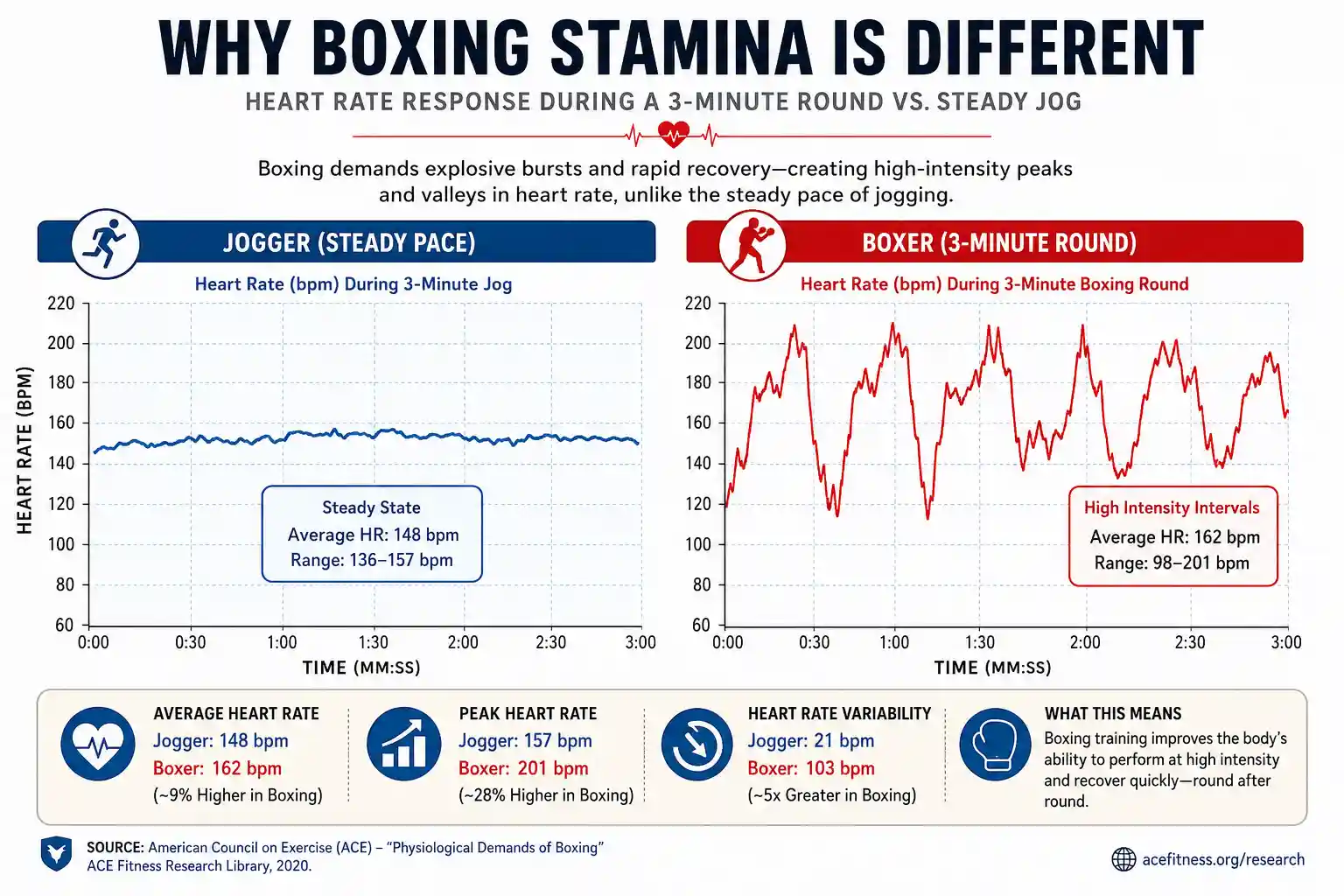
Visual Recommendation: A side-by-side heart rate graph comparing the steady, flat line of a jogger with the jagged, spiking line of a boxer during a 3-minute round.
Realistic Timelines for Building Conditioning
Building fight-ready stamina does not happen overnight. It is a gradual process of teaching your nervous system to relax under pressure and your muscles to endure repetitive extension. Here is what a realistic timeline often looks like for someone training two to three times a week.
Weeks 1 to 4: The Survival Phase
The first month is usually a shock to the system. During this phase, the primary goal is simply making it to the end of the round. Beginners often notice heavy legs, burning forearms, and a tendency to hold their breath during combinations. You might feel completely drained after just four rounds of shadowboxing. This is normal. The body is simply learning how to move in a boxing stance.
Weeks 5 to 12: The Rhythm Phase
Around the second month, things start to click. You stop muscling your punches and start using your hips and legs. Because your technique is slightly more efficient, you are burning less energy per punch. You can usually make it through a full six-round heavy bag session without dropping your hands to your waist. Breathing becomes a bit more automatic, though you will still gas out if you panic during sparring drills.
Months 3 to 6: The Sparring Phase
This is where real fight stamina begins to show. Sparring introduces an unpredictable element. You are not just throwing punches; you are reacting, defending, and thinking. Many beginners find that their conditioning holds up on the heavy bag, but completely falls apart when someone is actually trying to hit them back. It generally takes three to six months of consistent training to stay calm and keep breathing when under the pressure of an opponent.
| Timeframe | Conditioning Focus | What to Expect Physically |
|---|---|---|
| Month 1 | Muscle endurance, basic rhythm | Shoulder fatigue, heavy breathing, awkward footwork |
| Month 2-3 | Anaerobic recovery, combination pacing | Better breathing control, ability to recover between rounds |
| Month 4-6 | Mental fatigue management, reactive stamina | Maintaining form under pressure, faster footwork recovery |
Workout Structure: How Gyms Build Endurance
A typical boxing conditioning program is built around the structure of a fight. Professional and amateur bouts consist of three-minute rounds with one minute of rest in between. Therefore, most conditioning revolves around this clock.
The Heavy Bag Interval Session
The heavy bag is a primary tool for building stamina, but beginners often use it incorrectly. They throw as hard as they can for thirty seconds, completely empty the tank, and then spend the next two minutes and thirty seconds just tapping the bag to catch their breath.
A more practical approach used in many gyms involves pacing. Coaches often suggest breaking the three-minute round into smaller segments. For example, throwing a four-punch combination, moving the feet, circling the bag, and then engaging again. This mimics the natural ebb and flow of a real exchange.
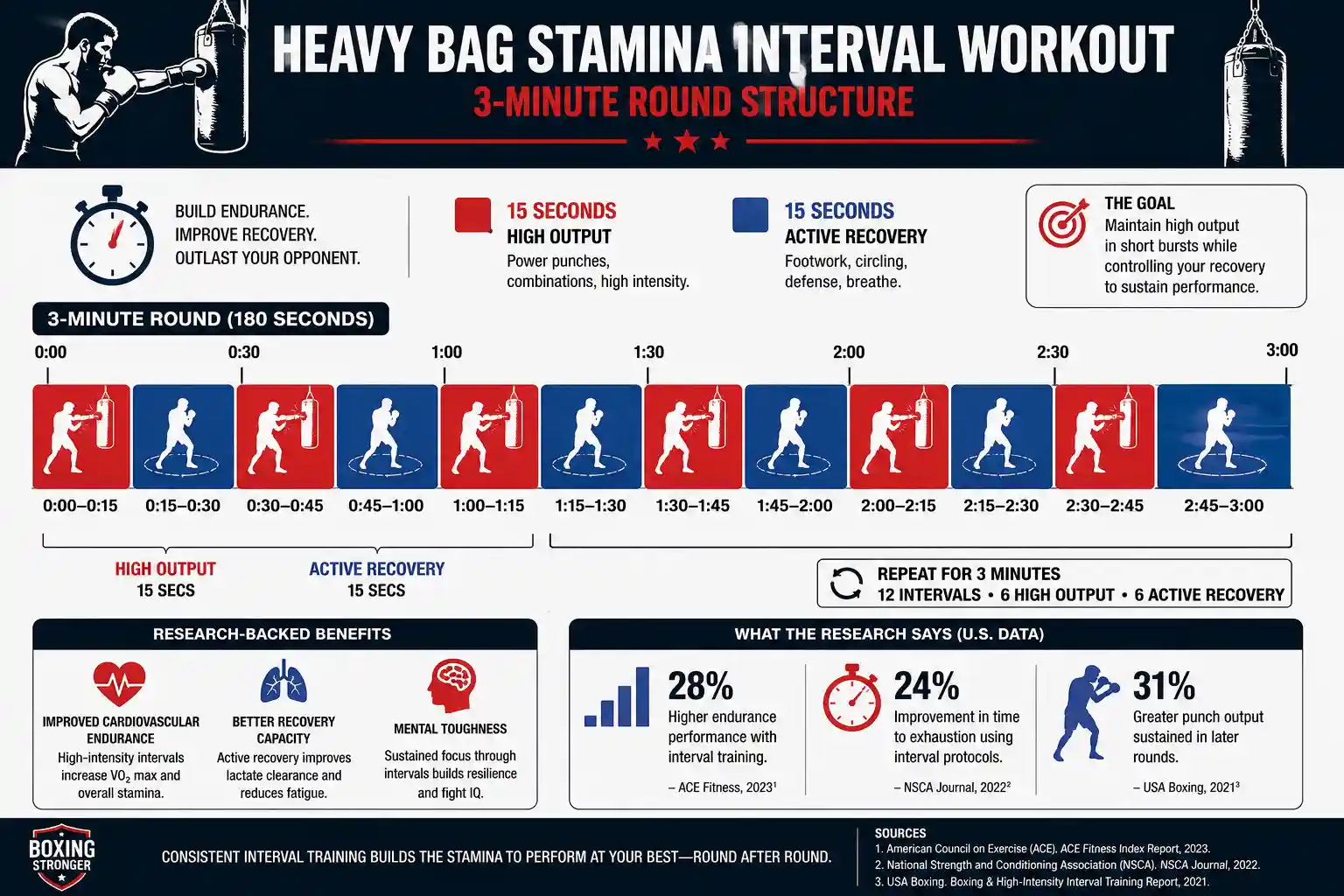
Visual Recommendation: A heavy bag interval chart showing a 3-minute round broken down into: 15 seconds high output, 15 seconds active footwork/circling, repeated throughout the round.
Shadowboxing with Resistance
Shadowboxing is often misunderstood as just a warm-up. For conditioning, it is highly effective. Throwing punches in the air without hitting a target forces the stabilizing muscles in the shoulders and back to decelerate the arm. This builds specific endurance. Some advanced classes use light one- or two-pound dumbbells for shadowboxing, though many traditional coaches prefer empty hands to prevent joint strain and maintain speed.
Roadwork (Running)
Roadwork is the traditional term for a boxer’s running routine. While the image of a boxer running in a gray sweat suit at 5 AM is iconic, the actual application has evolved. Many combat sports conditioning programs now blend steady-state jogging (for building a base aerobic capacity) with sprint intervals (to mimic the explosive bursts of a fight).
Sample Beginner Conditioning Week
| Day | Activity | Focus |
|---|---|---|
| Monday | Boxing Fundamentals Class (60 mins) | Technique, light bag work, footwork drills |
| Tuesday | Steady-State Run or Cycle (30 mins) | Building aerobic base, active recovery |
| Wednesday | Heavy Bag Intervals & Core (45 mins) | 3-min rounds, focusing on breathing and pacing |
| Thursday | Rest / Light Stretching | Joint recovery and mobility |
| Friday | Boxing Fundamentals Class (60 mins) | Partner drills, defensive movement |
| Saturday | Sprint Intervals or Jump Rope (20 mins) | Anaerobic threshold work |
| Sunday | Complete Rest | Nervous system recovery |
Common Conditioning Mistakes Beginners Make
When exhaustion hits, form breaks down. In many beginner boxing gyms, coaches often notice the same handful of energy-leaking habits. Fixing these mistakes is usually the fastest way to improve stamina without actually running more miles.
Mistake 1: The Death Grip
Beginners tend to clench their fists tightly inside their gloves the entire time they are on the bag. This keeps the forearm muscles in a constant state of contraction, leading to a “pump” or cramping sensation very quickly. The hands should be relatively relaxed, only clenching tightly at the exact moment of impact.
Mistake 2: Tensing the Shoulders
Keeping your hands up to protect your chin is mandatory. But many beginners hike their shoulders up toward their ears to do it. This creates immense tension in the trapezius and neck muscles. The goal is to keep the guard up using the skeletal structure and relaxed muscles, not by flexing the shoulders for three minutes straight.
Mistake 3: Forgetting to Exhale
People usually forget to breathe properly once the combination speeds up. You might see a beginner throw a six-punch combo while holding their breath entirely. This causes blood pressure to spike and oxygen levels to drop rapidly. A general rule in boxing is to exhale sharply on every single punch. This forces a breathing rhythm and naturally tightens the core upon impact.
Mistake 4: Muscling the Punches
Punching power and endurance come from the ground up through the legs, hips, and torso. When beginners get tired, they stop using their lower body and start “arm punching.” Arm punching is exhausting and ineffective. When the legs get heavy, the punch output naturally drops, which is a sign that footwork drills need more attention.
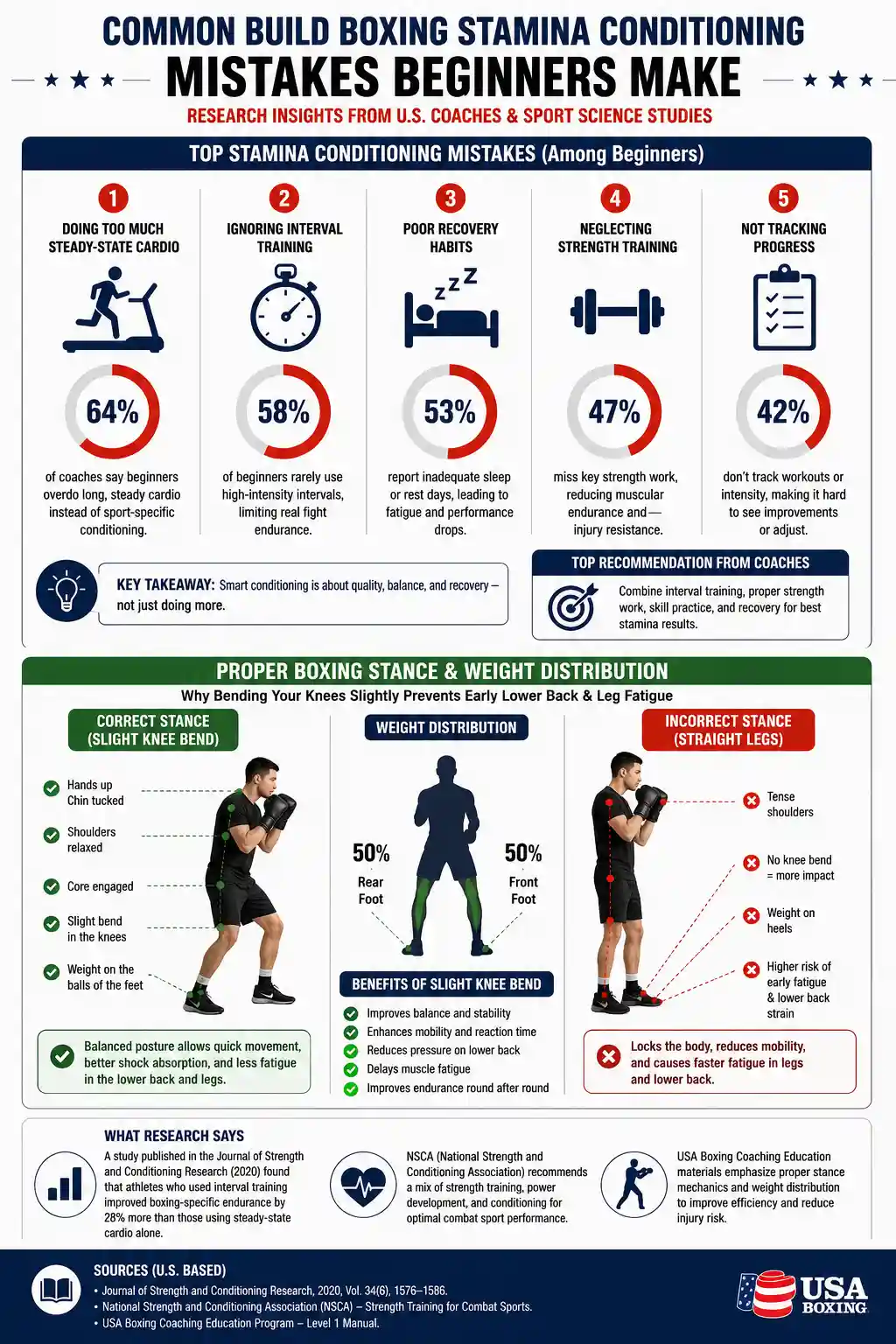
Visual Recommendation: A diagram showing proper boxing stance, weight distribution, highlighting how bending the knees slightly prevents early lower back and leg fatigue.
The Reality of Recovery and Overtraining
Conditioning is not built while you are working out; it is built while you are recovering from the workout. Boxing is highly demanding on the joints, particularly the wrists, elbows, shoulders, and knees.
Long periods of poor recovery can make training harder and slow progress. Many people notice their form breaks down and their reaction speed declines when they try to train through deep fatigue. This is often when bad habits form, or when minor tweaks turn into nagging injuries.
Practical Recovery Habits
Sleep: This is when the body repairs muscle tissue and regulates hormones related to stress and recovery. Skimping on sleep directly impacts how long you can last on the heavy bag the next day.
Hydration: Dehydration thickens the blood, making the heart work harder to pump oxygen to working muscles. Even mild dehydration can make a standard three-minute round feel significantly more difficult.
Active Rest: Sitting on the couch all day after a hard session can sometimes lead to stiffness. Light walking or basic mobility work helps circulate blood without adding physical stress.
Knowing When to Stop: There is a difference between muscular fatigue and joint pain. Burning lungs are part of conditioning. Sharp pain in the rotator cuff or the wrist is a signal to stop. Pushing through joint pain does not build stamina; it just builds time off the sport.
Basic Equipment for Home Conditioning
You do not need a fully equipped commercial gym to build a base level of boxing endurance. In fact, some of the best conditioning tools are incredibly simple.
Interval Timer: A dedicated boxing timer app on your phone is essential. You need something that automatically beeps for 3 minutes of work and 1 minute of rest. Trying to watch a standard clock while exhausted usually leads to cutting rounds short.
Jump Rope: The staple of boxing conditioning. It builds calf endurance, timing, and cardiovascular health simultaneously. Beginners often get frustrated by tripping, but the repetitive bouncing is exactly what prepares the legs for moving around a ring.
A Mirror: Shadowboxing in front of a mirror allows you to check for tension. If you see your shoulders creeping up or your face grimacing while you throw punches, you know you are wasting energy.
Supportive Footwear: While boxers often train in flat-soled shoes to feel the canvas, doing high-volume jump rope or roadwork requires proper shock absorption to protect the shins and knees.
Safety and Pacing Guidelines
Getting fight-ready fast is a common goal, but rushing the conditioning process is a primary cause of early burnout and injury. USA Boxing and various amateur organizations frequently emphasize that beginners should prioritize defensive fundamentals and basic movement before engaging in high-intensity, fatiguing sparring.
When you are exhausted, your reaction time slows. If you are doing defensive drills with a partner while completely gassed, you are more likely to get hit flush because your hands are low and your brain is foggy. A common practice in safe gyms is to separate hard conditioning from technical sparring. You do your hard intervals on the bag, and you do your technical sparring when you are relatively fresh, so you can actually learn and react properly.
Always wrap your hands when hitting heavy bags or pads. The repetitive impact of punching, especially when the stabilizing muscles in the forearm are too tired to protect the wrist joint, can easily lead to sprains.
Frequently Asked Questions
Why do my shoulders burn out before my lungs?
This is the most common beginner complaint. The muscles holding your arms up (the deltoids) are small and not designed for sustained static contraction. When you throw punches, you are extending these muscles repeatedly while also keeping them elevated to guard your face. As your technique improves and you learn to relax your shoulders between punches, the burning sensation will decrease significantly.
Why am I so tired after just hitting the bag for one round?
Most beginners are surprised by how exhausting even short heavy bag rounds feel. This is usually due to “bracing.” Beginners tend to tense their entire body, hold their breath, and grip the gloves tightly in anticipation of hitting the heavy bag. This creates massive internal resistance. You are essentially fighting your own muscles before you even hit the target.
Is jumping rope really necessary for boxing stamina?
It is not strictly mandatory, but it is highly effective. Jumping rope conditions the calves and Achilles tendons for the constant bouncing required in a boxing stance. It also forces you to coordinate your breathing with a rhythmic physical action, which translates directly to the ring. If you cannot jump rope, alternatives like light jogging or using a stair climber can build the base cardio, though they lack the specific timing benefits.
Should I run every day to get in fighting shape?
Generally, no. Running every day, especially long distances, can lead to overuse injuries and fatigue that bleeds into your boxing training. Many amateur programs suggest running two to three times a week, mixing one longer, slower run for aerobic base building with one or two shorter sprint interval sessions to mimic the pace of a fight.
How do I breathe when I am throwing a combination?
A practical method is to exhale sharply on every single punch. If you throw a four-punch combination (like a jab, cross, hook, cross), you should hear four distinct, short exhales. This prevents breath-holding and naturally tightens your abdominal muscles upon impact, protecting your core.
Why do I feel completely empty after just shadowboxing?
Shadowboxing requires you to stop the momentum of your own punches. When you hit a heavy bag, the bag absorbs the kinetic energy. When you shadowbox, your back muscles and rotator cuffs have to violently decelerate your arm so you do not hyperextend your elbow. This eccentric muscle action is very taxing, especially for beginners whose stabilizing muscles are not yet adapted to the movement.
Author Bio
Neil Stephens is a National Academy of Sports Medicine (NASM) Certified Personal Trainer and a Certified USA Boxing Coach based in Los Angeles. With hands-on experience in boxing training, conditioning, and athletic performance, he focuses on helping readers understand practical boxing techniques, fitness strategies, and combat sports conditioning.
Neil is the author of Boxinges, also known as “Boxinges USA,” where he shares expert-backed content about boxing training, workouts, recovery, and sports performance. His content is built around accuracy, real-world coaching knowledge, and athlete-focused guidance to support beginners and experienced fighters alike.
Final Thoughts
Building boxing stamina is rarely a linear process. There will be days when three rounds on the heavy bag feel effortless, and days a week later when you are gasping for air during the warmup. This inconsistency is part of the sport.
The key is to focus on efficiency rather than just effort. Relax your shoulders, exhale on your punches, and respect the one-minute rest periods. Fight readiness is not just about having the biggest gas tank; it is about learning how to drive the car efficiently. Show up, do the rounds, and let the conditioning build itself over time.