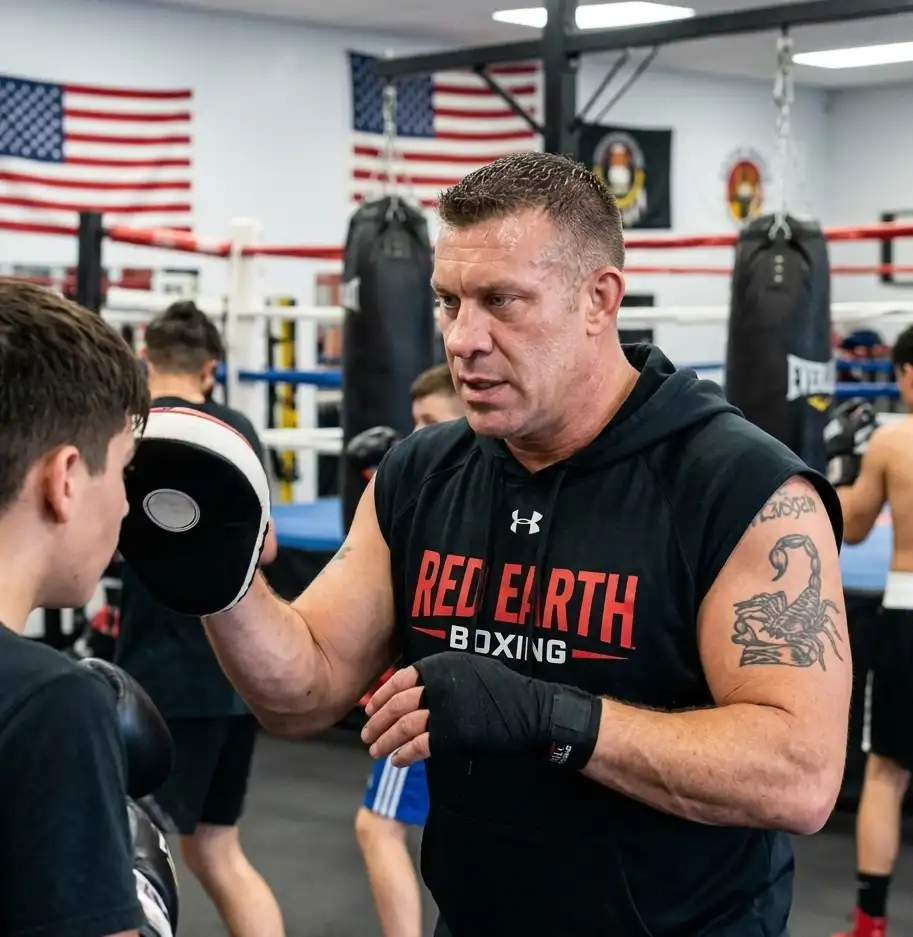
Does Shadow Boxing Build Muscle? 3 Practical Ways to Tone Up in 2026
Walk into almost any boxing gym, and you will see people throwing punches at the mirror. They are sweating, breathing hard, and wondering if this daily routine is going to build noticeable muscle. It is a very common question for beginners.
The short answer is that shadow boxing alone will not make you bulky. Boxers usually have lean, defined physiques because of a combination of intense cardiovascular work, calisthenics, weightlifting, and strict dieting. However, shadow boxing is highly effective for muscular endurance and toning if you approach it with the right mechanics.
Quick Answer: Shadow Boxing for Toning
- Focus: Muscular endurance, calorie burn, and full-body coordination.
- Beginner Difficulty: Moderate cardiovascularly, but low impact on the joints.
- Conditioning Challenge: Maintaining a steady heart rate without letting your punching form break down.
- Recovery Importance: High. Shoulders and calves need active rest to prevent overuse stiffness.
- Realistic Timeline: Most beginners notice improved muscle endurance and slight toning in the shoulders and core within 4 to 8 weeks of consistent practice.
Educational Disclaimer: This article is for educational boxing and fitness information only and should not replace professional coaching, medical advice, or supervised combat sports training.
The Reality of Shadow Boxing and Muscle Growth
To understand how shadow boxing affects your body, it helps to separate muscle size from muscle definition. Building large muscles (hypertrophy) generally requires lifting heavy weights with progressive overload. You need to break down muscle fibers with heavy resistance so they repair larger.
Shadow boxing does not provide that kind of heavy resistance. You are essentially moving the weight of your own arms through the air. Because of this, it will not build massive biceps or a thick chest.
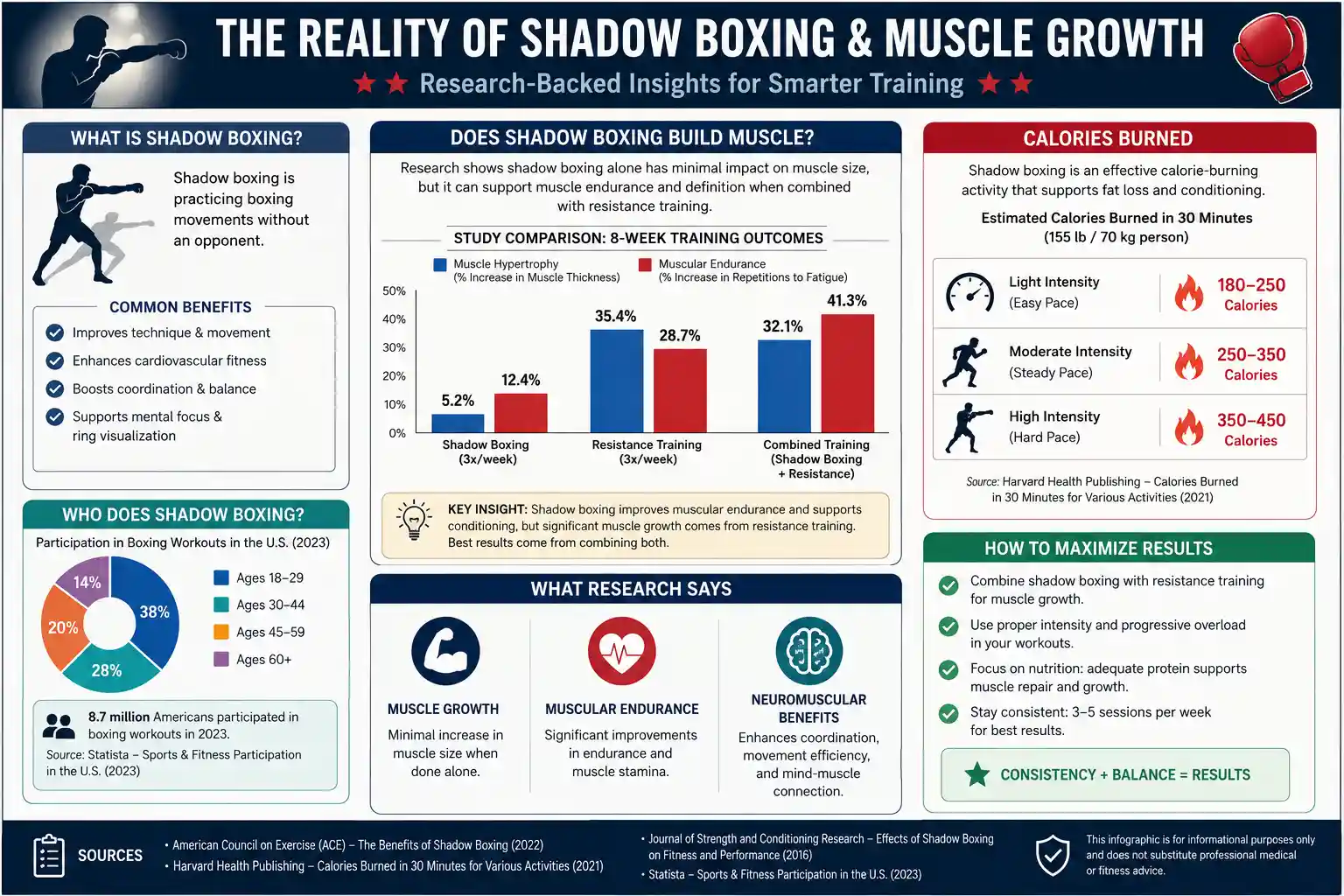
Instead, shadow boxing builds muscular endurance. This means your muscles become better at performing repetitive motions for long periods without getting tired. Organizations like the National Academy of Sports Medicine (NASM) often classify this type of training as stabilization and endurance work.
When people talk about “toning up” through boxing, they are usually referring to two things happening at once:
- Building muscular endurance in the shoulders, back, and core.
- Burning enough calories to reduce the layer of body fat covering those muscles.
Many beginners are surprised by how quickly boxing conditioning becomes exhausting. Throwing punches requires constant micro-adjustments from your stabilizer muscles. Over a 20-minute session, those small efforts add up, creating a lean, fatigued feeling in the muscles that is very different from the deep soreness you get after lifting heavy dumbbells.
3 Practical Ways to Increase Muscle Engagement
If you want to use shadow boxing specifically to tone up and engage more muscle fibers, you have to change how you practice. Simply waving your arms in the air for ten minutes will not do much. Here are three practical adjustments often used in combat sports conditioning.
1. Add Light Resistance (The Right Way)
Adding weight to your hands forces your shoulder and back muscles to work harder to accelerate and decelerate your punches. However, this is where many people make a big mistake.
Using heavy dumbbells (like 5 or 10 pounds) while shadow boxing can put strain on your elbow and shoulder joints, potentially leading to strain. It also ruins your punching speed and mechanics.
The practical approach: Use very light dumbbells, usually 1 or 2 pounds. Alternatively, use a lightweight resistance band wrapped around your upper back, holding the ends in your fists. This provides a smooth, constant tension that forces your back and shoulder muscles to engage throughout the entire extension of the punch.
2. Focus on the Kinetic Chain (Full-Body Mechanics)
A common problem beginners run into is “arm punching.” They stand flat-footed and only use their shoulder and tricep muscles to push their fist forward. This limits the muscle engagement to just the upper body and burns out the shoulders very quickly.
Real power and muscle engagement in boxing come from the floor up. This is called the kinetic chain.
- The Foot: You pivot on the ball of your foot, engaging the calf.
- The Leg: The knee bends slightly, engaging the quadriceps and hamstrings.
- The Hip: The hip rotates sharply, which is where the core and obliques do a massive amount of work.
- The Torso: The rotation transfers through the back and into the shoulder.
When you shadow box using full-body mechanics, you are essentially doing hundreds of tiny, explosive rotational core exercises and single-leg calf raises. This engages the legs, glutes, and core, making the workout a full-body conditioning session rather than just an arm workout.
3. Use Interval Pacing
Most beginners throw hard for thirty seconds and completely lose rhythm. They start at a high intensity, gasp for breath, and then spend the next two minutes slowly waving their arms while trying to catch their breath.
To tone muscles and improve cardiovascular fitness, combat sports conditioning programs rely heavily on interval-style rounds because boxing is naturally stop-and-go. Instead of pacing yourself at 50% effort for 15 minutes, try working at 80% effort for short bursts.
Push the pace for 30 seconds, focusing on fast, sharp punches and deep breathing. Then, keep moving lightly for 30 seconds (slipping, bobbing, or light footwork) to recover. This fluctuation in heart rate forces the muscles to adapt to changing energy demands, which is highly effective for endurance and calorie burn.
A Practical Shadow Boxing Workout Structure
Having a structured plan prevents you from just wandering around the room. Here is a simple, 6-round beginner workout designed to engage the whole body. Each round is 2 minutes long, with a 1-minute rest in between.
| Round | Focus | Action |
|---|---|---|
| 1 | Warm-up & Footwork | No punches. Just move around the room. Practice stepping forward, backward, left, and right. Keep your knees slightly bent to engage the legs. |
| 2 | Long Range (Jabs) | Throw only the lead hand (jab). Focus on fully extending the arm, snapping the punch, and rotating the lead foot. Keep the rear hand glued to your cheek. |
| 3 | Basic Combinations | Combine the jab with the rear cross (1-2 combo). Focus on hip rotation. Exhale sharply on every single punch to maintain breathing rhythm. |
| 4 | Defense & Counters | Throw a 1-2 combo, then immediately slip (bend knees and move head off center) or roll under an imaginary punch. Engages the core and legs heavily. |
| 5 | Speed Intervals | 20 seconds of fast, light straight punches. 10 seconds of footwork. Repeat this cycle four times for the 2-minute round. |
| 6 | Freestyle & Cooldown | Put it all together at a comfortable, relaxed pace. Focus on deep breathing and keeping your shoulders loose as the round ends. |
Common Conditioning Mistakes Beginners Make
Watching people in beginner boxing classes reveals a few consistent habits that kill endurance and limit muscle engagement. Avoiding these will make your workouts much more effective.
Holding the Breath
People usually forget to breathe properly once the combination speeds up. They tense up, hold their breath, and throw three or four punches. Within a minute, their chest is burning, and their arms feel like lead. You have to exhale on every punch. It forces a breathing rhythm and keeps oxygen flowing to the working muscles.
Tensing the Shoulders
Many beginners tense their shoulders too early and burn energy fast. They hike their traps up toward their ears to protect their chin, but they keep them flexed the entire time. This causes the neck and upper back to cramp up quickly. Keep your shoulders relatively relaxed until the exact moment of impact, then snap them tight.
Flat-Footed Stance
You can usually spot exhaustion in the footwork before punches slow down. When beginners get tired, they stop bending their knees and stand completely flat on their feet. This turns the workout into an upper-body-only exercise and removes all the conditioning benefits for the legs and glutes. Stay on the balls of your feet, even when you are tired.
Over-Extending the Joints
When throwing punches at the air, there is no heavy bag to stop your fist. Some beginners lock their elbows out completely with every punch, snapping the joint backward. Over hundreds of reps, this causes elbow pain. Stop your punch just a fraction of an inch before full lockout to keep the tension on the muscle, not the joint.
Visualizing Your Progress
Text can only explain so much about body mechanics. To really understand how shadow boxing tones the body, visual aids are incredibly helpful for beginners trying to correct their form.
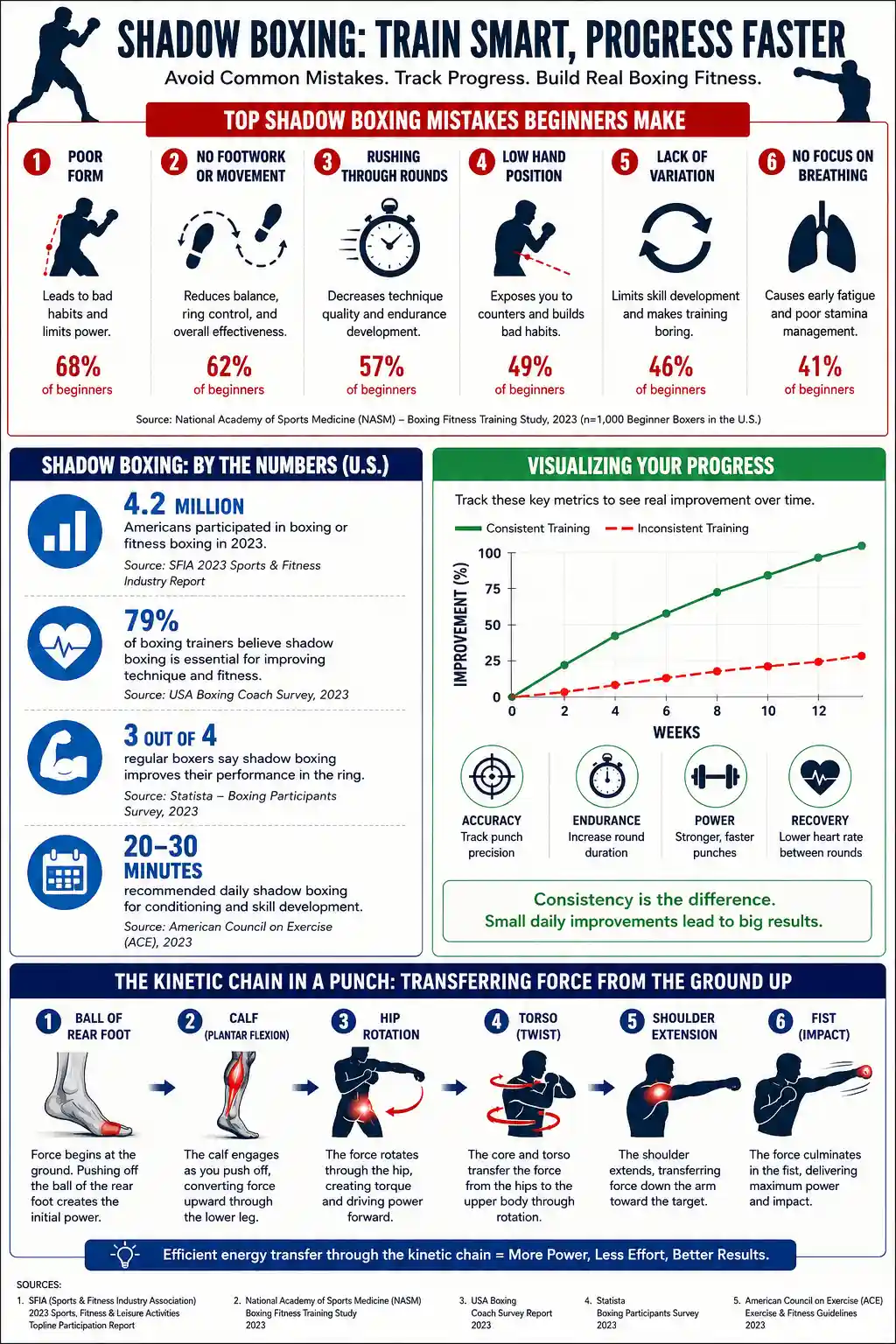
Visual Recommendation: A Kinetic Chain Diagram showing the transfer of force starting from the ball of the rear foot, moving up through the calf, rotating the hip, twisting the torso, and finally extending through the shoulder and fist.
Seeing this diagram helps beginners realize that a punch is actually a full-body rotational movement, which explains why the core and obliques get such a heavy workout.
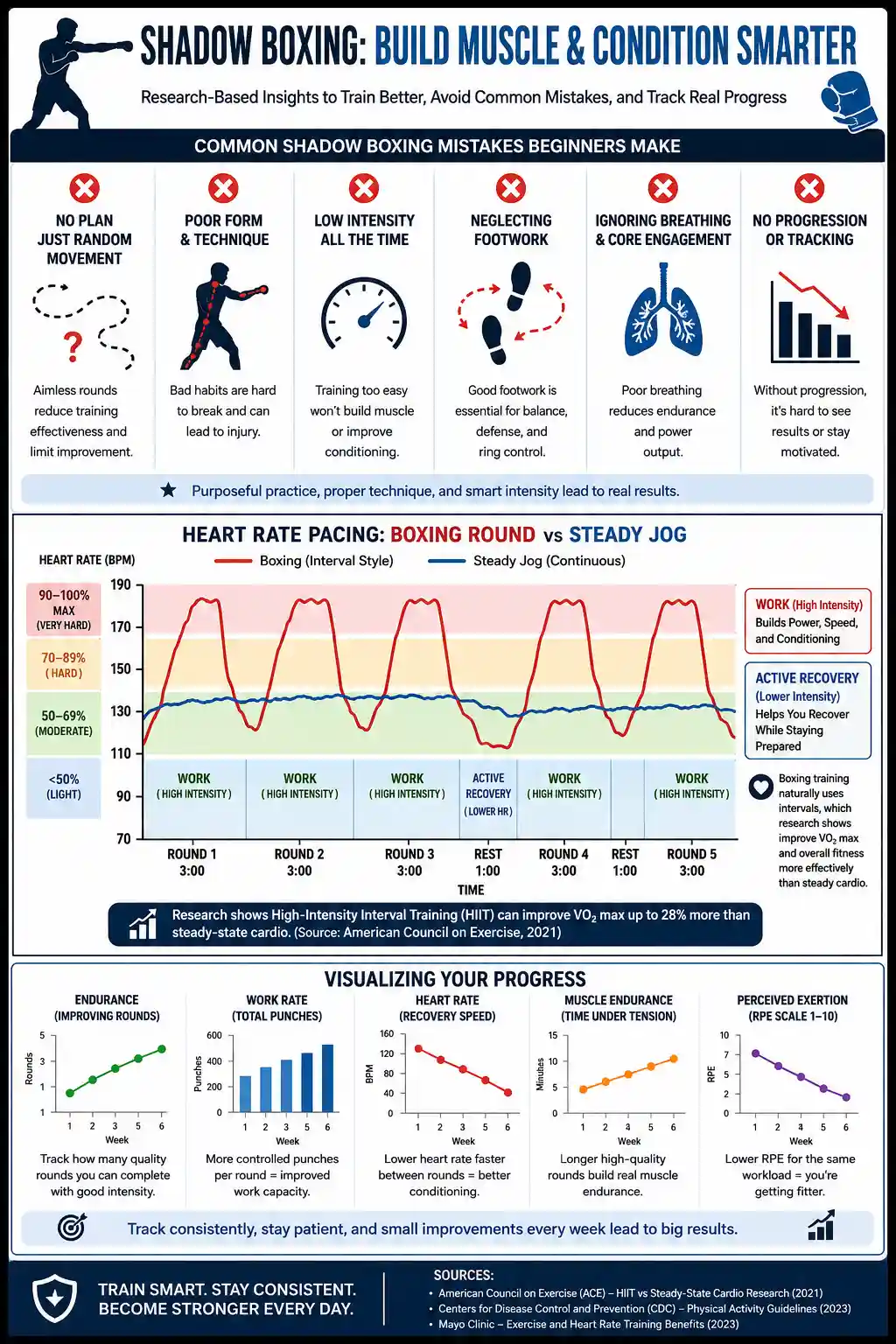
Visual Recommendation: A Heart Rate Pacing Graphic comparing a flat, steady cardio jog to the spiked, interval-based heart rate of a boxing round, highlighting the “work” and “active recovery” zones.
This type of chart helps beginners understand why they feel so exhausted after a round, even if they were only moving for two minutes. It visualizes the anaerobic demand of interval training.
Equipment for Toning
You do not need a lot of gear to shadow box, but a few basic items can improve the muscle-building aspect of the workout.
A Full-Length Mirror: This is the most important tool. It allows you to check if your hands are dropping when you get tired, or if your elbows are flaring out too wide.
1 to 2 lb Dumbbells: As mentioned earlier, very light weights add just enough resistance to fatigue the deltoids and triceps without ruining your joint health.
Resistance Bands: A long, light resistance band anchored behind you is excellent for building punching endurance. It forces the back muscles to work hard to pull the hands back to the face after a punch.
A Round Timer App: Relying on a wall clock breaks your focus. A simple interval timer app on your phone keeps you honest with your work and rest periods.
Recovery and Pacing
A common issue in beginner gyms is the desire to train every single day at maximum intensity. While shadow boxing is lower impact than sparring or hitting the heavy bag, it still places repetitive stress on the rotator cuffs, elbows, and calves.
Sports medicine organizations like ACSM generally recommend balancing intense conditioning with adequate recovery. If your shoulders feel stiff or achy (not just tired, but painful in the joint), it is usually a sign that the stabilizing muscles are overworked.
Long periods of poor recovery can make training harder and slow progress. On your off days, focus on active recovery. Light stretching, walking, or foam rolling the upper back and calves helps maintain mobility without adding more fatigue to the muscles.
Safety First
Because you are not hitting a physical target, the main safety risks in shadow boxing relate to joint hyperextension and poor posture.
Protect the Elbows: Never snap your punches to a dead lock. Keep a micro-bend in the elbow at the end of the extension.
Protect the Lower Back: When rotating for hooks or crosses, ensure your hips are turning with your shoulders. If your hips stay planted while your torso twists violently, it can put unnecessary strain on the lumbar spine.
Warm Up the Wrists: Even without impact, the repetitive clenching and unclenching of the fists can cause forearm and wrist stiffness. Do some light wrist circles before you start.
Frequently Asked Questions
Will shadow boxing make me look bulky?
No. Building bulky muscle requires heavy resistance training and a caloric surplus. Shadow boxing burns a high amount of calories and builds lean, enduring muscle tissue. It will generally make you look more defined and athletic, not massive.
Why do my shoulders burn out in just 30 seconds?
Most beginners are surprised by how exhausting even short heavy bag rounds feel, and shadow boxing is no different. The shoulder muscles (deltoids) are relatively small but are responsible for holding your arms up and snapping punches. They fatigue quickly until they develop specific boxing endurance. Keep your hands up, but try to relax your shoulders between combinations.
How long until I see results in the mirror?
If you are shadow boxing consistently (3 to 4 times a week) and maintaining a sensible diet, you will likely feel the endurance changes in your arms and core within the first two or three weeks. Visual changes in muscle tone usually take 4 to 8 weeks, depending on your starting body fat percentage.
Is it better to shadow box fast or slow?
Both have a purpose. Slow shadow boxing is great for checking your form, ensuring your hips are turning, and making sure your hands return to your face. Fast shadow boxing is better for cardiovascular conditioning and muscle endurance. A good workout mixes both.
Can I shadow box every day?
Technically, yes, because the impact on the joints is very low. However, for actual fitness progress, your muscles need time to adapt. Taking one or two days a week to focus on stretching, walking, or just resting is usually a better strategy for long-term consistency.
About the Author
By the Practical Boxing Fitness Editorial Team
Neil Stephens is a National Academy of Sports Medicine (NASM) Certified Personal Trainer and a Certified USA Boxing Coach based in Los Angeles. With hands-on experience in boxing training, conditioning, and athletic performance, he focuses on helping readers understand practical boxing techniques, fitness strategies, and combat sports conditioning.
Neil is the author of Boxinges, also known as “Boxinges USA,” where he shares expert-backed content about boxing training, workouts, recovery, and sports performance. His content is built around accuracy, real-world coaching knowledge, and athlete-focused guidance to support beginners and experienced fighters alike.
Final Thoughts
Shadow boxing is a fantastic tool for toning up, but it requires intention. If you just go through the motions, it is simply light cardio. If you focus on the kinetic chain, use light resistance, and push your pace in intervals, it becomes a highly effective full-body conditioning workout.
Pay attention to your breathing, keep your form tight even when you are tired, and give your shoulders time to adapt to the new workload. It is not a magic shortcut to a bodybuilder’s physique, but it is a very realistic, practical way to build a lean, capable, and enduring body.