Punching Bag Workout for Beginners: Burn Fat in 15 Minutes in 2026
Walking up to a heavy bag for the first time usually results in a lot of wasted energy. Many beginners throw punches as hard as they can, only to find their shoulders burning and their breathing heavy before the first minute is even over. Boxing conditioning is naturally stop-and-go. You work, you rest, you work again.
A 15-minute heavy bag session is often enough to challenge a beginner’s cardiovascular system without requiring a full hour in the gym. It forces you to manage your pace, keep your hands up when you are tired, and figure out how to breathe while moving.
Quick Answer: The 15-Minute Bag Workout
- Focus: Basic punch mechanics, interval pacing, and steady footwork.
- Realistic Difficulty: Moderate. Upper body exertion spikes the heart rate quickly.
- Conditioning Challenge: Keeping your guard up and breathing steadily once shoulder fatigue sets in.
- Recovery: 60 seconds of active movement between 3-minute rounds.
- Timeline: Beginners generally notice less gasping and better rhythm after 3 to 4 weeks of consistent practice.
Educational Disclaimer: This article is for educational boxing and fitness information only and should not replace professional coaching, medical advice, or supervised combat sports training.
The 15-Minute Heavy Bag Workout Structure
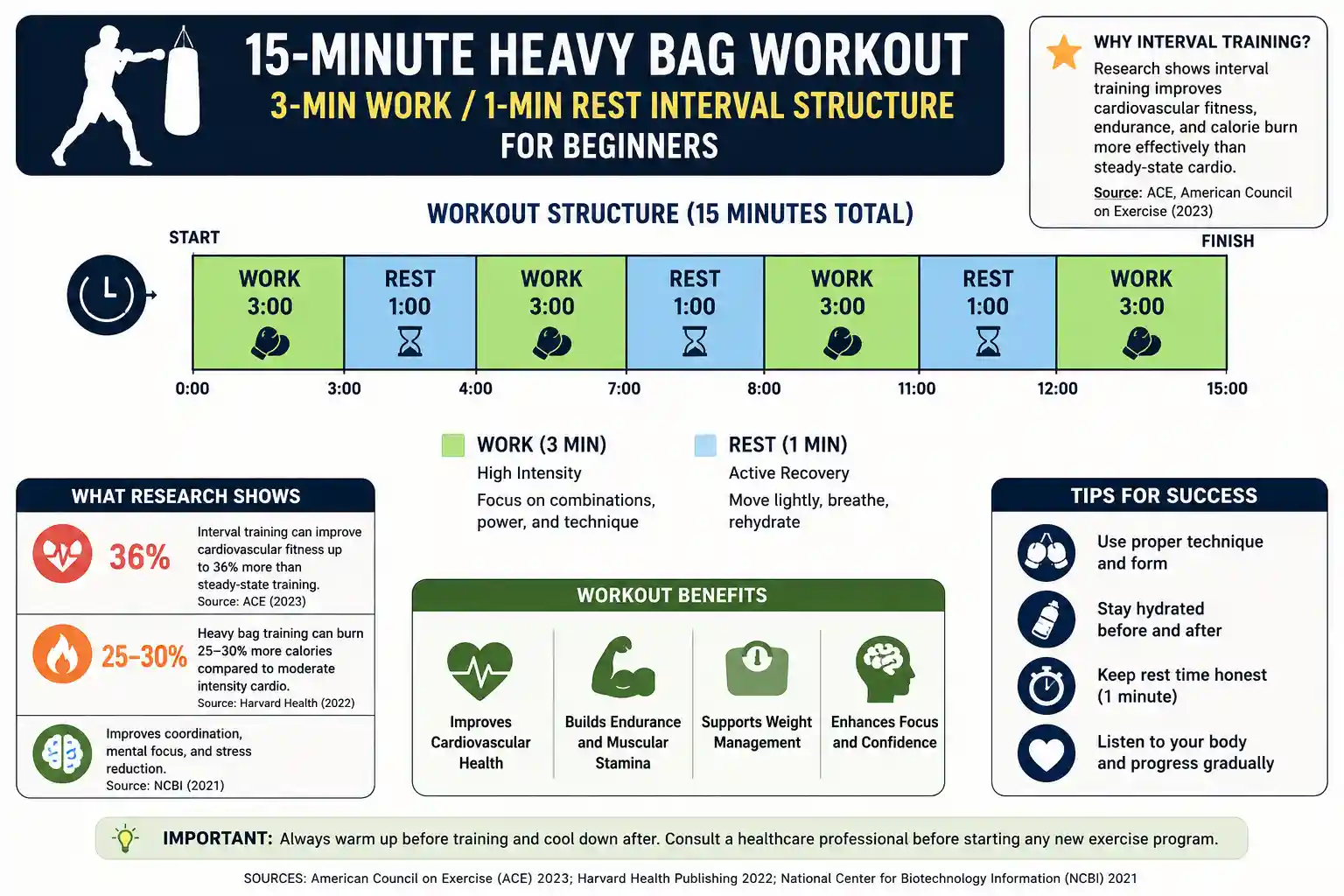
Many combat sports conditioning programs rely heavily on interval-style rounds because boxing is naturally stop-and-go. For a beginner, mimicking professional round times can be a bit much. A standard professional round is three minutes with a one-minute rest. This 15-minute workout uses that same ratio, but keeps the focus entirely on pacing rather than power.
The goal here is not to dent the bag. The goal is to keep moving for the entire three minutes without stopping to drop your hands and catch your breath.
| Round | Duration | Focus | Intensity |
|---|---|---|---|
| Round 1 | 3 Minutes | Long punches, finding distance, basic footwork. | Light / 50% |
| Rest | 1 Minute | Active recovery (walking, shaking out arms). | Low |
| Round 2 | 3 Minutes | Basic combinations (Jab-Cross), steady breathing. | Moderate / 70% |
| Rest | 1 Minute | Active recovery, focus on slow nasal breathing. | Low |
| Round 3 | 3 Minutes | Add hooks and uppercuts, pivot around the bag. | Moderate / 75% |
| Rest | 1 Minute | Active recovery, check shoulder tension. | Low |
| Round 4 | 3 Minutes | Free flow, mix punches, focus on not stopping. | Hard / 85% |
Recommended Visual: A simple interval timer chart showing the 3-minute work / 1-minute rest cycle, perhaps with color-coded blocks to visually represent the pacing required for beginners.
How to pace the rounds
In the first round, just throw straight punches. Step in, throw a jab, step back. Do not try to throw six-punch combinations. Use this time to figure out how far away you need to stand so your arms are fully extended right as your knuckles make contact.
By round three, you can start adding hooks. The heavy bag will swing. When it swings toward you, step off the center line. When it swings away, step in. This stops you from just standing flat-footed and waiting for the bag to return to your fists.
Common Conditioning Mistakes Beginners Make
Most beginners are surprised by how quickly boxing conditioning becomes exhausting. It is not just about cardiovascular fitness; it is about how your muscles handle being tense while in motion.
Here are a few things coaches often notice when watching people new to the heavy bag.
Throwing too hard, too early
People usually want to see the bag swing violently. They tense their entire arm, plant their feet, and throw a right hand with maximum effort. This burns a massive amount of glycogen in the shoulders and forearms. By minute two, their punches look like they are pushing the bag rather than snapping it. Power in boxing comes from relaxation and speed, not just muscle tension.
Forgetting to breathe
People usually forget to breathe properly once the combination speeds up. A beginner might throw a four-punch combo and hold their breath until it is over. After doing that ten times, the oxygen debt catches up. A common practice is to exhale sharply on every single punch. It creates a rhythmic breathing pattern that matches your physical output.
Tensing the shoulders
Keeping your hands high to protect your chin is a basic rule. But many beginners shrug their shoulders up to their ears to do this. Holding that shrugged position for three minutes will cause the trapezius muscles to fatigue rapidly. The trick is to keep the elbows tucked to the ribs, which supports the arms without requiring the neck and upper back to do all the work.
Waiting for the bag
You can usually spot exhaustion in the footwork before punches slow down. The heels get heavy, and the fighter starts reaching for the bag instead of stepping to it. If the bag swings away, let it go. Reset your feet and step back in rather than leaning forward and throwing off your balance.
Equipment and Bag Setup
You do not need an expensive setup to get a good conditioning workout, but a few basic items prevent minor injuries that can derail your training.
Hand Wraps: A standard 180-inch semi-elastic wrap is usually best for adults. They keep the small bones in the hand aligned and offer some wrist support.
Gloves: For heavy bag work, 12oz or 14oz gloves are standard for most adults. Heavier gloves (16oz) can build shoulder endurance, but might slow down a beginner’s technique too much early on.
Shoes: Running shoes have thick, squishy heels. This makes pivoting difficult and can tweak the ankle. Flat-soled shoes (like wrestling shoes, Converse, or specific boxing shoes) provide a much more stable base.
Setting the bag height
A common mistake in commercial gyms is leaving the heavy bag too high or too low. Generally, the center of the bag should align roughly with your chest or nipple line. If the bag is too high, you will find yourself hitting the top curve, which strains the wrists. If it is too low, you will be hunching over, which restricts your breathing and ruins your posture.
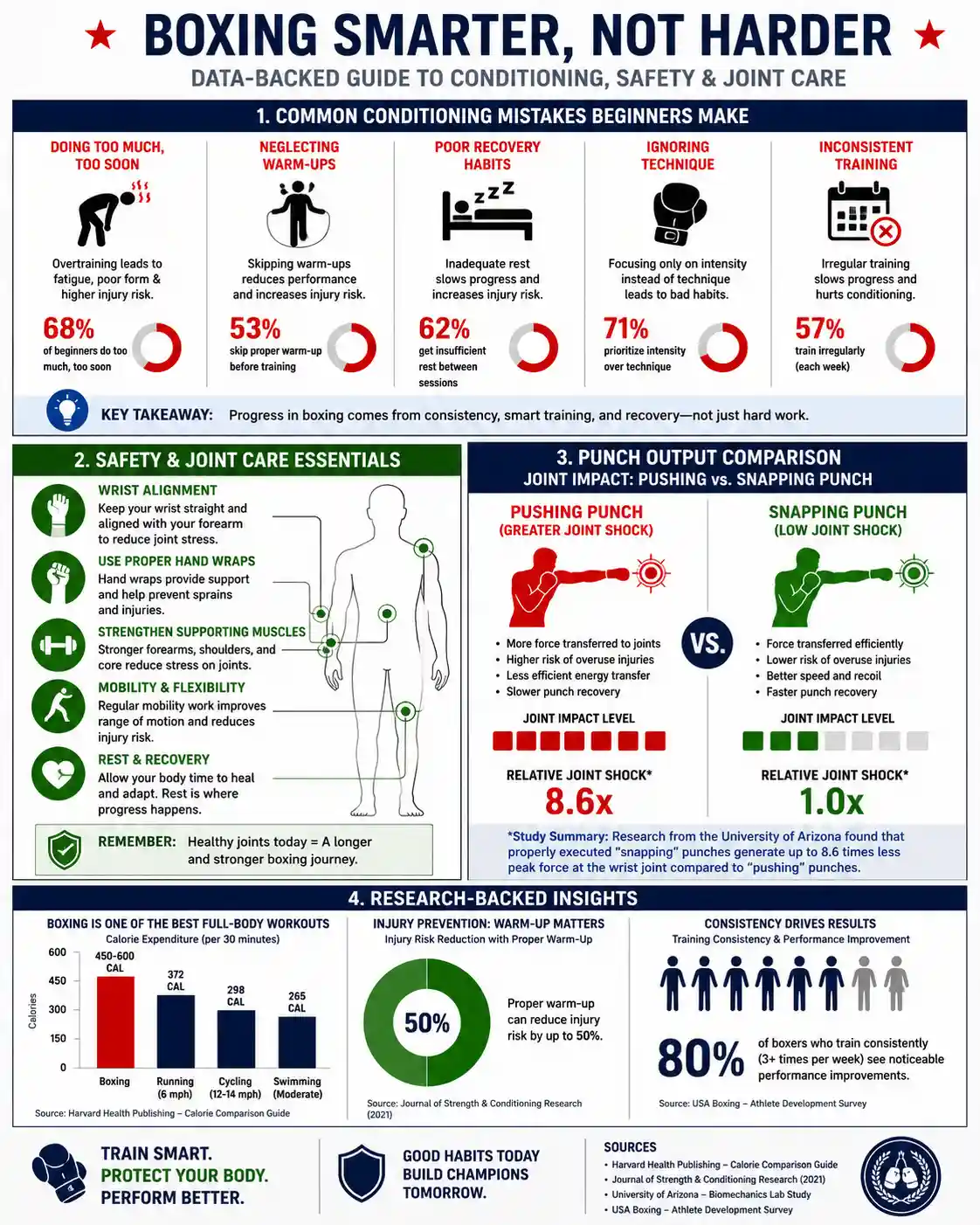
Recommended Visual: A diagram showing proper heavy bag height alignment relative to a beginner’s stance, alongside a basic hand-wrapping pattern for wrist support.
Recovery and Pacing Between Rounds
The 60 seconds between rounds is where the actual conditioning happens. If you sit down on a bench and look at your phone, your heart rate drops too fast, and your muscles will stiffen up. When the next bell rings, your arms will feel like lead.
Many combat sports conditioning coaches suggest “active recovery.” This simply means keeping the body moving at a very low intensity.
What to do in the corner
Keep walking: Pace around the bag or the mat. Do not stop moving your legs.
Shake it out: Let your arms hang loose and shake your hands. This helps relieve the isometric tension built up in the forearms and biceps.
Control the breath: Try to inhale through the nose and exhale slowly through the mouth. This signals the nervous system to calm down slightly before the next work period.
Check your form: Look in the mirror if there is one. Are your shoulders hiked up? Drop them. Is your chin pointing at the ceiling? Tuck it slightly.
Sports medicine organizations like the National Academy of Sports Medicine (NASM) generally emphasize active recovery in interval training to help the body manage metabolic byproducts. For a beginner, it mostly just feels like a necessary way to catch your breath without freezing up.
Safety and Joint Care
Boxing is relatively low impact on the lower body joints compared to running on concrete, but it introduces repetitive stress to the wrists, elbows, and shoulders.
Wrist alignment
When your glove hits the bag, your wrist should be perfectly straight. If it bends backward (extension) or sideways (deviation) upon impact, the force transfers directly into the small joints of the wrist. This is why wrapping the hands is considered mandatory for heavy bag work, even if you are just hitting lightly.
Snapping vs. Pushing
Pushing the heavy bag means your fist is still accelerating as it drives through the target. This transfers the shockwave back up your arm into the elbow and shoulder joints. Snapping the punch means the fist makes contact and immediately retracts. It protects the joints and actually moves the bag more violently because the energy is transferred into the bag rather than absorbed by your arm.
Shoulder care
Long periods of poor recovery and repetitive punching can make training harder and slow progress. If your shoulders feel sharp or pinchy when raising your arms outside of the gym, it is usually a sign to take a few days off from the heavy bag. Sports medicine organizations like ACSM generally recommend balancing intense conditioning with adequate recovery to prevent overuse injuries in the rotator cuff.
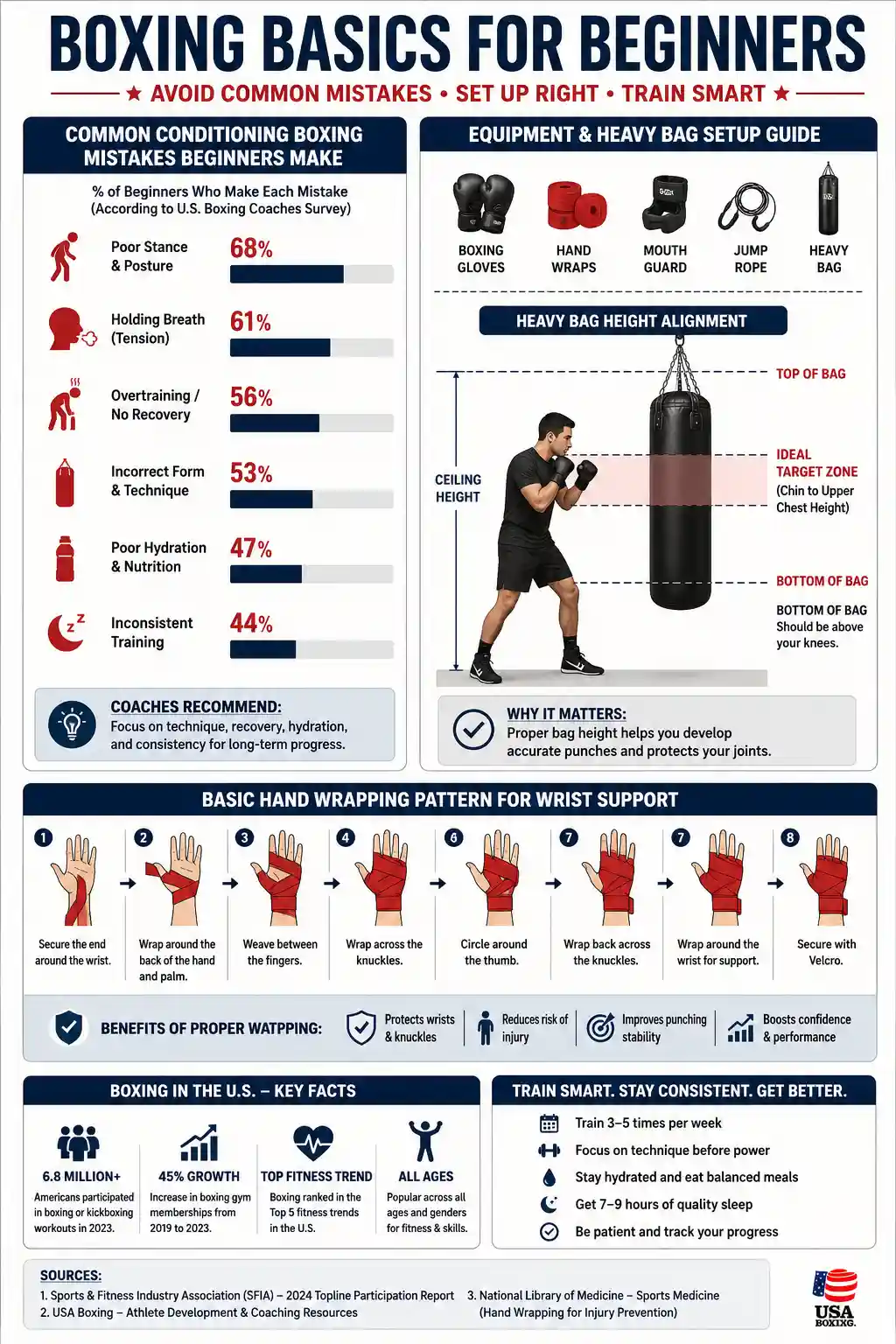
Recommended Visual: A punch output comparison chart showing the difference in joint impact between a “pushing” punch (great joint shock) and a “snapping” punch (low joint shock).
Frequently Asked Questions
Why do I get completely exhausted in the first 60 seconds?
Most beginners are surprised by how exhausting even short heavy bag rounds feel. Upper body cardio is very different from jogging or cycling. The muscles in the shoulders and back are relatively small compared to the legs, and they fatigue quickly when asked to hold a static guard position while also throwing punches. Pacing yourself in round one usually helps prevent the minute-one crash.
Is 15 minutes really enough to burn fat?
Calorie burn depends heavily on your current weight, the intensity of the work, and your daily diet. However, 15 minutes of interval conditioning with large muscle groups generally elevates the heart rate enough to contribute to a daily caloric deficit. It is a practical, time-efficient workout rather than a magic fat-melting solution.
My wrists hurt after hitting the bag. What am I doing wrong?
This is almost always an alignment or wrapping issue. Check that your knuckles (specifically the first two) are making flat contact with the bag. If you are hitting with the smaller outer knuckles, your wrist will naturally bend. Also, ensure your hand wraps are providing a rigid cast around the wrist joint, not just the knuckles.
I feel incredibly awkward and uncoordinated. Is this normal?
Yes. Throwing punches while moving your feet in different directions requires a lot of neural coordination that most people do not use in daily life. Footwork usually looks messy and feels clumsy before it looks smooth. USA Boxing recommends beginners prioritize defensive fundamentals and basic movement before worrying about complex combinations or intense sparring.
Should I wrap my hands if I am only doing light conditioning?
Generally, yes. Even if you are just tapping the bag to get a sweat on, the repetitive motion of making a fist and striking a dense surface hundreds of times can irritate the tendons in the hand and wrist over a few weeks. Wraps take about 45 seconds to put on and save a lot of joint irritation.
Final Thoughts
A 15-minute heavy bag workout is highly practical. It fits into a busy schedule, requires very little setup, and provides a very honest look at your current conditioning level. The bag does not care how strong you are; it only reacts to how well you can manage your energy.
Focus on breathing. Try to stay relaxed when your shoulders start to burn. Pay attention to your footwork when you get tired. If you can manage those three things, the conditioning will naturally improve over time without needing to spend hours in the gym.
About the Author
Boxing Fitness Observer & Writer
Neil Stephens is a National Academy of Sports Medicine (NASM) Certified Personal Trainer and a Certified USA Boxing Coach based in Los Angeles. With hands-on experience in boxing training, conditioning, and athletic performance, he focuses on helping readers understand practical boxing techniques, fitness strategies, and combat sports conditioning.
Neil is the author of Boxinges, also known as “Boxinges USA,” where he shares expert-backed content about boxing training, workouts, recovery, and sports performance. His content is built around accuracy, real-world coaching knowledge, and athlete-focused guidance to support beginners and experienced fighters alike.