Anthony Joshua Net Worth: Career Earnings, Fight History, and Ring Analysis
Anthony Joshua is a two-time unified heavyweight champion. He built his early career on physical dominance and knockout power, but his later fights have shown a more cautious approach in the ring. His career is marked by massive stadium wins in the UK, high-profile losses to Tyson Fury, Andy Ruiz Jr., and Oleksandr Usyk, and a recent shift toward different types of matchups.
Quick Fighter Snapshot
| Birthplace | Watford, England |
|---|---|
| Stance | Orthodox |
| Height | 6’6″ (198 cm) |
| Reach | 82″ (208 cm) |
| Pro Debut | 2013 |
| Major Titles Held | IBF, WBA, WBO, IBO |
Editorial Disclaimer
Financial figures and career earnings discussed in this article are based on publicly reported estimates from boxing and sports-business sources.
Career Timeline
Joshua’s career has moved through distinct phases, from a fast-tracked prospect to a unified champion, and eventually to a veteran trying to navigate a changing division.
- 2012: Wins Olympic Super Heavyweight Gold in London, turning professional shortly after with massive public backing.
- 2016: Wins his first world title, the IBF heavyweight belt, by knocking out Charles Martin in the second round.
- 2017: Stops Wladimir Klitschko in front of 90,000 fans at Wembley Stadium to add the WBA and IBO titles. This fight established him as the face of the division.
- 2018: Beats Joseph Parker by unanimous decision to add the WBO belt, unifying three major titles.
- 2019: Suffers a shock TKO loss to Andy Ruiz Jr. at Madison Square Garden, losing his titles. He wins the rematch later that year in Saudi Arabia by outboxing a heavier Ruiz.
- 2021: Loses his remaining belts to Oleksandr Usyk by unanimous decision in London.
- 2022: Loses the rematch to Usyk by split decision in Saudi Arabia.
- 2023: Picks up wins against Jermaine Franklin, Robert Helenius, and Otto Wallin while trying to rebuild his standing.
- 2024: Stops former MMA fighter Francis Ngannou in two rounds, but suffers a fifth-round knockout loss to Daniel Dubois later in the year.
- 2025: Stops Jake Paul in the sixth round of a crossover event in Miami.
Style Analysis
Joshua is a big, physical heavyweight who prefers to fight at mid-range. Early in his career, he relied heavily on a stiff jab to set up his right hand. Over time, his approach has become more measured and sometimes hesitant.
The Jab and Distance
He rarely wastes the jab early in fights. Instead of throwing it in bunches to blind opponents, he uses it mostly to measure distance. When he lands it cleanly, he usually follows it with a straight right hand. However, he tends to drop his left hand immediately after throwing the jab. This habit has left him open to counter right hands in several of his major losses.
Footwork and Power
His feet often reset before exchanges instead of after them. This gives him good balance for his power shots, but it makes him a stationary target. When he is forced to move backward, his punch output tends to drop. He does not like fighting off his back foot. Against smaller, awkward fighters, he sometimes struggles to cut off the ring, preferring to wait for them to come to him.
Pacing and Composure
He stays calmer than most heavyweights once the fights slow down. He rarely gets drawn into messy, high-paced brawls. But this caution can work against him. When an opponent refuses to engage in the center of the ring, Joshua can look flat-footed. He often waits for a clear opening instead of forcing combinations, which sometimes leads to low punch outputs on CompuBox scorecards.
Conditioning and Stamina
Early in his career, Joshua was heavily muscled, which led to questions about his stamina in the later rounds of 12-round fights. Against Wladimir Klitschko, he looked exhausted after surviving the sixth-round knockdown, and his output dropped noticeably in the championship rounds of his early title defenses.
However, his conditioning improved significantly as he matured. By the time he fought Joseph Parker and Andy Ruiz Jr. for the second time, he was noticeably leaner. He learned to pace himself, using the clinch to rest and relying on his jab to keep opponents at bay without burning unnecessary energy. Even in his losses to Oleksandr Usyk, his stamina was rarely the primary issue. He did not fade in the late rounds; rather, he simply could not catch a highly mobile opponent who refused to sit down on his punches.
Ring Psychology and Body Language
Watching Joshua between rounds and during tense moments reveals a lot about his approach. He is rarely an emotional fighter. Unlike some heavyweights who talk to their opponents or show visible anger when hit, Joshua usually maintains a blank, focused expression.
When he is hurt or dropped, as he was against Klitschko and Ruiz, his body language shifts. He tends to become rigid, looking to tie up immediately rather than trying to box his way out of trouble. His corner has often had to work hard to reset his mindset, reminding him to use his movement rather than stand flat-footed in front of a dangerous puncher.
When he is in control, he looks incredibly relaxed. He drops his hands slightly, walks his opponents down, and waits for them to make a mistake. This calm demeanor is one of his biggest assets, but it can also look like hesitation when he faces a fighter who is dictating the pace of the bout.
Strengths & Weaknesses
Strengths
Heavy Hands: He has genuine knockout power in both hands. His right cross is his most dangerous weapon, especially when he catches an opponent moving forward.
Size and Physicality: He is naturally one of the bigger men in the division. He uses his frame to lean on opponents in the clinch and tire them out in the later rounds.
Discipline: He rarely loses his composure. Even when hurt, he usually tries to tie up or box his way out of trouble rather than swinging wildly.
Weaknesses
Defense on the Retreat: When opponents press forward and force him backward, his defense breaks down. He tends to stand straight up and cover rather than pivot or move his head.
Adaptability: He looks most comfortable when a fight follows his preferred pace and distance. When opponents change the rhythm or fight from awkward angles, he sometimes struggles to adjust mid-fight.
Chin Suspicions: While he has recovered well in some fights, he has been stopped cleanly by heavy punchers like Andy Ruiz Jr. and Daniel Dubois, raising questions about his ability to take a flush shot late in his career.
Trainer History
Joshua has changed his corner several times as his career has progressed, usually looking for a new approach after a major loss.
Robert McCracken: His longtime trainer who guided him from his professional debut through his early title wins and the Klitschko fight. McCracken was known for a calm, disciplined approach.
Angel Fernandez: Brought in to help prepare Joshua for the Andy Ruiz Jr. rematch and the subsequent fights against Oleksandr Usyk. Fernandez focused heavily on conditioning and movement.
Ben Davison: Worked with Joshua for several fights in 2023 and 2024, including the wins over Otto Wallin and Francis Ngannou. Davison is known for his work with other British heavyweights.
Recent Changes: Following his loss to Daniel Dubois in 2024, Joshua made changes to his team again, reportedly working with members of Oleksandr Usyk’s coaching staff ahead of his 2025 crossover bout.
Fight Statistics and CompuBox Data
A look at Joshua’s general career averages based on public CompuBox data and BoxRec records. These numbers reflect his style as a deliberate, power-focused fighter who often lets his opponents throw more punches.
| Metric | Career Average / Notable Data |
|---|---|
| Total Bouts | 33 |
| Wins | 29 |
| Knockouts | 26 |
| Losses | 4 |
| Average Punches Thrown | Often in the low to mid-40s per round |
| Klitschko Fight (2017) | CompuBox recorded Joshua throwing fewer total punches than Klitschko, but landing a higher percentage of power shots. |
| Usyk I (2021) | Usyk outlanded Joshua significantly in total punches, largely due to a high-volume jab that Joshua struggled to counter. |
| Jab Reliance | Moderate (Used mostly for range finding rather than accumulation) |
| Power Punch Accuracy | Consistently above the heavyweight division average |
| Knockout Ratio | ~78% |
Career Turning Points
Wladimir Klitschko (2017)
Klitschko dropped him in the sixth round with a right hand. Joshua looked hurt, his legs were unsteady, and he held on to survive the round. By the eleventh round, he had recovered and stopped Klitschko. The fight proved he could take a heavy shot and survive, but it also showed the world that he could be hurt by an older, fading champion.
Andy Ruiz Jr. I (2019)
Ruiz slipped inside the jab and threw quick, short hooks. Joshua’s feet got flat, and he couldn’t keep his opponent at the end of his punches. When he was hurt, he tried to tie up, but he looked disorganized. The fight exposed major holes in his defense and proved he struggled when a smaller fighter changed levels and pressured him.
Oleksandr Usyk I (2021)
Usyk moved constantly, threw high volumes, and controlled the distance. Joshua spent a lot of the fight watching him and rarely let his hands go in combinations. The fight showed the limits of his power. Against an elite, highly mobile boxer who refused to stand still, Joshua’s careful, measured approach was not enough to win rounds.
Financial Overview
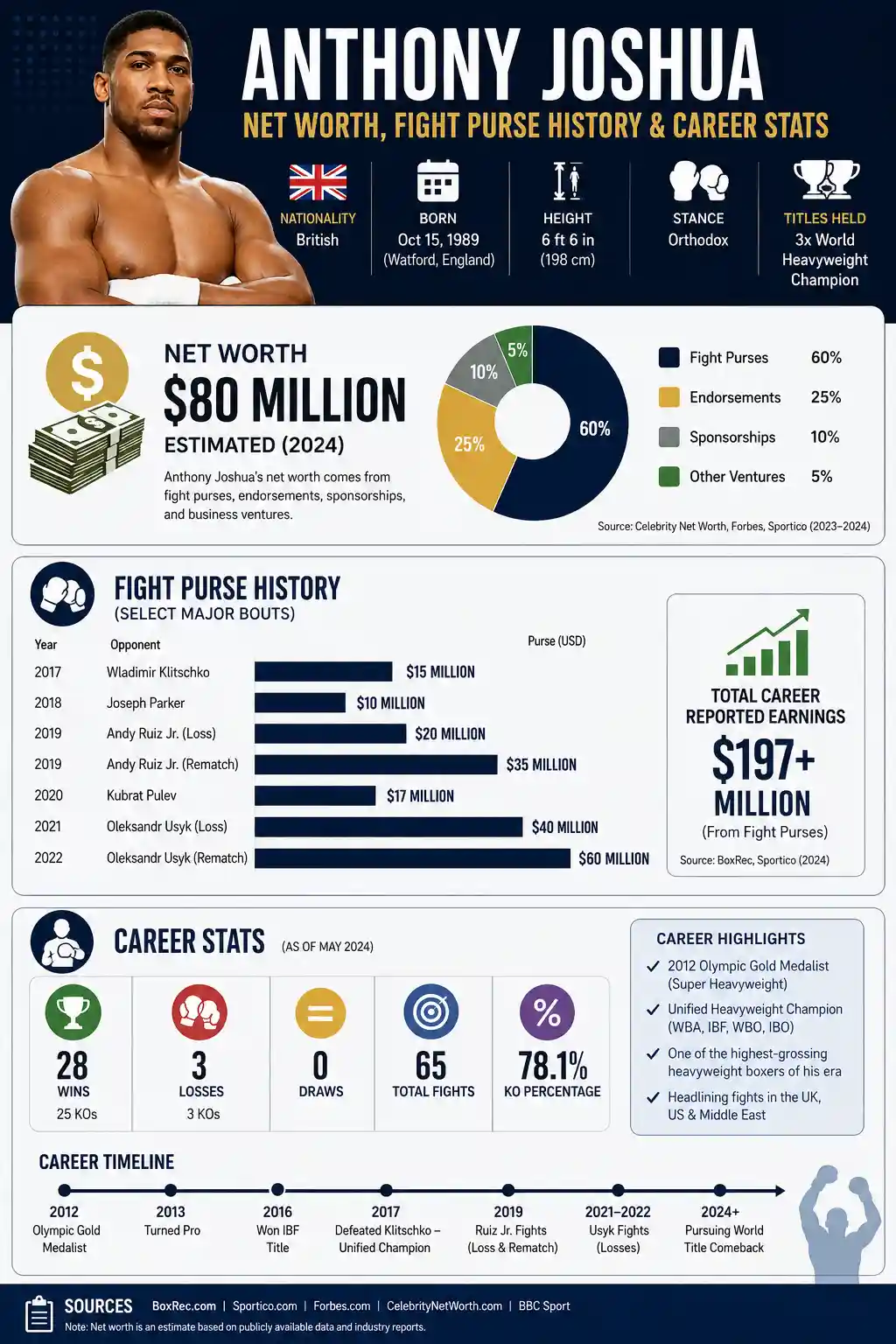
Joshua has been one of the highest-earning boxers of his generation. His purses grew significantly after he unified the heavyweight division, shifting from domestic UK shows to massive international events.
The UK Stadium Era
During his championship peak, Matchroom Boxing promoted his UK stadium fights. Boxing-business reporters noted that his live gate receipts and domestic pay-per-view shares placed him among the top earners in the sport. These fights were heavily reliant on the British market, and public estimates suggested he was taking home multi-million dollar purses for defending his titles at Wembley and the Principality Stadium.
Saudi Arabia Guarantees
When the heavyweight division shifted toward Saudi-backed promotions, his purse estimates changed again. Public estimates from Forbes and boxing-business outlets placed his guarantees for the Oleksandr Usyk fights in the tens of millions. Reports often cited figures between $30 million and $50 million for those events. These numbers are estimates, as exact contract details for these international events are rarely made public, but they marked a massive increase from his earlier career earnings.
The Changing Economics of the Division
Joshua’s career perfectly mirrors the shifting financial landscape of the heavyweight division. When he debuted, the major money was still largely controlled by traditional promoters relying on domestic television deals and local pay-per-view markets. Joshua became the undisputed king of the UK market, selling out stadiums and generating massive revenue through domestic broadcasters.
As his career progressed, the center of gravity for major boxing purses moved toward the Middle East. Saudi-backed promoters began offering massive, guaranteed site fees that traditional Western promoters struggled to match. This allowed Joshua to secure enormous paydays for the Usyk rematches and other international events, even as his domestic drawing power faced new challenges from younger fighters and rival champions like Tyson Fury. His ability to remain a global draw ensured he stayed at the top of the boxing earnings list, regardless of the promoter or location.
Sponsorships and Endorsements
Away from the ring, Joshua maintained a steady income from major brand partnerships. His long-running deals with brands like Under Armour and Beats by Dre are frequently mentioned in sports-business coverage. Boxing financial reporters note that these endorsements provide a massive secondary income stream that is not tied to his fight schedule or the risks of taking damage in the ring.
FAQ Section
How many heavyweight titles has Anthony Joshua held?
Joshua has held the IBF, WBA, WBO, and IBO heavyweight titles during his career. He became a unified champion by holding the IBF, WBA, and WBO belts simultaneously.
Who handed Anthony Joshua his first professional loss?
Andy Ruiz Jr. handed Joshua his first professional loss in June 2019, stopping him in the seventh round at Madison Square Garden to take his unified titles.
What is Anthony Joshua’s fighting style?
He is an orthodox, mid-range fighter who relies on a stiff jab to set up his power right hand. He prefers a careful, measured pace and uses his physical size to control opponents in the clinch.
What was the result of the Anthony Joshua vs. Daniel Dubois fight?
Daniel Dubois defeated Anthony Joshua by fifth-round knockout in September 2024. The fight was contested for the IBF heavyweight title, which Dubois held at the time.
Does Anthony Joshua hold an Olympic medal?
Yes. Before turning professional, Joshua won the Super Heavyweight Gold medal for Team GB at the 2012 London Olympics.
Author Bio
Neil Stephens is a National Academy of Sports Medicine (NASM) Certified Personal Trainer and a Certified USA Boxing Coach based in Los Angeles. With hands-on experience in boxing training, conditioning, and athletic performance, he focuses on helping readers understand practical boxing techniques, fitness strategies, and combat sports conditioning.
Neil is the author of Boxinges, also known as “Boxinges USA,” where he shares expert-backed content about boxing training, workouts, recovery, and sports performance. His content is built around accuracy, real-world coaching knowledge, and athlete-focused guidance to support beginners and experienced fighters alike.
Final Thoughts
He still has the physical tools to end a fight with one punch, but the movement and speed that defined his early career are harder to see now. When his initial game plan works, he looks like a champion. When it doesn’t, he tends to look flat-footed and cautious. He never quite figured out how to fight when his first plan didn’t work.