Tyson Fury Record, Net Worth, and Biggest Career Wins in 2026 (Updated)
Tyson Fury spent over a decade as the most polarizing and physically imposing figure in the heavyweight division. Standing at 6-foot-9, he moved with a fluidity that rarely matches his size. This profile examines his professional record, his most significant victories, his shifting fighting style, and the financial footprint he left on the sport.
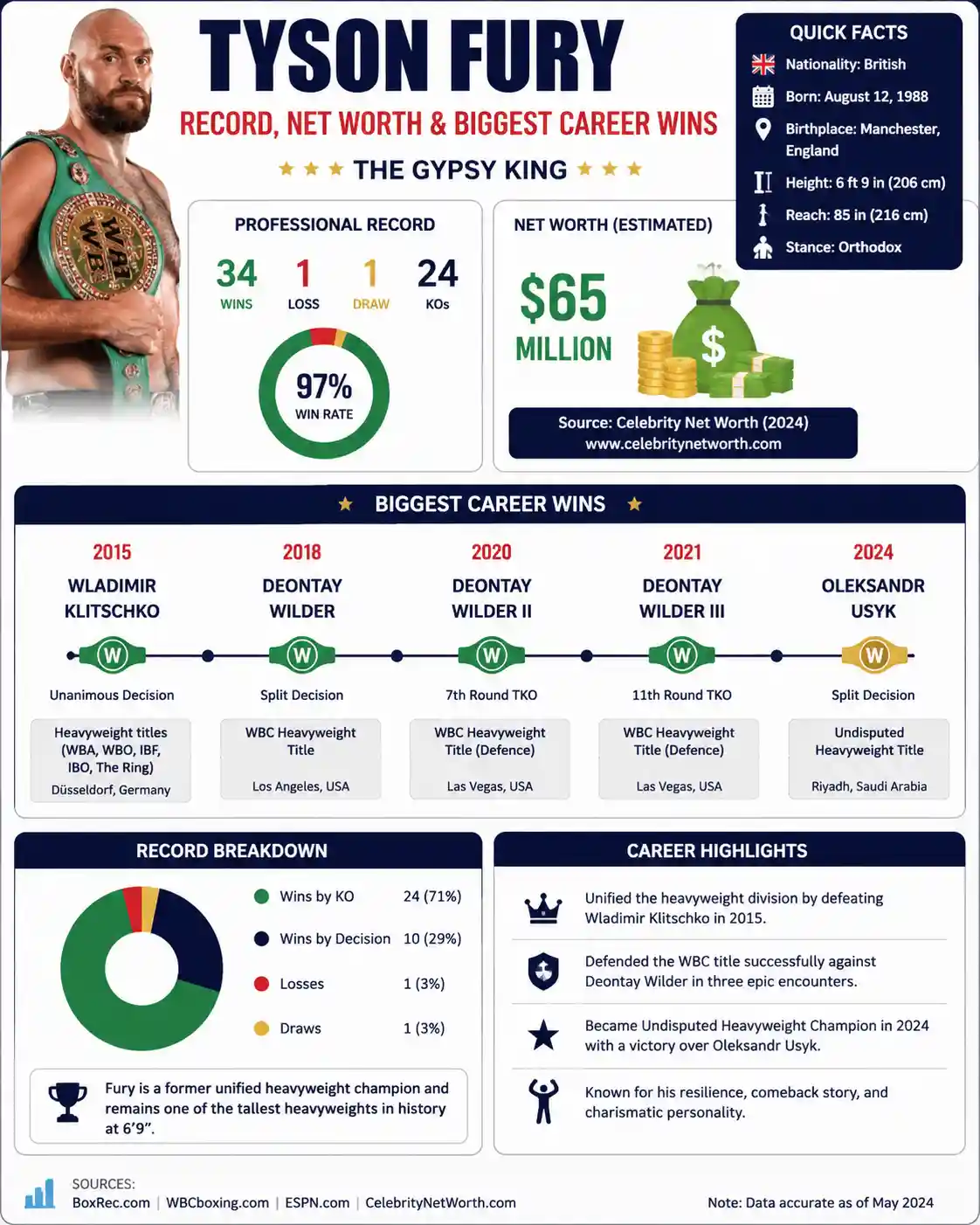
Quick Fighter Snapshot
- Name: Tyson Luke Fury.
- Born: August 12, 1988.
- Nationality: British.
- Height: 6 ft 9 in (206 cm).
- Reach: 85 in (216 cm).
- Stance: Switch / Orthodox / Southpaw.
- Weight Class: Heavyweight.
- Pro Debut: December 2008.
- Record (as of June 2026): 35 wins (24 KOs), 2 losses, 1 draw.
Editorial Disclaimer
Financial figures and career earnings discussed in this article are based on publicly reported estimates from boxing and sports-business sources. Exact contract purses are rarely disclosed in full by promoters.
Career Timeline
Fury’s career has been defined by long periods of dominance, unexpected retirements, and high-profile comebacks.
December 2008: Makes his professional debut in Nottingham, stopping Bela Gyongyosi in the first round.
June 2012: Fights Vinny Maddalone in a 12-round eliminator, stopping him in the fifth round to build his profile on the world stage.
November 2014: Faces Dereck Chisora for the second time, dominating him over 10 rounds before Chisora retires on his stool to win the British and European heavyweight titles.
February 2015: Stops Christian Hammer in the eighth round of a final eliminator to secure his mandatory ranking.
November 2015: Travels to Düsseldorf and defeats Wladimir Klitschko by unanimous decision, ending Klitschko’s decade-long reign and capturing the unified heavyweight titles.
June 2018: Returns to the ring after a long layoff, stopping Sefer Seferi in four rounds.
August 2018: Defeats Francesco Pianeta over 10 rounds in Belfast to shake off remaining ring rust.
December 2018: Fights Deontay Wilder in Los Angeles. Fury survives two knockdowns to secure a controversial split-decision draw.
February 2020: Faces Wilder in a rematch. Fury aggressively presses the action, stopping Wilder in the seventh round to claim the WBC heavyweight title.
October 2021: Meets Wilder for a trilogy fight. After a back-and-forth war, Fury knocks Wilder out in the 11th round.
April 2022: Defends the WBC title against Dillian Whyte, stopping him in the sixth round at Wembley Stadium.
December 2022: Stops Derek Chisora in the 10th round of their third meeting.
October 2023: Faces former UFC champion Francis Ngannou in a crossover boxing match. Fury is knocked down in the third round but recovers to win a highly disputed split decision.
May 2024: Faces undisputed champion Oleksandr Usyk in Riyadh. Fury drops a split decision in a closely contested tactical battle.
December 2024: Fights Usyk in an immediate rematch, losing by unanimous decision.
January 2025: Announces his retirement from professional boxing following the back-to-back defeats.
April 2026: Returns to the ring in a Netflix-streamed event at Tottenham Hotspur Stadium, securing a unanimous points victory over Arslanbek Makhmudov.
Style Analysis

Fury’s approach to boxing has always relied on deception and distance management rather than brute force.
Early in his career, he operated mostly out of a traditional orthodox stance, using his reach to keep opponents at the end of his jab. As he moved up the rankings, he began switching to southpaw more frequently. This was not just to confuse opponents, but to change the angle of his lead hand and create openings for straight lefts.
He rarely wastes the jab. Even range-finding shots usually move opponents backward or force them to reset their feet. When fighting taller, heavy-handed opponents like Wilder, Fury often leaned back, pulling his head just out of range while keeping his hands low. This drew criticism for being defensively risky, but it allowed him to counter off the shoulder.
In his later career, particularly during the Usyk fights, his pacing changed. He looked more comfortable at mid-range than inside exchanges. When Usyk forced him backward, Fury’s output dropped. His feet often reset before exchanges instead of after them, which meant he rarely threw in long, sustained combinations. Instead, he preferred to land one or two clean shots and step away.
Key Opponents and Matchup Dynamics
Different styles brought out different habits in Fury’s game.
Against Power Punchers (Wilder, Ngannou)
Fury usually fought cautiously against knockout artists. He relied heavily on upper-body movement, pulling his head back to draw lead hooks and overhand rights. Against Wilder, he often circled away from the right hand and used his left hand to paw at Wilder’s face, disrupting his rhythm. When he fought Ngannou, the same cautious approach led to him getting caught by a looping left hook in the third round. He spent the rest of that fight tying Ngannou up on the inside to prevent follow-up shots.
Against Pressure Fighters and Brawlers (Wallin, Chisora)
Fury struggled when opponents walked straight through his jab and refused to reset. Otto Wallin gave him significant trouble in 2019, throwing looping punches that caused severe cuts around Fury’s eyes. Wallin forced him into a grueling, messy inside fight where Fury couldn’t rely on his distance control. Against Chisora, who pressed forward with a high guard, Fury often stepped straight backward rather than pivoting, which allowed Chisora to march him down and land heavy hooks to the body.
Against Domestic Level Fighters (Whyte, Makhmudov)
When fighting less mobile, predictable opponents, Fury controlled the pace easily. He used his height to look down on them and threw straight right hands over their lead jabs. Against Whyte, he simply waited for Whyte to commit to a left hook, slipped under it, and landed a clean uppercut to end the fight.
Strengths & Weaknesses
Strengths:
Distance Control: He dictates the space between himself and his opponent. Opponents often find themselves swinging at air because Fury steps back just enough to make them miss.
Feints and Upper Body Movement: He uses shoulder rolls and subtle feints to draw reactions. This freezes opponents, giving him a split second to land a straight right hand.
Size and Balance: Despite his height, he rarely gets pushed backward easily. He uses his mass to lean on opponents in the clinch, draining their energy.
Switch Stance: Changing from orthodox to southpaw mid-fight forces opponents to constantly adjust their foot placement and guard.
Weaknesses:
Middle-Round Lulls: In several 12-round fights, his punch output drops noticeably between rounds four and eight. He tends to box cautiously to preserve his stamina.
Defensive Lapses on the Back Foot: When pressured against the ropes, his hand placement drops. He relies on pulling his head back, which can lead to him getting caught if the opponent steps in deep enough.
Inside Fighting: He rarely looks comfortable trading on the inside. When smaller, faster heavyweights get under his long arms, he usually resorts to tying up rather than working the body.
Pace Management: He struggles to match the sustained work rate of elite-level boxers who throw in combinations rather than single shots.
Fight Statistics Table
Here is a look at the official punch data from some of his most significant recent fights, based on CompuBox statistics.
Note: Connect percentages and totals are rounded to the nearest whole number based on publicly available CompuBox data.
Career Turning Points
Beating Wladimir Klitschko (2015)
Before this fight, Fury was seen as an awkward, unproven challenger. He used his switch stance and constant movement to frustrate Klitschko, who threw very few punches. The win proved Fury could execute a game plan against a disciplined, elite-level opponent. It shifted his public perception from a domestic curiosity to a legitimate world champion.
The First Deontay Wilder Fight (2018)
This fight tested Fury’s durability. He was knocked down heavily in the final round but managed to stand up and survive. While the draw was controversial, it showed he could take a clean shot from the division’s hardest puncher and still process what was happening around him.
Winning the Wilder Rematch (2020)
Fury completely changed his approach for this fight. Instead of moving and countering, he walked Wilder down and forced him to retreat. He showed he could apply pressure and take punches on the way in. The victory established him as the lineal champion and proved his stamina could hold up in a high-output fight.
The Usyk Fights (2024)
Losing back-to-back decisions to Usyk highlighted the limits of Fury’s style against a high-volume, relentless mover. Usyk stayed in the pocket and forced Fury to work at a pace he could no longer sustain for 12 rounds. This sequence of fights ultimately led to his January 2025 retirement announcement.
The 2026 Comeback
Returning against Makhmudov on a global streaming platform tested whether he still had the reflexes to compete at the top level. The fight showed his timing was still sharp, even if his overall punch output remained lower than it was during his championship peak.
Trainer History and Corner Changes
Fury’s corner has shifted depending on the style of opponent he was preparing for and his personal life at the time.
Early Career and Domestic Titles
His father, John Fury, trained him during his early professional fights and domestic title run. This period focused on establishing his physical dominance and basic boxing fundamentals.
The Klitschko Win and Wilder I
For the biggest fights of his early championship run, Fury worked with Ben Davison. Davison helped him tighten up his switch stance and refine his defensive shoulder rolls. This pairing was in place for the Klitschko victory and the first draw with Wilder.
The Championship Reign
When Fury returned to face Wilder for the second time, he brought in SugarHill Steward. Steward, the nephew of legendary trainer Emanuel Steward, encouraged Fury to plant his feet more and use his weight to push opponents backward. This led to a more aggressive style, resulting in the stoppage wins over Wilder and Chisora. Steward remained his primary trainer through the Usyk fights in 2024.
Notable Early Career Tests
Before facing world champions, Fury had a few domestic fights that exposed his durability and conditioning.
Neven Pajkic (2011)
Fury dropped Pajkic early but was caught coming in and knocked down himself in the second round. He recovered to stop Pajkic in the third. The fight showed that while he had power, he could be caught when dropping his hands.
Kevin Johnson (2012)
This was Fury’s first 12-round fight. Johnson was a durable, defensive fighter who rarely took risks. Fury outpointed him easily over the distance, proving he could maintain his stamina and focus for a full championship schedule, even when the opponent refused to engage.
Steve Cunningham (2013)
Fighting in the United States for the first time, Fury was dropped in the second round by Cunningham’s sharp counter punching. He adjusted in the second half of the fight, used his size to take over, and stopped Cunningham in the seventh. This win earned him a mandatory ranking to fight for a world title.
Financial Overview
Fury’s financial standing is tied directly to the modern era of heavyweight mega-fights and international investment in the sport.
Public estimates from Forbes and boxing-business outlets placed his earnings significantly above earlier heavyweight purses. Forbes reported that Fury earned approximately $50 million between June 2022 and June 2023, driven largely by domestic stadium fights and an exhibition bout.
Reported figures vary, but several outlets estimated the Fury vs. Wilder trilogy and the subsequent Usyk fights generated career-high earnings, heavily subsidized by Saudi Arabian entertainment initiatives like Riyadh Season. These guarantees often exceeded the traditional domestic pay-per-view models.
While exact career totals are private, sports-business analysts frequently place his career earnings well over the $150 million mark, factoring in base purses, PPV shares, and international broadcast rights. His 2026 return, streamed globally on Netflix, introduced a new broadcast revenue model that likely added significantly to his overall net worth.
FAQ Section
How many times did Tyson Fury fight Deontay Wilder?
Fury and Wilder fought three times. Their first bout in 2018 ended in a draw. Fury won the second fight in 2020 by seventh-round TKO, and the trilogy fight in 2021 by 11th-round knockout.
Did Tyson Fury retire?
Who trained Tyson Fury during his biggest fights?
Fury has worked with several trainers throughout his career. His father, John Fury, trained him early on. Ben Davison was in his corner for the Klitschko win and the first Wilder fight. For his later title defenses and the Usyk fights, he primarily worked with SugarHill Steward.
What is Tyson Fury’s reach advantage?
Fury stands 6-foot-9 with an 85-inch reach. This gives him a significant physical advantage over most heavyweights, allowing him to land his jab while remaining out of range of his opponent’s counter punches.
Did Tyson Fury ever fight an MMA fighter?
Yes. In October 2023, he fought former UFC heavyweight champion Francis Ngannou under boxing rules. Fury won a split decision but was knocked down during the fight.
About the Author
Neil Stephens is a National Academy of Sports Medicine (NASM) Certified Personal Trainer and a Certified USA Boxing Coach based in Los Angeles. With hands-on experience in boxing training, conditioning, and athletic performance, he focuses on helping readers understand practical boxing techniques, fitness strategies, and combat sports conditioning.
Neil is the author of Boxinges, also known as “Boxinges USA,” where he shares expert-backed content about boxing training, workouts, recovery, and sports performance. His content is built around accuracy, real-world coaching knowledge, and athlete-focused guidance to support beginners and experienced fighters alike.
Final Thoughts
Fury never relied on heavyweight size the way most champions do. While others used their weight to bully opponents in the clinch or lean on them late in fights, Fury used his height to create angles and his footwork to disappear when he needed to breathe. Even in his later years, when the pace caught up with him, the movement and the feints remained. He proved that a giant could box like a middleweight, and that deception often works just as well as a heavy right hand.
I’m Neil Stephens, an LA-based USA Boxing Coach and NASM-Certified Personal Trainer. I created Boxinges.online (Boxinges USA) to share what I’ve learned from years of hands-on coaching and athletic conditioning. My goal is simple: to cut through the noise and give you real-world, expert-backed advice on practical boxing techniques, fitness, and recovery. Whether you're just starting out or you're an experienced fighter looking to elevate your performance, I'm here to help you train hard, recover right, and get the most out of your time in the gym.