10 Powerful Benefits of Boxing for Fitness: Sculpt & Tone Fast in 2026
Boxing fitness has grown massively over the last decade. You often see advertisements promising you will sculpt and tone your physique quickly by taking up the sport. But if you spend time watching real boxing gyms, the reality is a bit more grounded. It is less about quick aesthetic fixes and more about building deep, functional endurance in muscles you rarely use in daily life.
Quick Answer: Boxing Fitness Reality
- Focus: Full-body muscular endurance and interval conditioning.
- Difficulty: High for beginners, mostly due to pacing issues and unfamiliar muscle use.
- Challenge: Keeping the arms elevated while rotating the core under fatigue.
- Recovery: Essential. Shoulders and calves need time to adapt to new rotational and bouncing forces.
- Timeline: Noticeable endurance improvements and muscle firmness usually appear within 3 to 4 weeks of consistent training.
Educational Disclaimer: This article is for educational boxing and fitness information only and should not replace professional coaching, medical advice, or supervised combat sports training.
The Reality of Sculpting and Toning in Boxing
When people talk about getting “toned,” they are generally talking about two things happening at once: building muscular endurance and reducing overall body fat. Boxing happens to address both simultaneously, but not through magic. It happens because the sport forces you to hold your arms up for extended periods while constantly moving your lower body.
Most beginners are surprised by how quickly boxing conditioning becomes exhausting. You might feel fine jogging for twenty minutes, but throwing punches for three-minute rounds taxes the body in a completely different way. The physical adaptations that follow are highly practical.
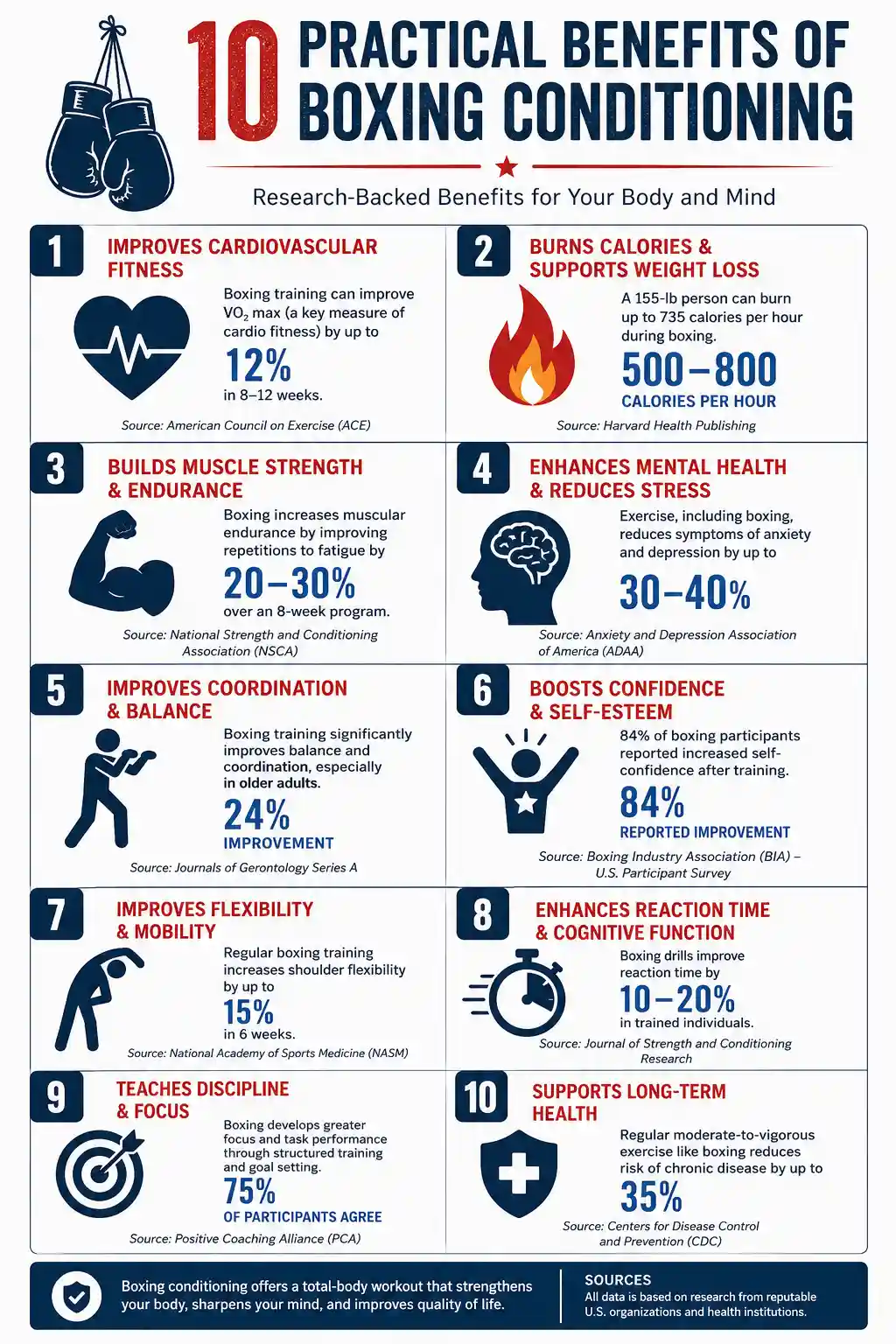
10 Practical Benefits of Boxing Conditioning
1. Shoulder and Upper Back Endurance
In many beginner boxing gyms, coaches often notice new students dropping their hands after just sixty seconds. Holding 12-to-16-ounce gloves up in a defensive guard requires constant, low-level contraction of the deltoids and trapezius muscles. Over a few weeks, this builds significant muscular endurance. The shoulders adapt to the workload, becoming firmer and more capable of sustaining effort without shaking or dropping.
2. Core Rotational Strength
A common problem beginners run into is “arm punching”—throwing punches using only the shoulder and elbow. Proper boxing technique requires power to originate from the floor, transferring through the hips and core. Every time you throw a hook or a cross, your obliques and deep abdominal muscles have to contract rapidly to rotate your torso. This repetitive twisting sculpts the midsection functionally, rather than just through static crunches.
3. Calf and Ankle Stability
You can usually spot exhaustion in the footwork before punches slow down. Boxers rarely stand flat-footed. The constant micro-adjustments, pivoting, and light bouncing place a heavy demand on the calves and the stabilizing muscles around the ankles. This lower-leg conditioning improves balance and gives the lower legs a highly defined, athletic look over time.
4. Stop-and-Go Cardiovascular Pacing
Boxing is naturally an interval sport. Traditional amateur bouts consist of three-minute rounds with one minute of rest. This stop-and-go structure forces the heart rate to spike and recover repeatedly. Many combat sports conditioning programs rely heavily on interval-style rounds because it mimics the actual demands of a fight. For general fitness, this interval approach often improves cardiovascular efficiency faster than steady-state jogging.
5. Hand-Eye and Foot-Hand Coordination
Hitting a heavy bag or focus mitts requires you to judge distance, time your movement, and coordinate your feet with your hands. Most beginners throw hard for thirty seconds and completely lose rhythm. As the weeks pass, the brain builds better pathways to coordinate these movements. You start to step and punch at the exact same time, which improves overall physical grace and reaction speed.
6. Postural Alignment and Awareness
A proper boxing stance requires you to keep your spine relatively straight, your chin tucked, and your shoulders settled. People who work at desks all day often develop a forward-head posture and rounded shoulders. The physical requirement of maintaining a tight guard and rotating from a centered spine naturally encourages better postural awareness, both in the gym and out of it.
7. High Caloric Expenditure
Because boxing requires the legs, core, and upper body to work together, it demands a lot of energy. Moving your entire body weight while throwing punches burns a significant number of calories. When combined with a reasonable diet, this high energy output is what ultimately leads to the “toned” look, as the layer of fat over the working muscles begins to decrease.
8. Bone Density and Impact Health
Jumping rope is a staple of boxing conditioning. Sports medicine organizations like the ACSM generally recommend weight-bearing and impact exercises to maintain bone density. The repetitive, low-impact hopping of a jump rope session, combined with the footwork drills, provides gentle stress to the skeletal system, which encourages bone strength over time.
9. Tension Management (Learning to Relax)
This is a benefit many people overlook. Beginners tend to tense every muscle in their body when they throw a punch. This burns energy incredibly fast. Experienced boxers learn to stay completely relaxed, only tensing their muscles at the exact fraction of a second their glove makes impact. Learning how to consciously relax your muscles under stress is a highly transferable skill that helps manage daily physical tension.
10. Mental Focus and Routine
Boxing requires intense presence. If you are thinking about your grocery list while doing defensive head movement drills, you will likely lose your balance or miss the coach’s cue. The necessity of focusing entirely on the physical task at hand provides a mental break from daily stressors. It forces a type of moving meditation that many find highly effective for clearing their head.
A Realistic Beginner Workout Structure
If you are stepping up to a heavy bag or just shadowboxing in your living room, pacing is everything. A common mistake is going 100% effort in the first round and gassing out. Here is a standard, manageable structure for a beginner.
| Round | Activity | Focus | Pacing |
|---|---|---|---|
| Round 1 | Shadowboxing | Footwork and straight punches | Slow, focus on balance |
| Round 2 | Heavy Bag | Jab and cross (1-2) | 50% power, steady rhythm |
| Round 3 | Heavy Bag | Add hooks and movement | 60% power, breathe out on punches |
| Round 4 | Core / Neck | Planks and chin tucks | Steady, controlled holds |
Note: Standard rounds are 3 minutes with 1 minute of rest in between. Beginners can start with 2-minute rounds if 3 minutes feels too long.
Common Conditioning Mistakes
People usually forget to breathe properly once the combination speeds up. Holding your breath spikes your heart rate and causes your muscles to fatigue almost instantly. Make a conscious effort to exhale sharply on every punch.
Another frequent issue is over-committing to power. Many beginners try to hit the heavy bag as hard as possible, twisting their torso too far and pulling their muscles. Speed and technique will naturally build the muscles; trying to force power before you have the conditioning usually just leads to sore joints and sloppy form.
Finally, dropping the non-punching hand. When the lead hand throws a jab, the rear hand should be glued to the cheek. When fatigue sets in, the guard drops, which not only ruins the defensive habit but also removes the isometric tension that helps build shoulder endurance.
Recovery and Joint Care
Long periods of poor recovery can make training harder and slow progress. Boxing is tough on the wrists, elbows, and calves.
Forearm and Wrist Care: The repetitive impact and tight fist clenching can make the forearms incredibly tight. Gentle wrist stretches and forearm massages are highly recommended after bag work.
Calf Rolling: Because of the constant bouncing, the calves take a beating. Using a foam roller on the lower legs can help maintain flexibility and prevent stiffness the next day.
Shoulder Mobility: While the shoulders get strong, they can also get tight from being held up in a guard. Arm circles and band pull-aparts help keep the shoulder joint healthy and mobile.
Basic Equipment Needs
You do not need a massive budget to start, but you do need to protect your hands. The small bones in the wrists and knuckles are vulnerable when hitting a dense, heavy bag.
Hand Wraps: A 180-inch semi-elastic wrap is standard. They provide crucial support to the wrist and knuckles. USA Boxing recommends beginners prioritize proper hand wrapping techniques before engaging in any heavy impact training.
Gloves: For heavy bag work, 14oz or 16oz gloves are generally preferred for adults. The extra padding protects your hands and adds a bit of resistance, which helps build that shoulder endurance mentioned earlier.
Footwear: Running shoes have thick, squishy heels that can make you unstable when pivoting. Flat-soled shoes, like basic cross-trainers or boxing boots, provide a much better connection to the floor.
Safety and Pacing
Boxing conditioning is demanding, but it should not cause sharp pain. Muscle burn in the shoulders and calves is normal; sharp pain in the wrist or elbow is not.
Listen to your joints. If your lower back starts to ache, it usually means your core has fatigued, and you are leaning too far forward. Take a rest, reset your posture, and focus on keeping your weight centered. Coordination and reaction speed usually decline once fatigue builds, which is when sloppy habits form. It is always better to end a session with good technique than to push through exhaustion and ingrain bad habits.
Frequently Asked Questions
Will boxing make my arms look too bulky?
Generally, no. Boxing builds muscular endurance rather than pure size. You are throwing thousands of punches with relatively light weight (the weight of your arm and a 16oz glove). This tends to create a firm, defined look rather than significant muscle mass hypertrophy.
Why do my shoulders burn so much after just one minute?
Most beginners are surprised by how exhausting even short heavy bag rounds feel. Your deltoids are not used to holding your arms up in front of your chest for extended periods. This burn is just local muscular fatigue. It usually improves significantly after the first few weeks of consistent training as the muscles adapt to the specific demand.
Do I need to spar to get the fitness benefits?
Not at all. Sparring is an advanced skill that carries inherent risks. You can achieve excellent cardiovascular and muscular conditioning strictly through shadowboxing, heavy bag work, jump rope, and pad work with a coach.
How do I stop getting completely out of breath?
Pacing is usually the culprit. Many beginners throw combinations too fast and forget to exhale. Slow your hands down, focus on stepping smoothly, and make a “shh” sound every time you extend a punch. This forces you to breathe rhythmically.
Is boxing bad for my joints?
If done with proper technique and adequate recovery, it is generally very safe for healthy joints. The main risk comes from hitting a heavy bag with poor wrist alignment or wearing improper footwear that prevents the ankle from pivoting correctly. Always wrap your hands and pivot your feet.
About the Author
Neil Stephens is a National Academy of Sports Medicine (NASM) Certified Personal Trainer and a Certified USA Boxing Coach based in Los Angeles. With hands-on experience in boxing training, conditioning, and athletic performance, he focuses on helping readers understand practical boxing techniques, fitness strategies, and combat sports conditioning.
Neil is the author of Boxinges, also known as “Boxinges USA,” where he shares expert-backed content about boxing training, workouts, recovery, and sports performance. His content is built around accuracy, real-world coaching knowledge, and athlete-focused guidance to support beginners and experienced fighters alike.
Final Thoughts
Boxing is a fantastic tool for general fitness, but it requires patience. The “sculpting and toning” happens as a byproduct of learning how to move efficiently, manage your breathing, and sustain effort over three-minute rounds. Expect the first few weeks to feel a bit awkward and incredibly tiring. Your shoulders will burn, and your footwork will feel clumsy. That is completely normal. Stick with the basics, focus on your breathing, and the physical adaptations will follow naturally.