
How to Build Boxing Endurance Without Overtraining (The 5-Step Plan)
Walking into a boxing gym for the first time usually comes with a specific realization. You wrap your hands, put on the gloves, step up to the heavy bag, and throw a few combinations. For the first twenty seconds, you feel great. Then, the timer keeps ticking, your shoulders start to burn, and your breathing gets shallow. By the time the bell rings to end the three-minute round, your arms feel heavy, and your footwork has completely stopped.
This is a very common experience. Boxing conditioning is uniquely demanding because it requires a mix of short, intense bursts of energy and sustained, low-level movement. Many people try to solve this by simply training harder, which often leads to burnout, sore joints, and a sudden drop in motivation. Building endurance actually requires pacing, rhythm, and knowing when to pull back.
Quick Answer
- What this focuses on: Building sustainable work capacity for 3-minute boxing rounds.
- Realistic beginner difficulty: Moderate. It requires holding back power, which can feel mentally difficult.
- Expected challenge: Managing breathing and keeping shoulders relaxed while moving.
- Recovery importance: High. Skipping rest days usually leads to shoulder and wrist fatigue.
- Realistic timeline: Noticeable pacing improvements generally show up after 3 to 4 weeks of consistent, moderate practice.
Educational Disclaimer: This article is for educational boxing and fitness information only and should not replace professional coaching, medical advice, or supervised combat sports training.
Why Boxing Endurance Feels Different
If you come from a background in long-distance running or steady-state cycling, boxing conditioning can feel surprisingly difficult. Running a 5K relies heavily on steady aerobic output. Boxing is naturally stop-and-go.
You are moving your feet constantly (aerobic), but then you suddenly throw a rapid six-punch combination while ducking under an imaginary hook (anaerobic). Many combat sports conditioning programs rely heavily on interval-style rounds because this mimics the actual demands of a match. Your heart rate spikes, you need to recover quickly while still moving, and then you have to do it again when the next bell rings.
Sports medicine organizations like ACSM generally recommend balancing intense conditioning with adequate recovery to prevent joint strain. When beginners try to treat a boxing workout like a steady jog, they usually end up gassing out because they aren’t preparing for those sudden heart-rate spikes.
The 5-Step Plan to Build Endurance (Without Burning Out)
Building the ability to last three full minutes on the heavy bag or in the ring doesn’t require doing burpees until you collapse. It usually just requires adjusting how you approach the basic drills.
Step 1: Shadowboxing for Breath Control
Shadowboxing is often treated as just a warm-up, but it is actually one of the best tools for building endurance. The main problem beginners run into is holding their breath when they focus on technique.
When you throw a one-two combination in the mirror, listen to your breathing. You should generally hear a slight exhale—a short “shh” or “ish” sound on every punch. If you throw four punches and only breathe out once at the end, your oxygen debt builds up incredibly fast.
Observation: People usually forget to breathe properly once the combination speeds up. Start slow. Throw a jab, exhale. Throw a cross, exhale. Linking the breath to the physical extension of the arm keeps your heart rate manageable.
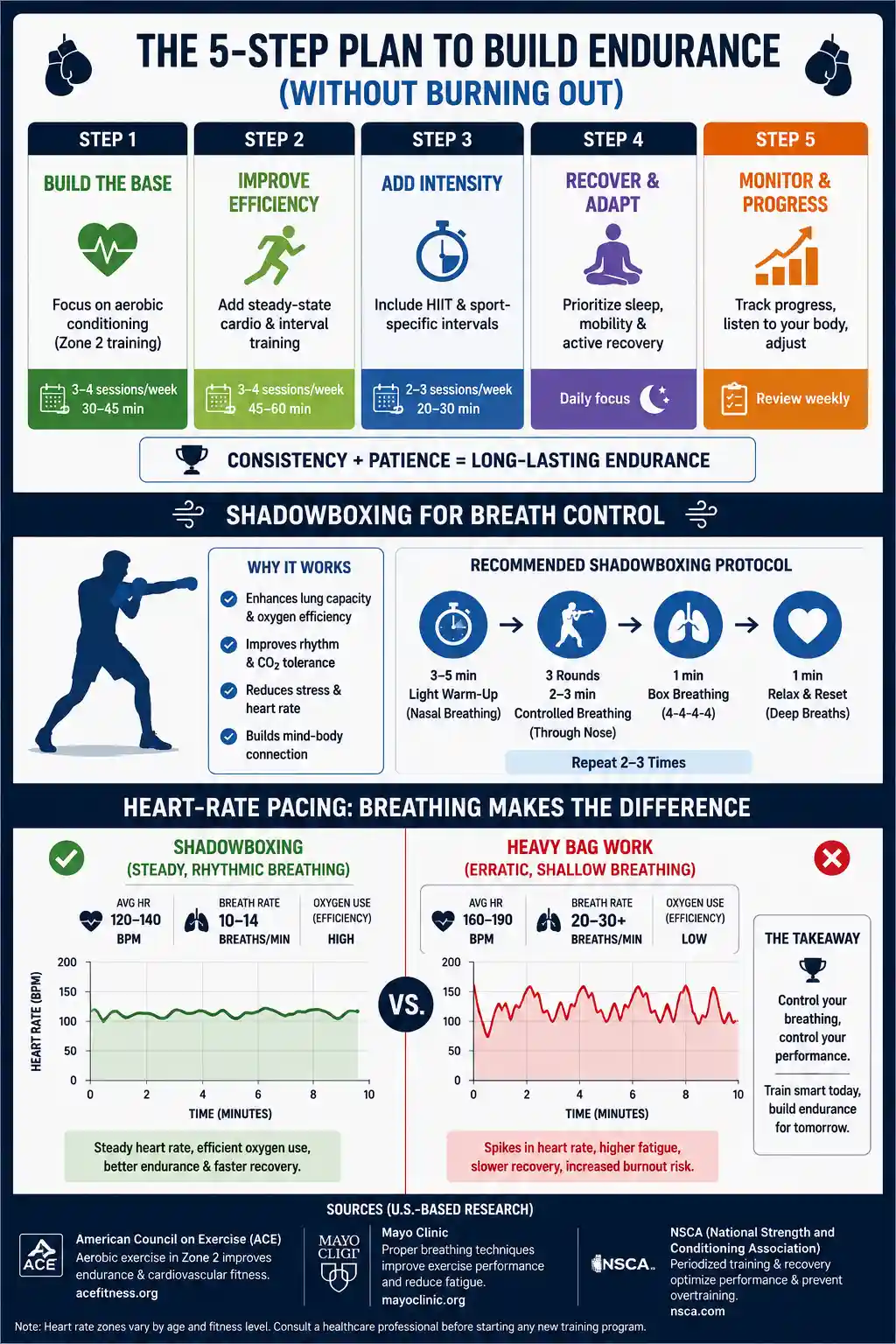
Visual Recommendation: A heart-rate pacing graphic showing steady, rhythmic breathing during shadowboxing versus erratic, shallow breathing during heavy bag work.
Step 2: Pacing the Heavy Bag (The 70% Rule)
The heavy bag is where most conditioning mistakes happen. Many beginners walk up to the bag and try to hit it as hard as possible. Throwing maximum power punches requires a massive amount of muscular tension, which drains energy rapidly.
To build endurance, try to spend the majority of your bag work at about 70% power. Focus on snapping the punches, keeping your hands up, and moving your feet around the bag. You can usually spot exhaustion in the footwork before punches slow down. If your feet are planted firmly and you are just leaning into the bag, you are likely working too hard and burning out your shoulders.
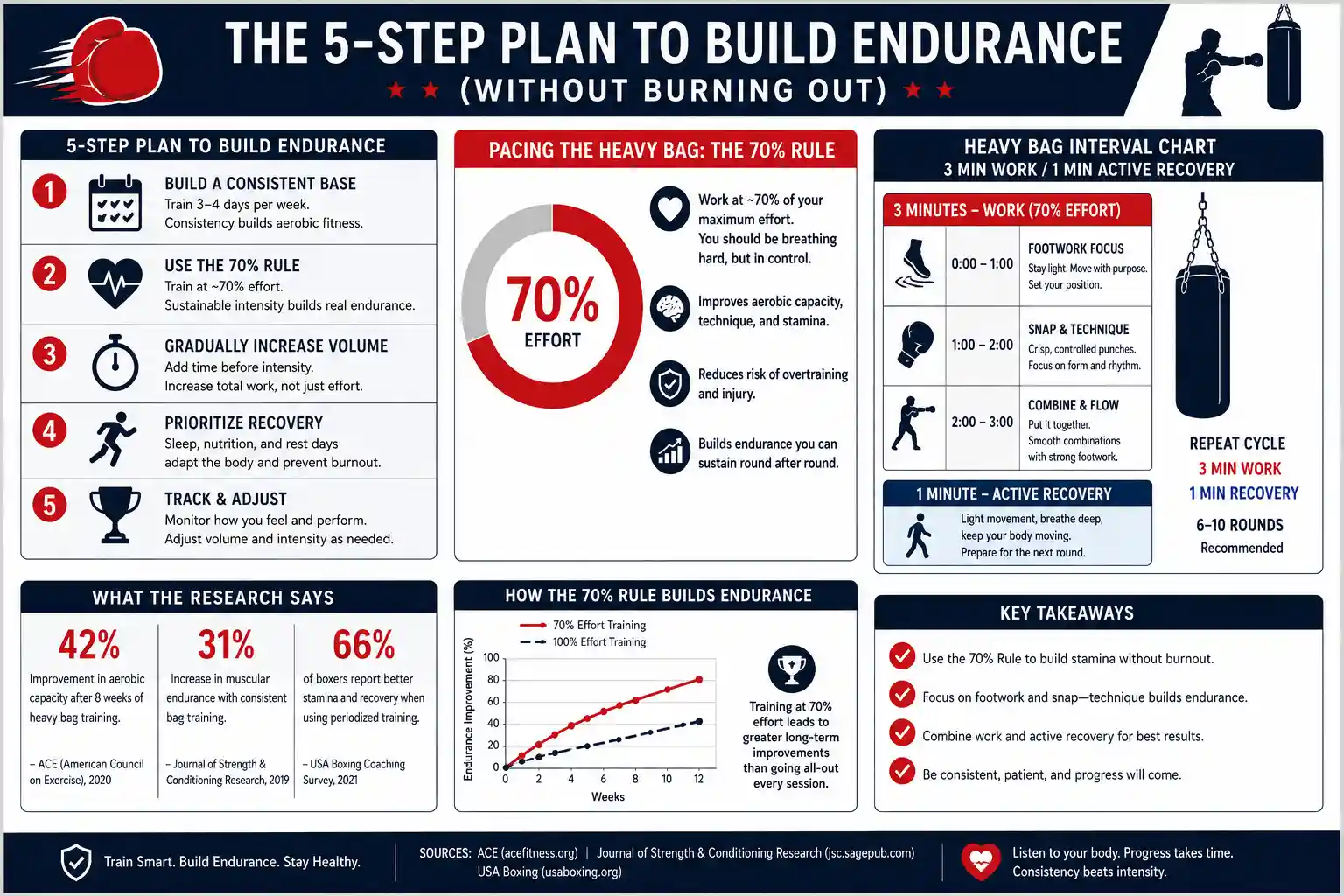
Visual Recommendation: A heavy bag interval chart showing 3 minutes of work at 70% effort, emphasizing footwork and snap, followed by 1 minute of active recovery.
Step 3: Jump Rope as a Metronome
Jumping rope is a staple in boxing gyms, but it often causes frustration for beginners. The goal isn’t to do double-unders or jump as fast as possible. The goal is to establish a baseline rhythm.
When you jump rope, try to stay relaxed. Keep your elbows tucked near your ribs and use your wrists to turn the rope. If you find yourself constantly tripping and getting frustrated, your heart rate is spiking from stress, not conditioning. It is often better to just do a basic two-foot bounce, or even step side-to-side over the rope if the timing is too difficult at first. The point is to keep moving lightly on your toes for three minutes, not to set speed records.
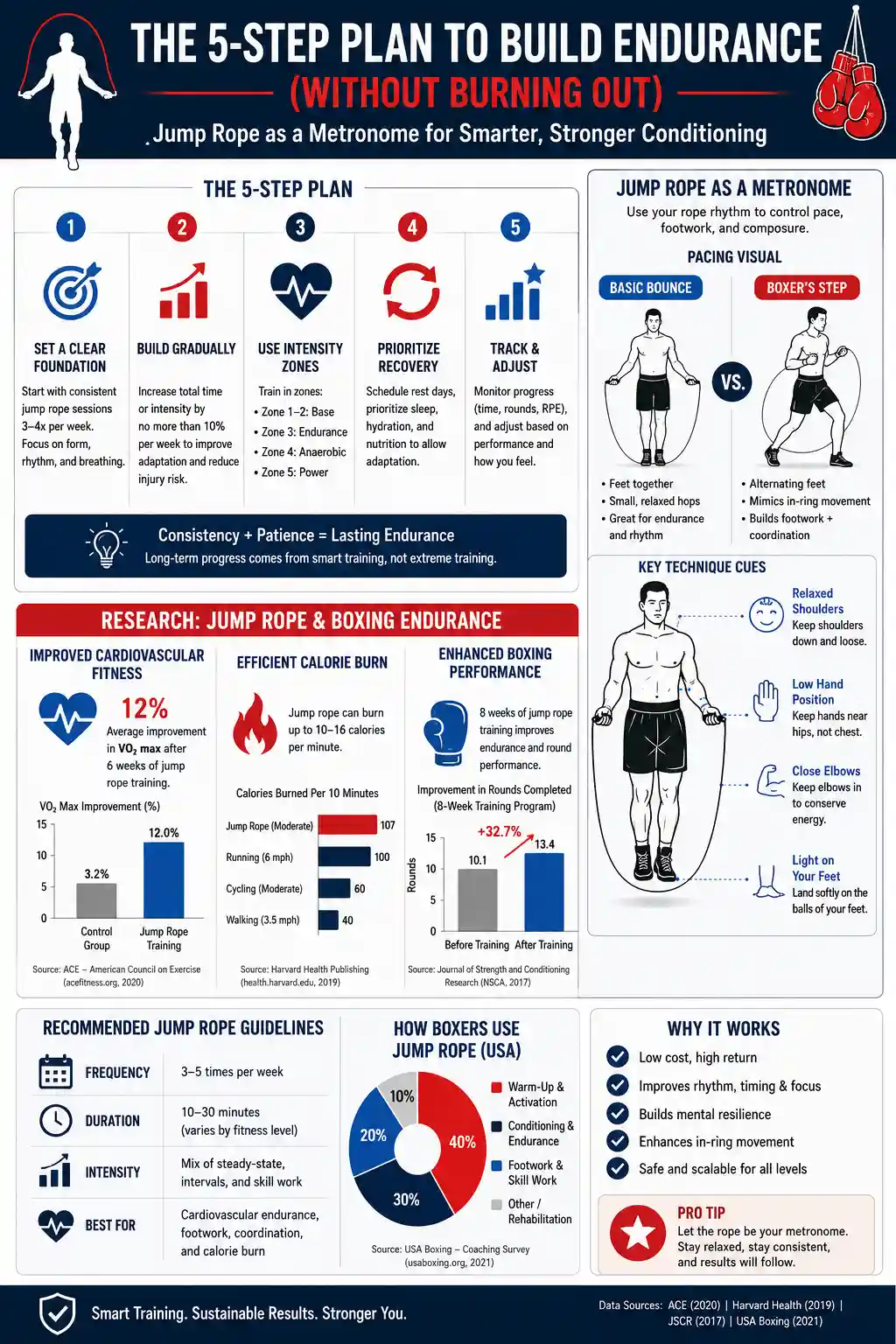
Visual Recommendation: A jump rope pacing visual demonstrating the basic bounce versus the boxer’s step, highlighting relaxed shoulders and low hand positioning.
Step 4: Active Rest Periods
What you do when the bell rings is just as important as what you do during the round. In a boxing gym, you will often see beginners immediately drop their hands, lean heavily against the heavy bag, or sit on a bench as soon as the round ends.
While resting is necessary, completely stopping your movement can make your legs feel heavy when the next round starts. During your 60-second rest period, try to keep walking around slowly. Shake out your arms to release tension in your shoulders. Take deep breaths in through your nose and out through your mouth. This active recovery helps clear fatigue and prepares your body for the next interval.
Step 5: Structuring the Week
Doing intense bag work every single day is a fast track to overtraining. Your muscles and central nervous system need time to adapt to the new physical demands. A practical weekly structure balances hard conditioning days with lighter, technique-focused days.
| Day | Focus | Intensity Level |
|---|---|---|
| Monday | Heavy Bag Intervals (3 min work / 1 min rest) | Moderate-High |
| Tuesday | Shadowboxing & Footwork Drills | Low-Moderate |
| Wednesday | Active Recovery (Light walk, stretching) | Very Low |
| Thursday | Jump Rope & Defensive Drills | Moderate |
| Friday | Heavy Bag (Focus on combinations, not power) | Moderate |
| Weekend | Rest or light recreational activity | Low |
This kind of schedule allows you to build work capacity without accumulating excessive joint fatigue. Long periods of poor recovery can make training harder and slow progress significantly.
Common Conditioning Mistakes Beginners Make
Even with a good plan, certain physical habits can drain your energy faster than you might expect. These are a few common issues often spotted in beginner boxing gyms.
Tensing the Shoulders
Many beginners tense their shoulders too early and burn energy fast. When people feel nervous or tired, they naturally shrug their shoulders up toward their ears. Keeping your hands up to protect your face is important, but you can do this without locking your shoulder muscles in a constant state of contraction. Periodically drop your hands slightly during shadowboxing to consciously relax the trapezius muscles.
The Death Grip
It is very common to squeeze your fists tightly inside the gloves from the moment you wrap your hands. This creates tension all the way up the forearm and into the bicep. Try to keep your hands relatively relaxed, only clenching your fist tightly at the very last fraction of a second when the punch makes contact with the bag or mitts.
Stopping the Feet
When the punches start flying, the feet often stop moving. Throwing a combination while standing completely flat-footed requires your upper body to do all the work, which is exhausting. Maintaining a slight bounce or shifting your weight from foot to foot helps distribute the physical effort across your entire body.
Recognizing Overtraining vs. Normal Fatigue
It can be difficult to tell the difference between being tired from a good workout and pushing your body into a state of overtraining. Since boxing involves a lot of repetitive impact on the wrists, elbows, and shoulders, paying attention to joint health is important.
Normal Fatigue Usually Looks Like:
- Muscle soreness that peaks a day or two after a heavy bag session.
- Feeling tired in the evening but sleeping relatively well.
- Being slightly out of breath during the first round, but finding your rhythm by round three.
- Feeling motivated to return to the gym after a rest day.
Signs You Might Be Pushing Too Hard:
- Lingering pain in the wrists or rotator cuffs that doesn’t go away with rest.
- Disrupted sleep patterns or feeling restless at night.
- A noticeable drop in coordination, dropping your hands frequently, or missing the heavy bag entirely.
- Dreading the thought of wrapping your hands and going to the gym.
If you notice these signs, taking a few extra days off or switching to purely defensive shadowboxing can help reset your system.
Recovery and Equipment Essentials
Conditioning isn’t just about what you do during the workout; it is also about the tools you use to protect your body while you build endurance.
Hand Wraps and Gloves
Wrist fatigue can ruin a conditioning session. If your wrists are weak or poorly supported, your forearms will overcompensate and tire out quickly. Taking the time to learn a proper hand wrapping technique provides a stable base, allowing you to hit the bag with confidence without exhausting your grip and forearm muscles just to keep your wrist straight.
Footwear
Running shoes are designed for forward motion and often have thick, cushioned heels. Boxing requires lateral movement, pivoting, and staying on the balls of your feet. Wearing thick running shoes on a gym mat can make footwork feel clumsy and tiresome. Many people find that flat-soled boxing shoes, or even minimalist training shoes, make moving around the bag feel significantly lighter and less exhausting.
Hydration
Boxing gyms can get very warm, and wearing layers of clothing plus 16oz gloves causes heavy sweating. Dehydration thickens the blood slightly, making the heart work harder to pump oxygen to tired muscles. Sipping water consistently throughout the day, rather than chugging it right before the round timer starts, generally helps maintain steady energy levels.
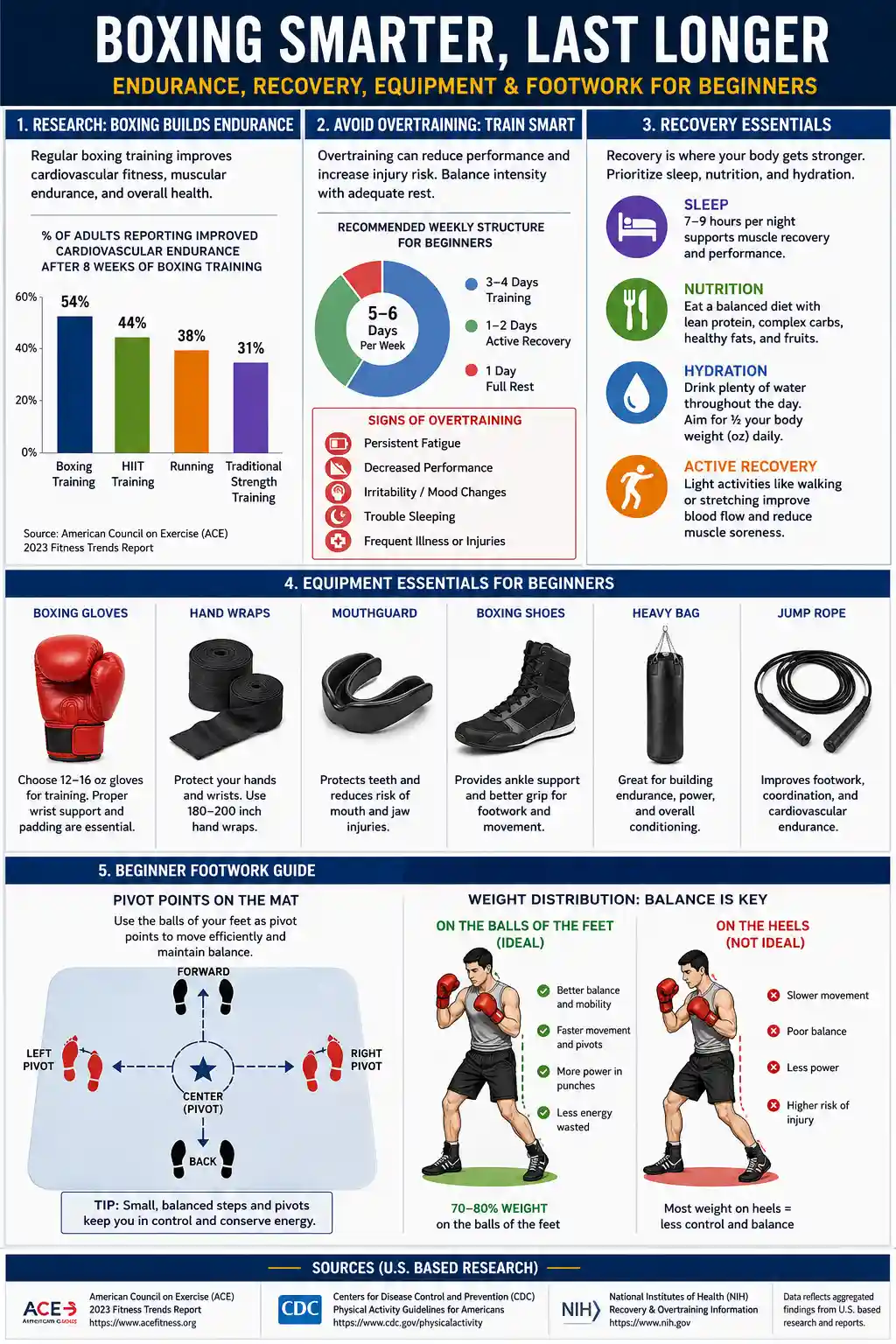
Visual Recommendation: A beginner footwork diagram showing the pivot points on the mat and the correct weight distribution on the balls of the feet versus the heels.
Safety and Listening to Your Body
Because boxing conditioning involves repetitive motions, minor aches can turn into frustrating injuries if ignored. It is important to differentiate between the burn of tired muscles and the sharp pain of a strained joint.
Shoulder impingements and elbow tendonitis are frequent complaints among people who spend hours hitting the heavy bag with poor form. If your elbow starts to ache on the inside or outside joint, it might mean you are throwing hook punches with your arm too extended, or you are hyperextending your elbows when you miss the bag.
USA Boxing recommends beginners prioritize defensive fundamentals and proper technique before engaging in intense sparring. The same logic applies to conditioning. Taking a few weeks to just focus on light shadowboxing and perfect form will build a much stronger foundation for endurance than trying to force your way through heavy bag intervals with sloppy mechanics.
Frequently Asked Questions
Why do my shoulders burn after just one minute on the heavy bag?
This is incredibly common. Most beginners are surprised by how exhausting even short heavy bag rounds feel. The burning is usually caused by keeping the arms elevated and the shoulder muscles tensed for three straight minutes. As your body adapts to keeping the hands up, and as you learn to relax your shoulders between punches, this specific type of fatigue usually decreases.
Is it normal to feel completely out of breath while shadowboxing with no weights?
Yes. Shadowboxing requires constant movement, balancing, and rapid changes of direction, all while remembering to breathe out on every punch. When beginners hold their breath while trying to remember a combination, oxygen levels drop quickly. Focusing on the audible exhale helps regulate this.
How many days a week should a beginner do boxing conditioning?
For many people, three to four days a week is a realistic starting point. This provides enough stimulus to build work capacity but leaves adequate time for the joints and muscles to recover. Doing intense conditioning every day often leads to burnout or wrist strain.
Should I do strength training or boxing conditioning first?
This often depends on the primary goal for the day. If the focus is on learning new boxing techniques or building ring endurance, it is usually better to do conditioning while fresh. Trying to learn complex footwork patterns or practice timing on the heavy bag after a heavy weightlifting session can lead to sloppy form and a higher risk of tripping or straining a muscle.
Does running help with boxing endurance?
Roadwork (running) has a long history in boxing, and it does build a strong aerobic base. However, long, slow distance running doesn’t perfectly mimic the stop-and-go nature of a boxing match. Many modern programs incorporate interval running or sprints alongside steady jogging to better match the demands of the ring. Both can be useful, but neither replaces the specific endurance built by actually spending time on the heavy bag and moving around the mat.
About the Author
Neil Stephens is a National Academy of Sports Medicine (NASM) Certified Personal Trainer and a Certified USA Boxing Coach based in Los Angeles. With hands-on experience in boxing training, conditioning, and athletic performance, he focuses on helping readers understand practical boxing techniques, fitness strategies, and combat sports conditioning.
Neil is the author of Boxinges, also known as “Boxinges USA,” where he shares expert-backed content about boxing training, workouts, recovery, and sports performance. His content is built around accuracy, real-world coaching knowledge, and athlete-focused guidance to support beginners and experienced fighters alike.
Final Thoughts
Building boxing endurance is rarely about finding a secret, grueling workout routine. It is usually about managing your energy, remembering to breathe, and showing up consistently without breaking your body in the process.
When you step up to the heavy bag next time, try dropping your power output slightly. Focus on your footwork, listen for the sound of your exhale on every jab, and use your rest periods to actually recover rather than just collapsing. Over a few weeks, those small adjustments generally add up, making the three-minute bell sound a lot less intimidating.