How Many Calories Does Shadow Boxing Burn in 30 Minutes? (A Practical Guide)
People always ask about calorie burn when they start boxing. It is a fair question. You see people in the gym sweating through their shirts, moving constantly, and assume the energy output must be massive. Shadow boxing looks simple enough. You are just throwing punches at the air. But as anyone who has tried it for more than a few minutes knows, it is surprisingly deceptive.
Quick Answer: Shadow Boxing Calorie Burn
In a 30-minute session, shadow boxing generally burns between 200 and 350 calories for most people.
- Focus: Full-body pacing, coordination, and aerobic conditioning.
- Beginner Difficulty: Moderate physically, but mentally taxing due to coordination demands.
- Conditioning Challenge: Managing shoulder tension and remembering to breathe through combinations.
- Recovery Importance: High. Beginners often carry tension into their rest periods, preventing heart rate recovery.
- Realistic Timeline: Expect to feel winded within the first three minutes as your body adapts to the stop-and-go rhythm.
This article is for educational boxing and fitness information only and should not replace professional coaching, medical advice, or supervised combat sports training.
The Real Numbers: Tracking the Burn
If you look at standard fitness charts, organizations like the American College of Sports Medicine (ACSM) and Harvard Health generally estimate that vigorous boxing training burns roughly 300 to 400 calories per half hour for an average-sized adult. But there is a catch. Those estimates usually assume you are working at a high, sustained intensity—often hitting a heavy bag or doing intense pad work with a coach.
Shadow boxing is slightly different. Because you are not meeting physical resistance (like the heavy impact of a bag), the pure mechanical work is a bit lower. A realistic estimate for 30 minutes of active shadow boxing is closer to 200 to 300 calories.
However, the math on a piece of paper rarely matches what happens on the gym floor. Many beginners are surprised by how quickly boxing conditioning becomes exhausting, even without hitting anything. The calorie burn in shadow boxing actually comes from three hidden sources:
- Constant Micro-Movements: You are never truly standing still. Even when resting your hands, you should be shifting weight, bouncing slightly, or pivoting.
- Core Engagement: Throwing a proper punch requires twisting the torso and stabilizing the hips, which uses significantly more energy than just moving the arms.
- Inefficiency: Beginners waste a massive amount of energy. We will get into this more later, but doing something poorly actually burns more calories than doing it efficiently.
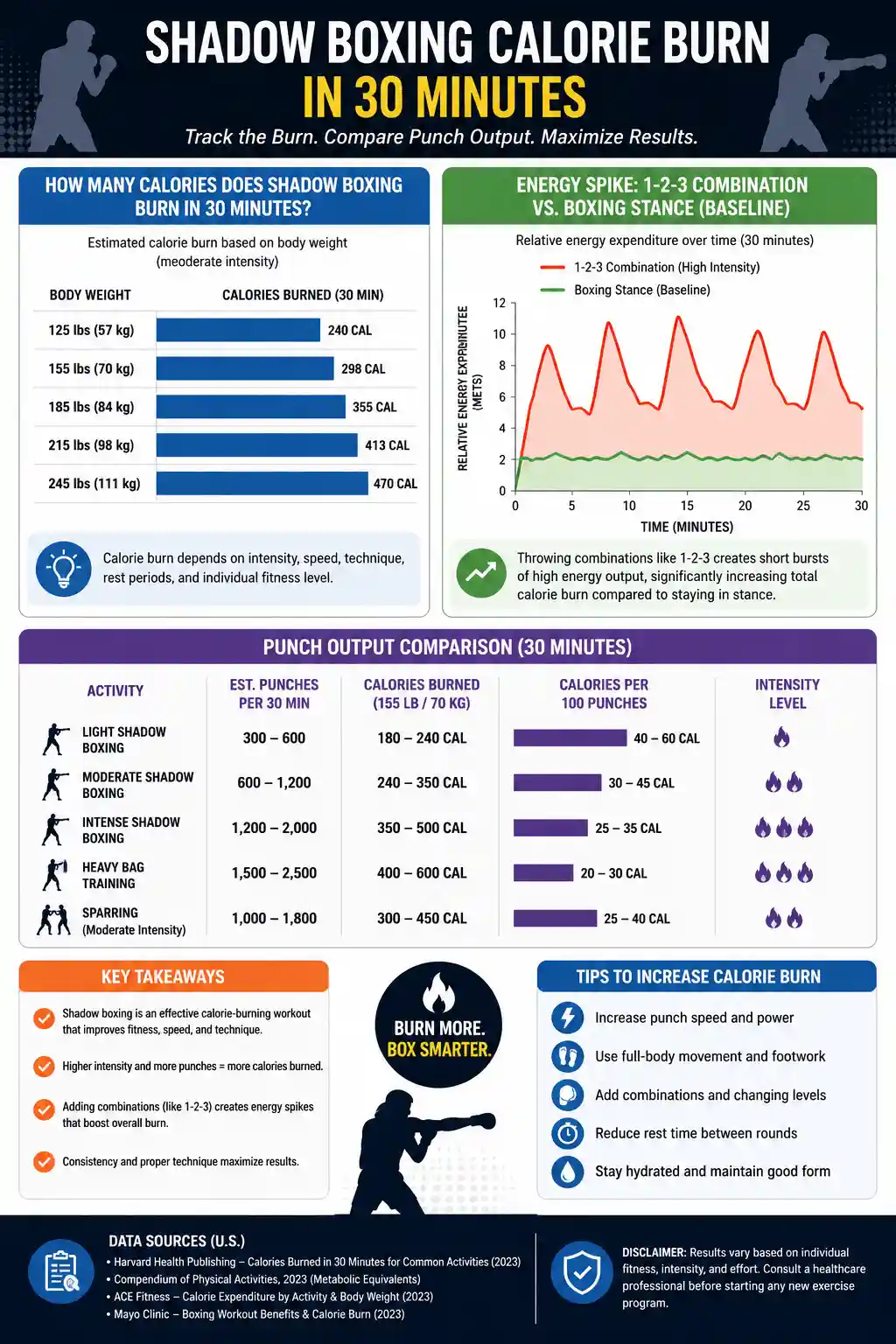
One major issue with tracking this activity is smartwatches. Fitness trackers often overestimate calorie burn during shadow boxing. They measure heart rate spikes. When a beginner forgets to breathe and tenses their shoulders, their heart rate spikes from the physiological stress and mild panic of poor breathing, not necessarily from a massive output of physical work. The watch thinks you are running a sprint, but you are just standing there holding your breath.
Why Beginners Burn Calories Differently
There is a strange paradox in combat sports conditioning. A professional boxer can shadow box for six rounds and look like they are barely working. Their heart rate stays relatively low because their movement is entirely efficient. They only use the exact muscles needed for the punch.
Beginners, on the other hand, often look like they are fighting for their lives after ninety seconds.
This happens because of tension. Many beginners tense their shoulders too early and burn energy fast. When you throw a jab, your shoulder muscle flexes. But beginners often keep their shoulders flexed the entire time their hands are up by their face. This constant isometric hold exhausts the trapezius and deltoid muscles very quickly.
You can usually spot exhaustion in the footwork before punches slow down. After two minutes of shadow boxing, a beginner’s feet will often start to cross, or they will stand flat-footed, losing the slight bounce in their step. The legs are the largest muscles in the body. When the legs get tired from supporting a tense, poorly balanced upper body, the overall calorie burn increases simply because the body is struggling to maintain basic posture.
Additionally, pacing is rarely natural at first. Most beginners throw hard for thirty seconds and completely lose rhythm. They throw a six-punch combination with maximum effort, realize they are out of breath, and then spend the next forty seconds of the round just walking around the mat catching their breath. This stop-and-go pattern is actually quite taxing on the cardiovascular system, mimicking interval training, but it limits the total continuous calorie burn.
Workout Structure: A Realistic 30-Minute Session
If you want to burn calories effectively and actually improve your conditioning, you cannot just throw random punches at a mirror for half an hour. You will just get frustrated and tired. In many beginner boxing gyms, coaches often notice that unstructured shadow boxing leads to bad habits and quick burnout.
A standard boxing round is three minutes of work, followed by one minute of rest. A 30-minute session usually consists of six to eight rounds, depending on how long your warm-up is.
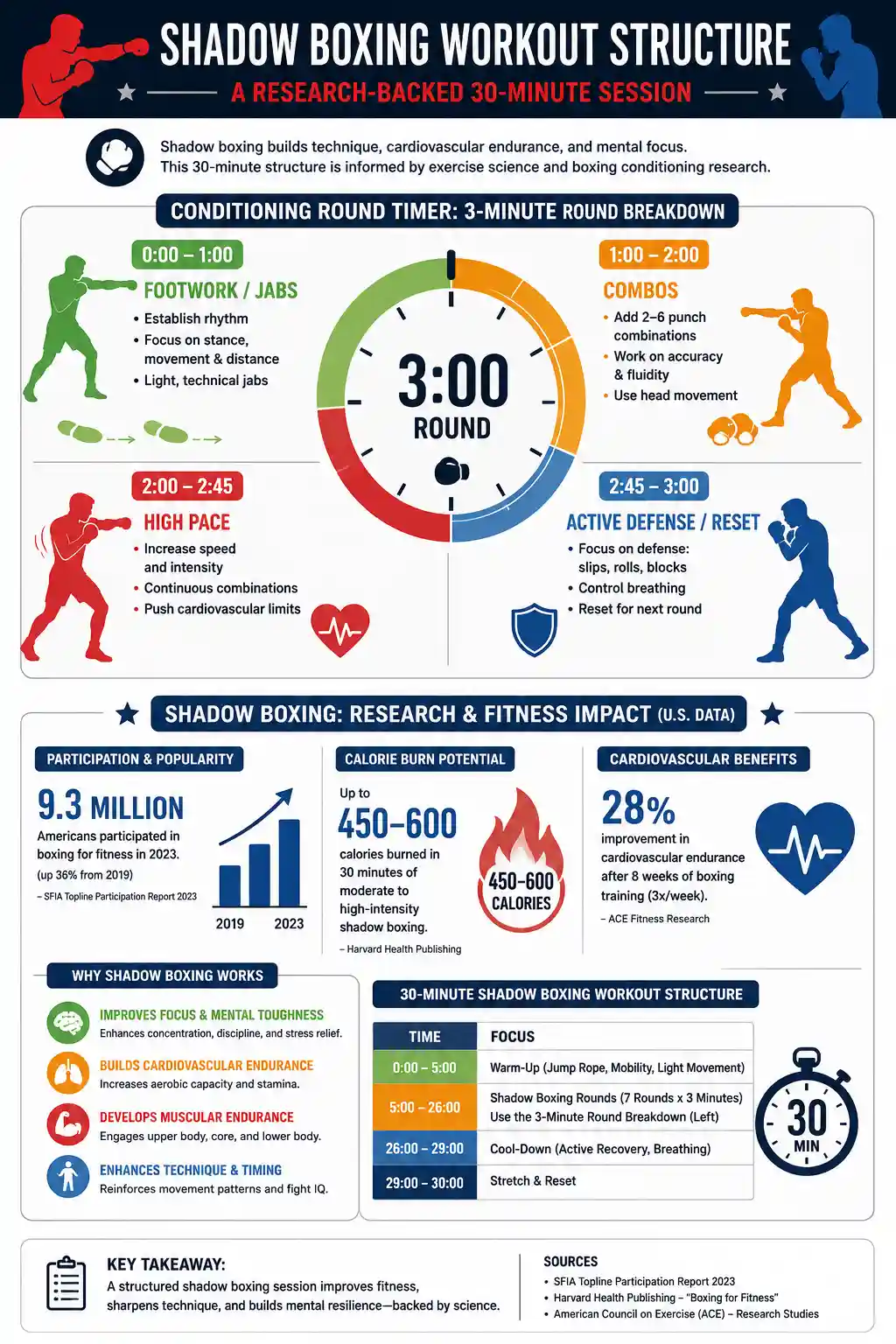
Here is a practical, structured 30-minute shadow boxing workout designed to keep the heart rate up without causing complete system failure in the first round.
Round 1: Footwork and Stance (No Punches)
Do not throw a single punch. Just stay in your stance. Move forward, backward, left, and right. Focus on not crossing your feet. The goal here is to get the blood flowing to the legs and establish your balance. If you cannot move smoothly without punching, you will not move smoothly when you add the arms.
Round 2: The Jab and Step
Add only the lead hand (the jab). Step forward with a jab, step back with a jab. Move laterally and jab. Keep the rear hand glued to your chin. This round builds shoulder endurance and teaches you to coordinate your feet with your hands.
Round 3: Basic 1-2 Combinations
Now add the cross (the 1-2). Focus on exhaling sharply on every single punch. The breathing is what will sustain your calorie burn and keep you from gassing out. Move around the space, throw the 1-2, and immediately change your angle.
Round 4: Defense and Counters
Shadow boxing is not just about offense. Spend this round slipping, rolling, and pulling back. Imagine punches coming at you. Slip left, throw a hook. Roll under, throw an uppercut. Defensive moves require deep knee bends and core twists, which heavily engage the lower body and spike the heart rate.
Round 5: Freestyle (Low Intensity)
Put it all together, but keep the speed at about 40%. Focus on fluid movement. Do not try to be fast. Try to be smooth. This is an active recovery round that keeps the body warm and continues burning calories without overwhelming your breathing.
Round 6: Pace Changes (Intervals)
This is where the real conditioning happens. Move at a normal pace for 20 seconds. When you hear the 20-second mark (or count in your head), explode into maximum speed straight punches for 10 seconds. Then return to normal pace. Do this four or five times in the round. This mimics the pacing of a real boxing match and is highly effective for cardiovascular conditioning.
Round 7: The “Burnout” Round
Keep your feet planted in a wide, stable base. Throw non-stop, light, fast, straight punches (shoe-shines) while bending your knees and shifting your weight from leg to leg. This is purely for muscular endurance and emptying the tank.
Round 8: Cool Down and Visualization
Slow everything down. Deep breathing. Visualize an opponent, but move in slow motion. Focus on perfect technique, full extension, and complete rotation of the hips.
Common Conditioning Mistakes
Even with a good structure, beginners run into several common conditioning traps that make shadow boxing feel much harder than it needs to be. Recognizing these can make your 30 minutes significantly more productive.
1. Holding the Breath During Combinations
People usually forget to breathe properly once the combination speeds up. You will often see a beginner throw a four-punch combo while completely holding their breath, only to gasp for air the second they stop. This spikes blood pressure and causes immediate fatigue. Every punch should have a corresponding short, sharp exhale. If you are throwing four punches, you should hear four distinct breaths.
2. Locking the Elbows
Many beginners throw punches and lock their elbow joints out at full extension. This does two things. First, it is terrible for the joint health of the elbow. Second, it requires extra muscular effort to violently stop the arm at the end of the extension. Leave a tiny micro-bend in the elbow at the end of a punch. It saves energy and protects the joint.
3. Over-Rotating the Hips
Coaches always teach that power comes from the hips. But beginners often take this too far, violently twisting their lower back and hips on every single jab. A jab is a fast, snapping punch. It requires a quick, subtle shift of weight, not a massive, exhausting rotation. Over-rotating throws you off balance, meaning you have to spend extra energy just getting back into your stance.
4. Dropping the Hands When Tired
As the shoulders burn, the hands slowly drift down from the chin to the chest, and eventually to the waist. This is a natural reaction to fatigue, but it breaks the kinetic chain. When your hands drop, you have to work twice as hard to bring them back up to defend or attack. Keeping the hands up, even when exhausted, is half the battle of boxing endurance.
Recovery and Pacing Between Rounds
What you do in the 60 seconds between rounds dictates how well you will perform in the next one. Long periods of poor recovery can make training harder and slow progress.
In many commercial gyms, beginners will finish a three-minute round, immediately collapse onto a bench, pull out their phone, and sit completely still. This is a mistake for conditioning. When you sit down immediately after high-intensity movement, blood can pool in the legs, making you feel dizzy and heavy when the next round starts.
Instead, practice active recovery.
Keep moving: Walk slowly around the gym floor. Shake out the arms and shoulders to release tension.
Nasal breathing: Try to breathe in through the nose and out through the mouth. This helps regulate the heart rate faster than shallow mouth-breathing.
Mental reset: Do not think about how tired you are. Think about one specific technical goal for the next round, like “keep my rear heel off the ground” or “exhale on the cross.”
Coordination and reaction speed usually decline once fatigue builds. If you do not use the rest period to actively lower your heart rate and clear your head, the next round will just be sloppy, uncoordinated movement rather than useful conditioning.
Equipment and Environment
One of the best things about shadow boxing is the lack of required gear. However, the environment and the footwear you choose can drastically change the physical demand of the workout.
The Mirror
Shadow boxing in front of a mirror is incredibly useful for beginners. It provides immediate visual feedback. You can see if your chin is exposed when you throw a hook, or if you are dropping your lead hand when you jab. However, it can also be distracting. It is often helpful to spend half the session facing the mirror for technique, and the other half facing away from it to focus purely on the physical feeling and spatial awareness.
Footwear Choices
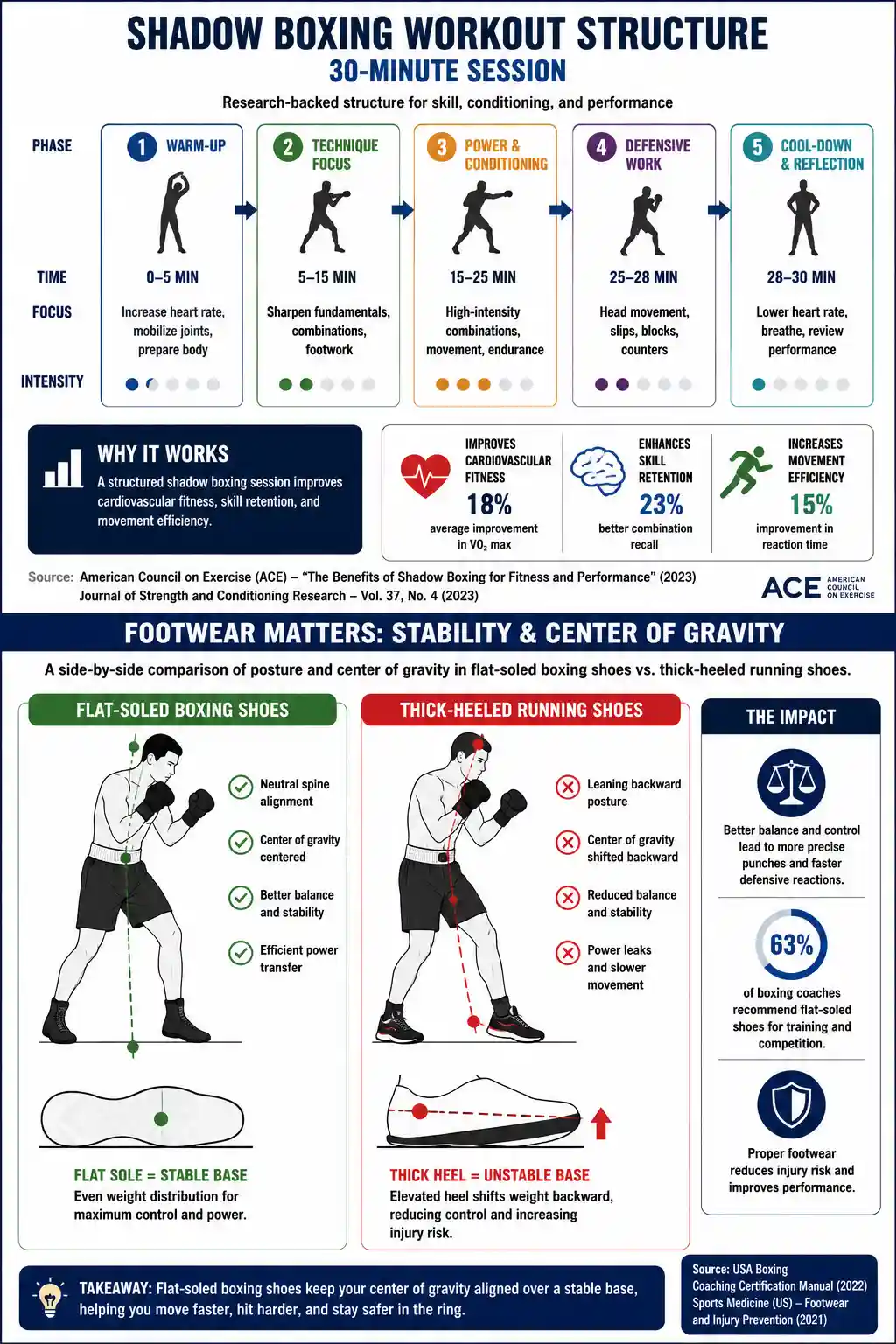
This is a surprisingly common issue. Many people show up to boxing fitness classes wearing thick, heavily cushioned running shoes. Running shoes are designed to propel you forward in a straight line. They have thick heels that elevate your foot.
In boxing, you need to move laterally, pivot, and stay balanced on the balls of your feet. A thick running shoe makes you unstable. It forces your ankles to work much harder to maintain balance, which leads to premature calf and ankle fatigue. If you do not have actual boxing shoes, flat-soled shoes (like wrestling shoes, minimalist training shoes, or even classic canvas sneakers) are generally much better for boxing movement. Some people prefer to shadow box barefoot or in socks on a mat, which is excellent for strengthening the small stabilizing muscles in the feet and ankles.
Safety and Joint Health
While shadow boxing is a low-impact exercise compared to hitting a heavy bag or sparring, it is not entirely risk-free. The repetitive nature of throwing thousands of punches into the air can lead to joint strain if mechanics are ignored.
The most common issue is elbow hyperextension. As mentioned earlier, snapping the arm completely straight with force transfers the shock directly into the elbow joint. Over a 30-minute session, doing this hundreds of times can lead to soreness or inflammation. Focus on the speed of the retraction (pulling the hand back to the face) rather than the violent extension of the punch.
Shoulder health is also a factor. Boxing requires the arms to be elevated for long periods. This can cause impingement or rotator cuff irritation if the shoulder blades are not moving properly. Ensure you are not just hunching your shoulders up to your ears. The posture should be upright, with the chest relatively open and the shoulders packed down slightly, even while the hands are high.
Wrist alignment is critical. Even though you are not hitting anything, the wrist should be kept perfectly straight upon the “impact” point of the shadow punch. Bending the wrist backward or sideways while throwing a hard shadow punch trains the neuromuscular system to accept poor alignment, which can lead to injury later when you actually hit a heavy bag.
Frequently Asked Questions
Will shadow boxing for 30 minutes build muscle?
Generally, no. Shadow boxing is primarily a cardiovascular and muscular endurance exercise. It will tone the muscles and improve definition over time as you lose fat, but it does not provide the progressive overload or mechanical tension required to build significant muscle mass. If your goal is hypertrophy, you need to lift weights. If your goal is conditioning and calorie burn, shadow boxing is excellent.
Should I hold light dumbbells while shadow boxing?
Many combat sports conditioning programs advise against this for beginners. Holding 1kg or 2kg dumbbells alters the mechanics of the punch. It places unnatural leverage and stress on the elbow and shoulder joints during high-speed extensions. It also trains you to “push” the punch rather than “snap” it. It is usually safer and more effective to just shadow box faster, or use light resistance bands, which provide tension that scales with your extension.
Why am I so tired after just 3 minutes of shadow boxing?
Most beginners are surprised by how exhausting even short heavy bag rounds feel, and shadow boxing can be just as tiring. This is almost always due to inefficiency. You are likely holding tension in your neck and shoulders, forgetting to breathe rhythmically, and using unnecessary muscle groups to maintain your balance. As you practice and your technique improves, the same three minutes will feel significantly easier.
Does shadow boxing burn more calories than running?
It depends entirely on the intensity. A steady, moderate jog for 30 minutes will generally burn a very consistent, predictable amount of calories. Shadow boxing is more erratic. If you are just going through the motions, it burns fewer calories than running. But if you are doing high-intensity interval shadow boxing (like the pace changes in Round 6 above), incorporating deep squats, pivots, and explosive movements, the calorie burn and the “afterburn” effect can rival or exceed a standard run.
How often should I shadow box to see conditioning improvements?
For beginners, two to three times a week is a realistic timeline for building fight endurance. The central nervous system and the specific stabilizing muscles need time to adapt to the unusual movements. Doing it every single day often leads to sloppy technique and shoulder overuse injuries. Balance it with other forms of training and adequate rest.
Is it normal for my calves to burn more than my arms?
Yes. A proper boxing stance requires you to stay slightly on the balls of your feet, keeping the calves engaged constantly to allow for quick movement and pivoting. If your calves are burning, it usually means your footwork is active, and you are staying off your heels, which is a good thing for your boxing mechanics.
About the Author
Neil Stephens is a National Academy of Sports Medicine (NASM) Certified Personal Trainer and a Certified USA Boxing Coach based in Los Angeles. With hands-on experience in boxing training, conditioning, and athletic performance, he focuses on helping readers understand practical boxing techniques, fitness strategies, and combat sports conditioning.
Neil is the author of Boxinges, also known as “Boxinges USA,” where he shares expert-backed content about boxing training, workouts, recovery, and sports performance. His content is built around accuracy, real-world coaching knowledge, and athlete-focused guidance to support beginners and experienced fighters alike.
Final Thoughts
Shadow boxing is the foundation of boxing conditioning. It is where you build the rhythm, the balance, and the breathing patterns that will sustain you when the fatigue really sets in.
While the exact number of calories burned in 30 minutes will vary based on your weight, your intensity, and your level of physical efficiency, the true value of the exercise is not just on a fitness tracker. The real benefit comes from learning how to manage your energy.
It teaches you how to relax your shoulders when everything in you wants to tense up. It teaches you how to find your breath when your heart is pounding. And it teaches you how to keep your hands up and your feet moving even when you are tired. That kind of conditioning does not just change your body; it changes how you handle physical stress entirely. Keep it practical, keep it consistent, and the endurance will follow.