Orthodox vs Southpaw: Which Boxing Style Is Better for Beginners?
You can always spot the new guys on their first day at the gym. They get their hands wrapped, step up to the heavy bag, look down at their feet, and freeze. They don’t know which foot goes in front. They shift their weight, square up to the bag, throw a couple of awkward punches, and look over at the coach for help.
Choosing between an orthodox and southpaw stance is the very first decision you make in boxing. Get it right, and your balance, power, and defense will naturally fall into place over time. Get it wrong, and you will spend the next two years fighting your own body, losing your balance every time you throw a combination, and wondering why your punches feel weak.
Forget what you’ve seen in movies or what your friends told you. Here is how we actually figure out where you belong on the gym floor.
How to Actually Find Your Natural Stance
Most beginners try to choose their stance based on what looks cool or what they think will give them an advantage. But your stance isn’t a choice; it’s a reaction. It is dictated by your central nervous system and your dominant side.
If I have a new guy in the gym and he isn’t sure which way to stand, I don’t ask him what feels comfortable. Comfort is a bad metric for beginners because everything in boxing feels uncomfortable at first. Instead, I do the push test.
I stand behind them and give them a slight, unexpected shove on the back. Whichever foot they instinctively step forward with to catch their balance is their lead foot. If they step with the left foot, they are orthodox. If they step with the right foot, they are southpaw.
Another easy test is the soccer ball. If you naturally kick a ball with your right foot, your left leg is your plant leg. Your plant leg is your anchor. In boxing, your anchor leg goes in the back to provide stability and power. So, right-footed kickers are usually orthodox.
When beginners guess their stance wrong, you notice it immediately. They look stiff. When they try to throw their rear hand, they pull their shoulder back first, completely telegraphing the punch. They have no hip rotation because their dominant side is trapped in the front, unable to turn over properly. Stick to your natural side.
The Orthodox Stance: What Coaches Notice
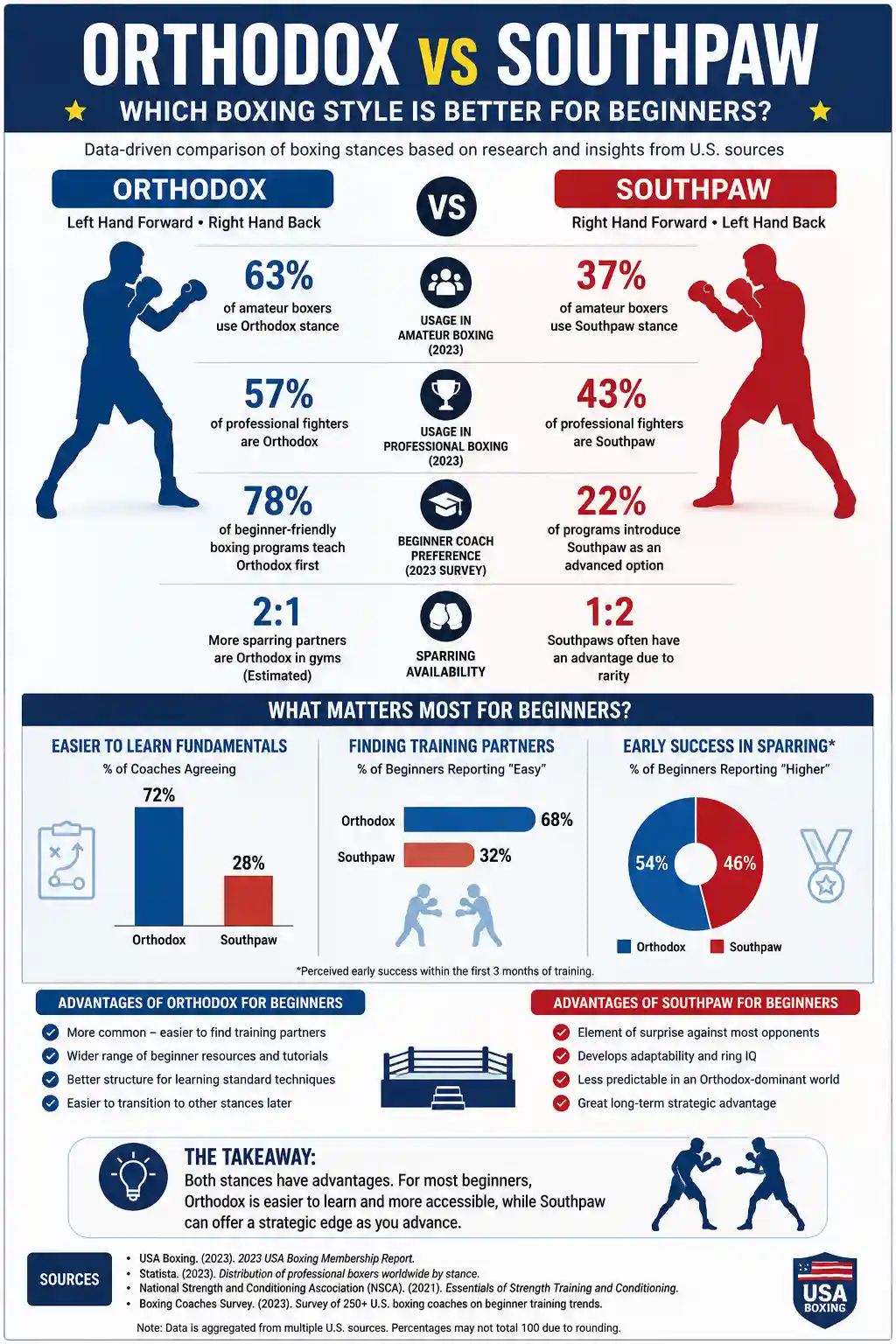
In the orthodox stance, your left foot and left hand are in front. Your right foot and right hand are in the back. This is how about 80% to 90% of the boxing world fights.
The logic is simple: your dominant right hand is further away from your target. This gives it more distance to travel, which means it has more time to build momentum and generate power. Your left hand is closer, making it perfect for the jab—a quick, snapping punch used to measure distance, blind your opponent, and set up the heavy right hand.
What happens on the heavy bag:
You can always tell a beginner’s stance when they hit the heavy bag. They start in profile. By round three, they are completely squared up to the bag, flat-footed, just brawling. When orthodox beginners get tired, they drop their right hand. You will see them throw a jab, and their right hand will drop down to their chest instead of staying glued to their cheek. The second they get tired, their defense disappears.
The elbow flare:
New orthodox fighters almost always flare their right elbow out like a chicken wing when they throw the cross. They think power comes from the arm, so they tense up and swing wide. Power comes from the floor, through the hips. If your elbow flares, you lose the kinetic chain, and your punch just becomes a push.
The Southpaw Stance: The “Awkward” Advantage
In the southpaw stance, your right foot and right hand are in front. Your left foot and left hand are in the back. This is the natural stance for left-handed fighters.
People talk about the “southpaw advantage” like it’s magic. It’s not magic. It’s just a matter of familiarity. Because 90% of people are orthodox, orthodox fighters are used to fighting other orthodox fighters. When a righty fights a lefty, the angles are flipped. The punches come from blind spots they aren’t used to defending.
But being a southpaw comes with its own set of awkward beginner phases.
The lead shoulder burn:
Lefties almost always complain about their left shoulder burning after a few rounds on the bag. That’s because they are jabbing with their non-dominant hand. They don’t know how to snap the punch yet, so they try to muscle it using their shoulder joint instead of their hips and lats. Once they learn to relax and snap the jab, the burning stops.
The liver shot vulnerability:
Southpaws have a very specific weak spot. Because their left side is exposed, a well-placed right hook to the body from an orthodox fighter lands right on the liver. Southpaw beginners often drop their lead elbow when they punch, leaving their ribs completely wide open. If you are a lefty, you have to be paranoid about keeping that lead elbow tucked tight to your body.
Should a Righty Fight Southpaw? (The Myth)
Every few months, a right-handed beginner walks into the gym and tells me they want to fight a southpaw. They usually give me the same reason: “I want my strong hand in front so I can have a really fast, hard jab.”
They usually watched a clip of a pro doing it, or they heard about fighters who switched stances. Here is the reality of the gym floor: fighting opposite your dominant hand is a massive mistake for beginners.
Yes, having your dominant hand in front gives you a strong lead hook and a stiff jab. But it completely ruins your rear hand. Your rear hand is supposed to be your knockout punch. If you are right-handed and you fight a southpaw, your left hand is in the back. Your left hand doesn’t have the neurological connection to your hips to generate knockout power. You will end up with a decent jab, a decent lead hook, and a completely useless straight left hand.
Furthermore, beginners haven’t developed the footwork to pivot off their lead foot. If you put your dominant hand in front, you will likely just stand there and try to brawl. You need your dominant side in the back so you can learn how to sit down on your punches and rotate your hips properly. Don’t try to be a switch-hitter until you have been boxing for at least three or four years and have mastered your natural stance.
Sparring Realities and Footwork Breakdowns
Stance isn’t just about where your feet are when you stand still. It’s about how your feet interact with your opponent’s feet once the bell rings. This is where beginners completely break down.
The Open vs. Closed Stance:
When two orthodox fighters spar, they are in a “closed stance.” Their hind feet are on the same side. It’s relatively easy to manage distance, and head clashes are rare.
When an orthodox fighter meets a southpaw, they are in an “open stance.” This creates the most common beginner problem in boxing: the battle for the outside foot.
If a southpaw steps their lead right foot to the outside of the orthodox fighter’s lead left foot, the southpaw has the dominant angle. Their straight left hand has a clear path right down the pipe, while the orthodox fighter’s right hand is blocked by the southpaw’s shoulder. Beginners rarely understand this. You will see two beginners bumping helmets every ten seconds because they both try to step straight down the center line instead of stepping to the outside.
The Fatigue Factor:
People usually stop moving their feet once they get tired. When the legs get heavy, the stance gets narrower. Beginners start standing with their feet close together, like they are waiting for a bus. A narrow stance means zero balance. The first time someone throws a light jab at them when they are tired, they stumble backward. Conditioning in boxing is explosive and stop-start. If you don’t pace yourself, your stance will collapse by round two.
Common Beginner Mistakes
Regardless of whether you are orthodox or southpaw, coaches see the same bad habits repeating on the floor every single night.
Crossing the feet: When beginners try to move laterally under pressure, they cross their feet. The second your feet cross, you are off-balance. If you get pushed while your feet are crossed, you will fall over. Always step and drag. Never cross.
Staring at the floor: Beginners often stare at their own punches or look down at their opponent’s chest. You need to look at the opponent’s eyes or collarbone to see their shoulders move. You can usually tell who only trains on heavy bags because they freeze once movement starts, and they lose eye contact.
Holding the breath: Beginners often hold their breath without realizing it when they throw a combination. When they finally exhale, they drop their hands and reset. You can hear panic breathing before you see defensive mistakes. Breathe out sharply on every single punch.
Telegraphing: New boxers almost always throw harder than necessary. To get that extra power, they pull their hand back slightly before throwing the punch. A good opponent will see you load up and will counter you before your punch even leaves your shoulder.
Beginner Stance Checklist
Before you start hitting the pads or the bag, run through this quick mental checklist. If you check these boxes, your foundation is solid.
Feet shoulder-width apart: Not too wide (you won’t be able to move), not too narrow (you’ll lose your balance).
Weight distribution: Roughly 50/50 or slightly favoring the back leg (60/40). Never lean heavily on your front foot.
Knees soft: Never lock your knees. A slight bend acts as a shock absorber and helps you generate upward power.
Rear heel off the ground: Your back heel should always be slightly raised. This keeps your weight on the ball of your foot, ready to pivot or spring forward.
Chin tucked: Tuck your chin down toward your lead shoulder. Your eyes should be looking up through your eyebrows.
Hands up, elbows in: Rear hand glued to the cheekbone. Lead hand slightly forward. Elbows tucked tight to protect the ribs.
Equipment and Hand Wrapping
Your stance dictates how your body absorbs impact, which means your equipment needs to support your specific mechanics.
Hand Wrapping:
If you are a southpaw, your left hand is your money maker. It takes the brunt of the impact when you throw your power shots. Lefties need to be meticulous about wrapping their dominant hand, ensuring the wrist is heavily supported, and the knuckles are padded. A sprained wrist in your power hand will sideline you for weeks. Don’t rush the wrap just because you want to hit the bag.
Gloves:
Beginners should generally train in 16oz gloves, regardless of their stance or weight class. The extra weight slows your hands down slightly, forcing you to rely on your hips and stance for power rather than just arm speed. It also provides more padding, which is crucial when you are still learning distance management and accidentally hitting your sparring partner’s elbows or forehead.
Safety and Sparring Realities
Boxing is a contact sport, and your stance directly impacts your safety in the ring. The biggest safety issue for beginners isn’t getting knocked out; it’s the accumulation of small injuries due to bad positioning.
Head clashes are the most common cause of cuts and concussions in amateur boxing. As mentioned earlier, head clashes happen constantly when a righty and a lefty spar because they both try to step straight down the center line. If you are sparring someone in the opposite stance, you must consciously force yourself to step to the outside of their lead foot. If you end up on the inside, tie them up or pivot out immediately. Do not stay in the pocket on the inside of the foot.
Furthermore, beginners often forget that defense starts with the feet. If you are flat-footed, you cannot slip punches. USA Boxing guidelines heavily emphasize footwork and defensive movement for novices before allowing hard sparring. If you cannot move your head off the center line while maintaining your stance, you have no business sparring hard yet. Stick to the mitts and the heavy bag until your balance is automatic.
Gym-Specific FAQs
I’m left-handed, but I write and eat with my right hand. Which stance should I use?
We call this being “mixed-footed” or cross-dominant. Go back to the push test or the soccer ball test. Whichever side provides your natural balance and explosive kicking power should be your rear side. If you feel completely lost in one stance, spend three weeks doing shadowboxing in both. Your body will eventually tell you which one feels like home. Don’t force it.
Do southpaws really get hit in the liver more often?
Yes, statistically and practically. The orthodox right hook to the body travels in a direct, unobstructed line to a southpaw’s lead side. If you are a lefty, you need to drill your lead elbow tuck until it becomes a subconscious habit. Every time you throw your straight left hand, your right elbow must actively squeeze against your ribs.
How long does it take for the stance to feel natural?
Most beginners need a few months before movement starts feeling natural. The first few weeks are awkward. Your calves will ache from keeping your rear heel raised. Your lead shoulder might get tired. You will catch yourself standing square when you get tired. Just keep correcting yourself. Eventually, your muscle memory takes over, and you won’t have to think about it.
Can I switch stances later if I want to?
Yes, but not yet. Switch-hitting is a high-level skill. Pros do it to confuse opponents or to rest their lead shoulder. If you try to switch stances as a beginner, you will just be a beginner in two different stances. Master your natural side first. Once you have sharp footwork, good defense, and consistent power, you can start playing with the opposite stance on the heavy bag.
Why do my feet squeak and slide when I try to pivot?
You are likely putting too much weight on your lead foot, or you are trying to pivot on a flat foot. Pivoting requires you to shift your weight slightly, lift the heel of the pivoting foot, and turn on the ball of the foot. If you are sliding and squeaking, you are grinding your rubber sole into the canvas. Lighten up your step.
Author Bio
Neil Stephens is a National Academy of Sports Medicine (NASM) Certified Personal Trainer and a Certified USA Boxing Coach based in Los Angeles. With hands-on experience in boxing training, conditioning, and athletic performance, he focuses on helping readers understand practical boxing techniques, fitness strategies, and combat sports conditioning.
Neil is the author of Boxinges, also known as “Boxinges USA,” where he shares expert-backed content about boxing training, workouts, recovery, and sports performance. His content is built around accuracy, real-world coaching knowledge, and athlete-focused guidance to support beginners and experienced fighters alike.
Final Thoughts
Choosing between orthodox and southpaw isn’t about picking a style; it’s about accepting how your body is wired. The guys who progress the fastest in the gym are the ones who stop fighting their natural mechanics. They put their dominant hand in the back, they keep their knees bent, and they accept that the first three months are going to feel clumsy.
Don’t worry about the “southpaw advantage” or trying to mimic a world champion who fights out of an unorthodox stance. World champions have spent ten years perfecting their hip rotation and footwork. You just need to learn how to stand without crossing your feet when someone throws a jab at you.
Find your natural side, wrap your hands properly, keep your chin tucked, and spend time on the heavy bag. The power and the timing will come. Just keep your feet moving.