Deontay Wilder Knockout Record and Career Earnings and Heavyweight Run
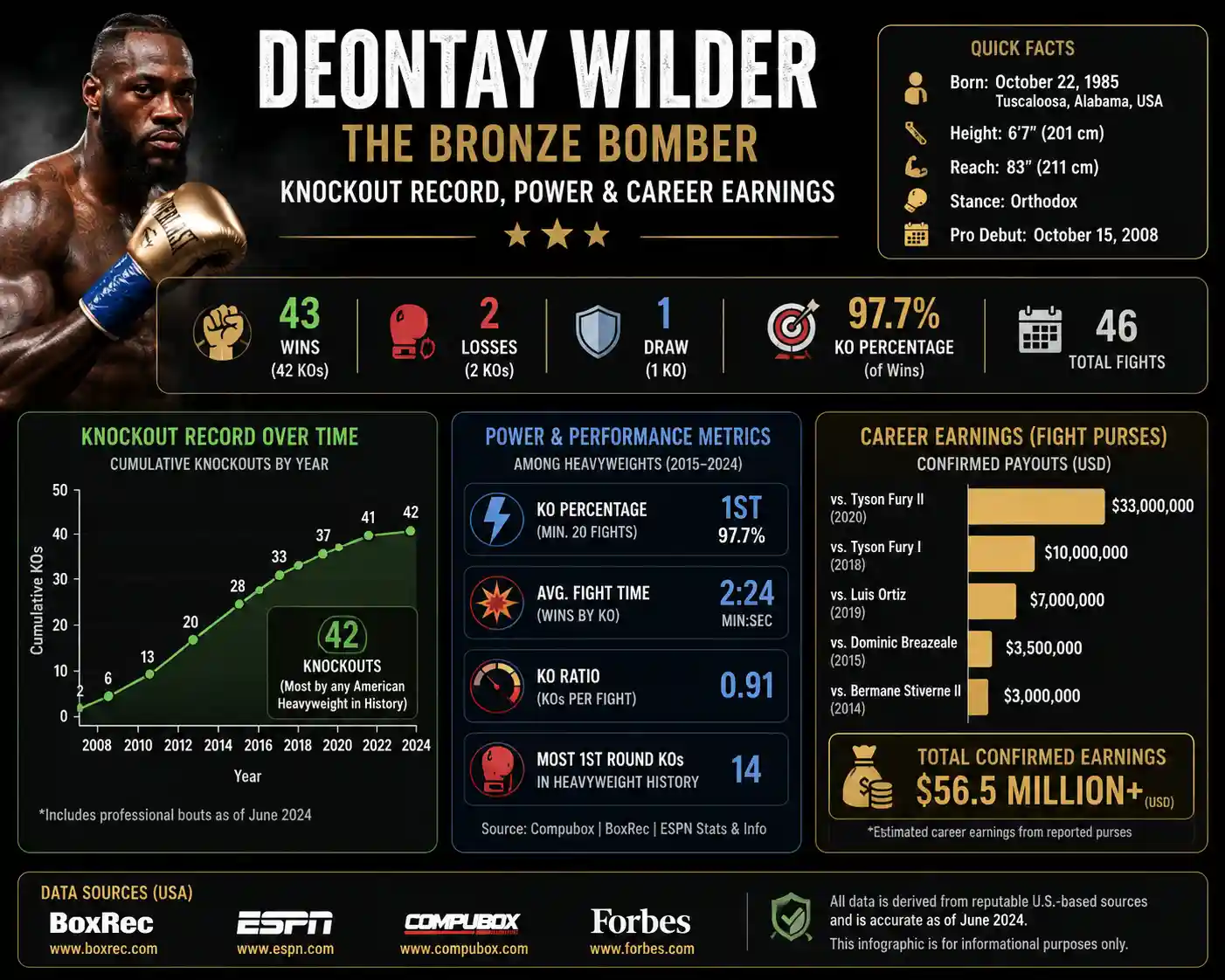
Deontay Wilder held the WBC heavyweight title for five years. His run at the top of the division was defined by a single, devastating right hand and a knockout ratio that sits near 95 percent. He didn’t always win by outboxing his opponents. He usually won by waiting for them to make a mistake, then landing one clean shot.
While his later career was marked by high-profile losses and tactical shifts, his initial run through the heavyweight division remains one of the most dominant streaks in modern boxing. This profile breaks down his fight history, his earnings, and the specific habits he showed in the ring over a 15-year professional career.
Quick Fighter Snapshot
| Category | Details |
|---|---|
| Stance | Orthodox |
| Height | 6’7” (201 cm) |
| Reach | 83” (211 cm) |
| Pro Record | 44 Wins, 4 Losses, 1 Draw |
| Knockouts | 43 |
| Titles Held | WBC Heavyweight (2015–2020) |
Editorial Disclaimer: Financial figures and career earnings discussed in this article are based on publicly reported estimates from boxing and sports-business sources. Exact contract details and net worth remain private.
Early Career and Amateur Background
Wilder started boxing relatively late. He didn’t put on gloves until he was 20 years old. Despite the late start, he moved through the amateur ranks quickly. His amateur career peaked at the 2008 Beijing Olympics, where he won a bronze medal in the 91kg (201 lbs) division. That medal earned him the nickname “The Bronze Bomber,” which he carried throughout his professional career.
He turned professional shortly after the Olympics, signing with Golden Boy Promotions before later moving to Premier Boxing Champions. His early professional run was built entirely on power. He didn’t face highly ranked contenders in his first 20 fights. Instead, he fought journeymen and prospects, stopping almost all of them in the first or second round.
BoxRec records show that it took him four years to break into the top ten rankings. He fought frequently during this period, sometimes taking fights on short notice. The goal was simply to build a record, get television time, and eventually position himself for a mandatory title shot. That shot finally came when he was matched against Bermane Stiverne in early 2015.
The Title Run and Defenses
Wilder won the WBC heavyweight title by defeating Bermane Stiverne by unanimous decision in January 2015. It was the first time he went the distance in his professional career. The fight was competitive, and Stiverne had moments of success inside, but Wilder’s activity and jab control secured the decision.
Once he won the belt, Wilder became one of the most active champions in the division. He defended the WBC title 10 times against a mix of mandatory challengers and voluntary opponents.
WBC Title Defenses (2015–2018)
| Opponent | Result | Round | Notable Details |
|---|---|---|---|
| Eric Molina | KO | 4 | Dropped Molina multiple times before the stoppage. |
| Chris Price | KO | 1 | Price fell out of the ring on the final punch. |
| Chris Arreola | RTD | 8 | Wilder tore his bicep and injured his hand during the fight. |
| Gerald Washington | KO | 5 | Washington rushed in, leaving himself open for a right hand. |
| Artur Szpilka | KO | 9 | A severe knockout that left Szpilka on the canvas for several minutes. |
| Chris Arreola | TKO | 8 | Wilder dominated the rematch, forcing a corner stoppage. |
| Bermane Stiverne | KO | 1 | Wilder knocked out Stiverne in their rematch after winning the belt from him. |
| Johann Duhaupas | KO | 11 | Duhaupas survived early rounds but was eventually worn down. |
| Dominic Breazeale | KO | 4 | Breazeale was dropped early and could not recover from the right hand. |
| Luis Ortiz | KO | 10 | Wilder was losing on the scorecards before landing a late right hand. |
During this four-year stretch, Wilder rarely lost a round on the scorecards. He controlled the distance, kept opponents at the end of his jab, and waited for them to make a mistake. When they did, he threw his right hand. The pattern repeated in almost every defense.
Style Analysis and Ring Habits
Wilder’s style in the ring was highly unorthodox for a heavyweight champion. Most champions rely on combinations, footwork, and head movement. Wilder relied almost entirely on distance management and a single power punch.
He kept his opponents at the very end of his reach. His jab wasn’t particularly heavy, and he didn’t use it to cause damage. Instead, he used it to measure distance. He would flick the jab out just to keep his opponent from stepping into range. If an opponent tried to close the distance, Wilder would tie them up or push them away.
When he threw his right hand, it usually came from a low angle. He didn’t always sit down on his punches early in the fight. He would throw the right hand almost casually to test his opponent’s guard. As the fight progressed, he started throwing it with more weight behind it.
His footwork was notably flat. He rarely pivoted or used lateral movement to create angles. Instead, he moved forward and backward in straight lines. This made him easy to track for fighters who knew how to cut off the ring. But against opponents who just walked forward in a straight line, his flat-footed stance allowed him to plant his feet and generate maximum power.
Defensively, Wilder didn’t slip punches often. He relied on his reach to stay out of range, and when he was in range, he kept his hands high or used his arms to block. He didn’t roll with punches the way some middleweights do. He either blocked them or took them on the chin. This defensive habit worked well against fighters with average power, but it became a major liability when he faced heavier hitters later in his career.
Strengths and Weaknesses
Looking at his fight history, a clear pattern of strengths and weaknesses emerges.
Strengths
One-punch knockout power: He didn’t need to land in combinations. A single clean right hand was usually enough to end the fight.
Distance control: He was excellent at keeping shorter opponents away using his 83-inch reach.
Chin and recovery: In his first fight with Luis Ortiz, Wilder was dropped and badly hurt. He managed to survive the round, recover, and win the fight later on. He also survived knockdowns against Tyson Fury.
Patience: He rarely rushed. Even when he was losing rounds on the scorecards, he didn’t abandon his game plan. He just kept waiting for the opening.
Weaknesses
Inside fighting: When opponents managed to get past his jab and tie him up on the inside, Wilder struggled to fight back. He didn’t have a strong short-range game.
Footwork and mobility: He couldn’t move well laterally. Fighters who knew how to step to the side and force him to turn had success.
Combination punching: He rarely threw more than two or three punches at a time. If his first punch missed, he usually reset rather than follow up.
Pacing: In longer fights, his output tended to drop. He threw so much energy into his right hand that he often looked fatigued in the later rounds.
Fight Statistics Breakdown
CompuBox statistics from his title defenses highlight his specific approach to fighting. The numbers show a fighter who threw fewer punches than average, but landed a higher percentage of power shots.
| Metric | Wilder Average | Heavyweight Average |
|---|---|---|
| Total Punches Thrown (Per Round) | ~35 | ~45 |
| Jabs Thrown (Per Round) | ~20 | ~25 |
| Power Punches Landed (%) | ~48% | ~35% |
| Total Punch Accuracy (%) | ~34% | ~28% |
The data shows that Wilder was not a volume puncher. He threw significantly fewer punches per round than the division average. However, when he did throw a power punch, he was highly accurate. This statistical profile perfectly matches his visual style: wait, measure, and throw with the right hand.
Career Turning Points
Several specific fights defined the trajectory of Wilder’s career, shifting him from a rising contender to a champion, and eventually exposing his limitations.
Luis Ortiz I (2018)
This fight proved Wilder could take a heavy punch. Ortiz, a highly skilled Cuban southpaw, controlled the early rounds. In the seventh round, Ortiz caught Wilder with a right hook and dropped him. Wilder looked badly hurt, but the bell rang. In the tenth round, Wilder caught Ortiz coming in and landed a straight right hand that ended the fight. The victory secured his position as the top heavyweight in the world at the time and set up his unification bout with Anthony Joshua, which ultimately fell through.
Tyson Fury I (2018)
Wilder entered the fight with Fury as a heavy favorite. But the fight didn’t go as expected. Fury used his size and reach to stay on the outside and tie Wilder up on the inside. Wilder threw very few power shots and looked cautious. He dropped Fury twice, including a massive right hand in the 12th round that left Fury flat on his back. Fury beat the count, and the fight ended in a split draw. The draw exposed Wilder’s inability to close the show when his opponent refused to engage in a traditional shootout.
Tyson Fury II (2020)
The rematch showed Wilder’s weaknesses against a fighter willing to press forward. Fury didn’t box on the back foot this time. He walked Wilder down, threw punches in bunches, and bullied him on the inside. Wilder couldn’t reset his feet to throw his right hand. He dropped Fury twice again, but Fury kept coming. Wilder looked exhausted by the middle rounds and was stopped in the seventh when his corner threw in the towel. This fight proved that Wilder’s distance game could be dismantled by a larger, more aggressive opponent.
Financial Overview and Earnings
Wilder’s career earnings were heavily back-loaded. While he made solid money during his early title defenses, his biggest paydays came during the trilogy with Tyson Fury.
During his early defenses against fighters like Eric Molina and Gerald Washington, his disclosed purses were relatively standard for a heavyweight champion at the time. Reports from the Nevada State Athletic Commission and boxing outlets listed his guarantees for those fights in the $1 million to $1.5 million range.
The financial landscape changed significantly with the Fury fights. Public estimates from Forbes and sports-business journalists placed his earnings much higher. For the first Fury fight, estimates suggested both fighters walked away with guarantees exceeding $14 million, plus a share of the pay-per-view revenue.
For the second and third Fury fights, the reported figures were even larger. Forbes listed Wilder among the highest-paid athletes in the world during those years, estimating his total earnings for the Fury trilogy well over $50 million when factoring in PPV shares and international broadcast rights.
Later in his career, his earnings reportedly scaled back. His fights against Robert Helenius and Joseph Parker were not major PPV events in the United States, and boxing-business outlets estimated his purses for those fights were significantly lower than his peak years. While exact career net worth figures are never confirmed and remain private, the public record shows he secured generational wealth during his five-year title run and the subsequent trilogy.
Frequently Asked Questions
What is Deontay Wilder’s professional knockout ratio?
BoxRec records list his knockout ratio at roughly 95.5 percent. He knocked out 43 of his 44 professional wins, making it one of the highest ratios in heavyweight history.
Did Deontay Wilder ever hold the undisputed heavyweight title?
No. He only held the WBC heavyweight title. He never fought for the WBA, IBF, or WBO belts during his reign, and he lost the WBC title to Tyson Fury before an undisputed matchup with Anthony Joshua could happen.
Who handed Wilder his first professional loss?
Tyson Fury handed him his first professional loss in their February 2020 rematch, stopping him in the seventh round.
Who trained Deontay Wilder for most of his career?
Jay Deas was his primary trainer from the start of his professional career through most of his title run. He also worked with Malik Scott during the later fights of the Fury trilogy.
Why did Wilder wear the elaborate ring walk outfits?
Wilder started wearing masks and elaborate costumes for his ring walks early in his career to build a distinct persona and generate media attention. He continued the practice throughout his career, often citing comic books and movies as inspiration for the designs.
About the Author
Neil Stephens is a National Academy of Sports Medicine (NASM) Certified Personal Trainer and a Certified USA Boxing Coach based in Los Angeles. With hands-on experience in boxing training, conditioning, and athletic performance, he focuses on helping readers understand practical boxing techniques, fitness strategies, and combat sports conditioning.
Neil is the author of Boxinges, also known as “Boxinges USA,” where he shares expert-backed content about boxing training, workouts, recovery, and sports performance. His content is built around accuracy, real-world coaching knowledge, and athlete-focused guidance to support beginners and experienced fighters alike.
Final Thoughts
Deontay Wilder didn’t box like a traditional champion. He didn’t have the footwork of Ali, the inside game of Frazier, or the jab of Klitschko. He just stood at the edge of the ring, kept his left hand out, and waited.
For five years, that was enough. His reach kept guys away, and his right hand ended the fight before his lack of movement could be fully exposed. When he finally met opponents who could walk through his punches and force him to fight on the inside, the flaws in his game became obvious. But for a long stretch, he proved you don’t need to be a complete boxer if you only need one punch to do the job.