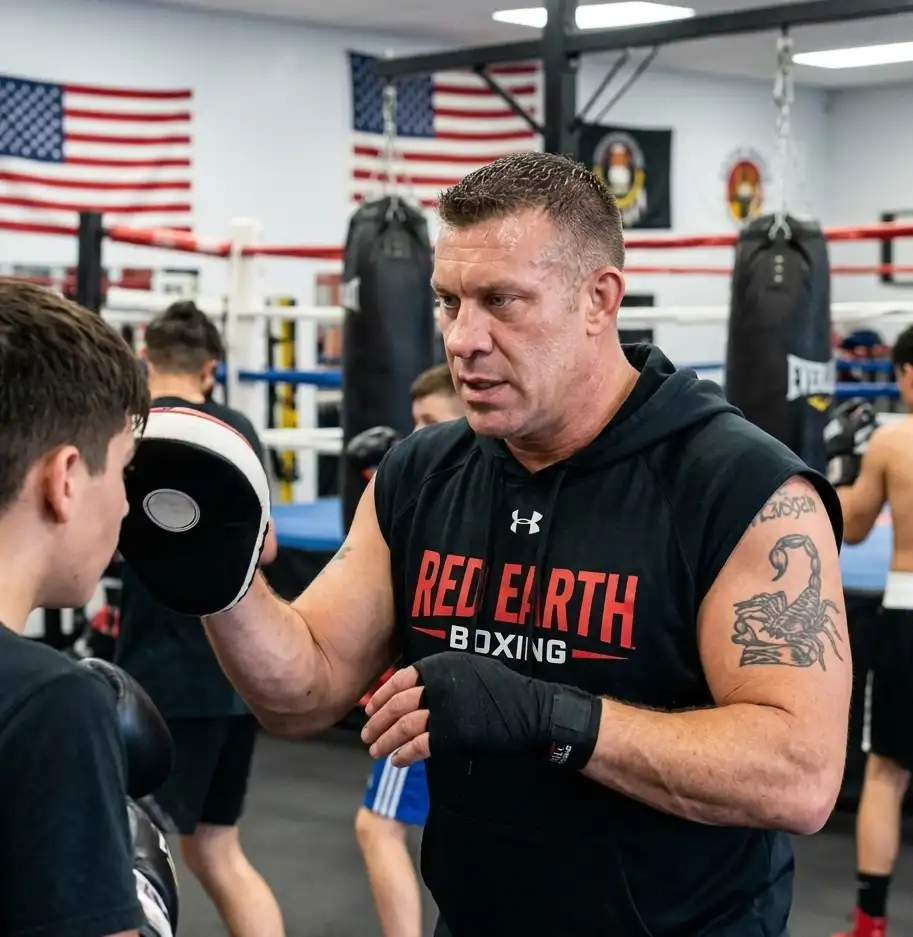
Is Jumping Rope a Good Exercise for Boxing? (The Real Benefits)
If you walk into almost any traditional boxing gym, the sound of a PVC rope slapping the canvas is usually the first thing you hear. It is one of the most recognizable images in combat sports. But for someone just starting out, the reality of jumping rope often looks very different from the movie montages. Most beginners grab a rope, try to mimic the speed of the advanced fighters, and end up tripping, whipping their shins, and gasping for air within three minutes.
Jumping rope is definitely a staple in boxing conditioning, but it is rarely the magical, effortless fat-burner that general fitness magazines make it out to be. It requires a specific kind of coordination that takes time to build. This breakdown looks at why boxers actually use the jump rope, what it does for your body in the ring, and how beginners can approach it without burning out or injuring their calves.
Quick Answer: Jump Rope for Boxing
- Primary Focus: Developing footwork rhythm, calf endurance, and shoulder stamina.
- Beginner Difficulty: Harder than expected. Coordination and timing usually fail before cardiovascular endurance does.
- Conditioning Challenge: Keeping the shoulders relaxed and breathing steadily while maintaining a continuous bounce.
- Recovery Importance: High impact on the lower legs. Calves and Achilles tendons need adequate rest to avoid stiffness.
- Realistic Timeline: Expect 3 to 4 weeks of consistent, slow practice to stop tripping and find a comfortable basic rhythm.
Educational Disclaimer: This article is for educational boxing and fitness information only and should not replace professional coaching, medical advice, or supervised combat sports training. Always consult a physician before starting a new conditioning routine.
Why Boxers Actually Jump Rope (Beyond the Movie Montage)
Many beginners assume the jump rope is just a warm-up tool or a simple way to sweat before hitting the heavy bag. While it does get the heart rate up, its primary purpose in a boxing gym is much more specific. It teaches weight transfer.
When you shadowbox or hit the pads, it is easy to plant your feet flat or lean too far forward. The jump rope forces you to stay on the balls of your feet. If your weight drops back onto your heels, you will trip. If you lean too far forward, the rope catches your toes. It provides instant, unforgiving feedback on your balance and posture.
In many boxing gyms, coaches watch a beginner’s footwork during rope skipping to see if they are naturally staying light. It builds a subconscious habit of keeping the weight forward and the knees slightly bent, which is the exact posture needed to move quickly around the ring. It is less about burning calories and more about wiring the nervous system to stay mobile and balanced under fatigue.
It also acts as a mental transition. Walking off the street and straight into high-intensity sparring or heavy bag work often leads to sloppy technique and quick exhaustion. The rhythmic, repetitive nature of skipping forces a fighter to slow down, regulate their breathing, and focus on a single, continuous motion. It bridges the gap between the stress of the day and the intense focus required for boxing. You will often see fighters use the rope to visually map out their footwork, imagining an opponent moving around them as they shift their weight from side to side.
The Real Conditioning Benefits for the Ring
Boxing is naturally stop-and-go. It requires bursts of energy followed by moments of active recovery. Many combat sports conditioning programs rely heavily on interval-style rounds because of this rhythm, and the jump rope mimics that demand perfectly.
Shoulder Endurance
One of the first things beginners notice is that their shoulders burn. Keeping your hands up while turning the rope requires sustained tension in the deltoids and upper back. In a real sparring session, a common problem beginners run into is dropping their hands in the later rounds simply because their shoulders are exhausted. Jumping rope conditions those specific stabilizing muscles to hold the guard up while the rest of the body is working.
Calf and Ankle Stamina
You can usually spot exhaustion in the footwork before punches slow down. When the calves fatigue, a boxer’s movement becomes flat and sluggish. The continuous, low-impact bouncing of skipping rope builds endurance in the lower legs, allowing fighters to maintain their lateral movement and pivots even in the final rounds of a workout.
Core Stabilization and Ankle Stiffness
Boxing requires a solid connection between the ground and the fists. When you throw a cross, the power originates from the push off the back foot, travels through the legs, and rotates through a braced core. Jumping rope, particularly the “boxer’s skip,” where weight shifts from one foot to the other, trains the ankle to remain stiff and reactive upon landing while the core maintains stability.
If the core relaxes or the ankle collapses inward upon impact, energy leaks out, and balance is lost. The rope exposes these weak links quickly. When fatigue sets in, and a beginner’s core starts to slump, their timing on the rope immediately falls apart, offering a real-time indicator of their postural endurance.
Rhythm and Timing
Boxing is highly rhythmic. Combinations, defensive slips, and footwork all flow together in a specific tempo. The jump rope acts as a metronome. It forces you to coordinate your upper body (turning the wrists) with your lower body (bouncing) while maintaining a steady breathing pattern. When beginners speed up their combinations on the heavy bag, they often forget to breathe properly. The steady tap of the rope encourages a more regulated breathing cycle.
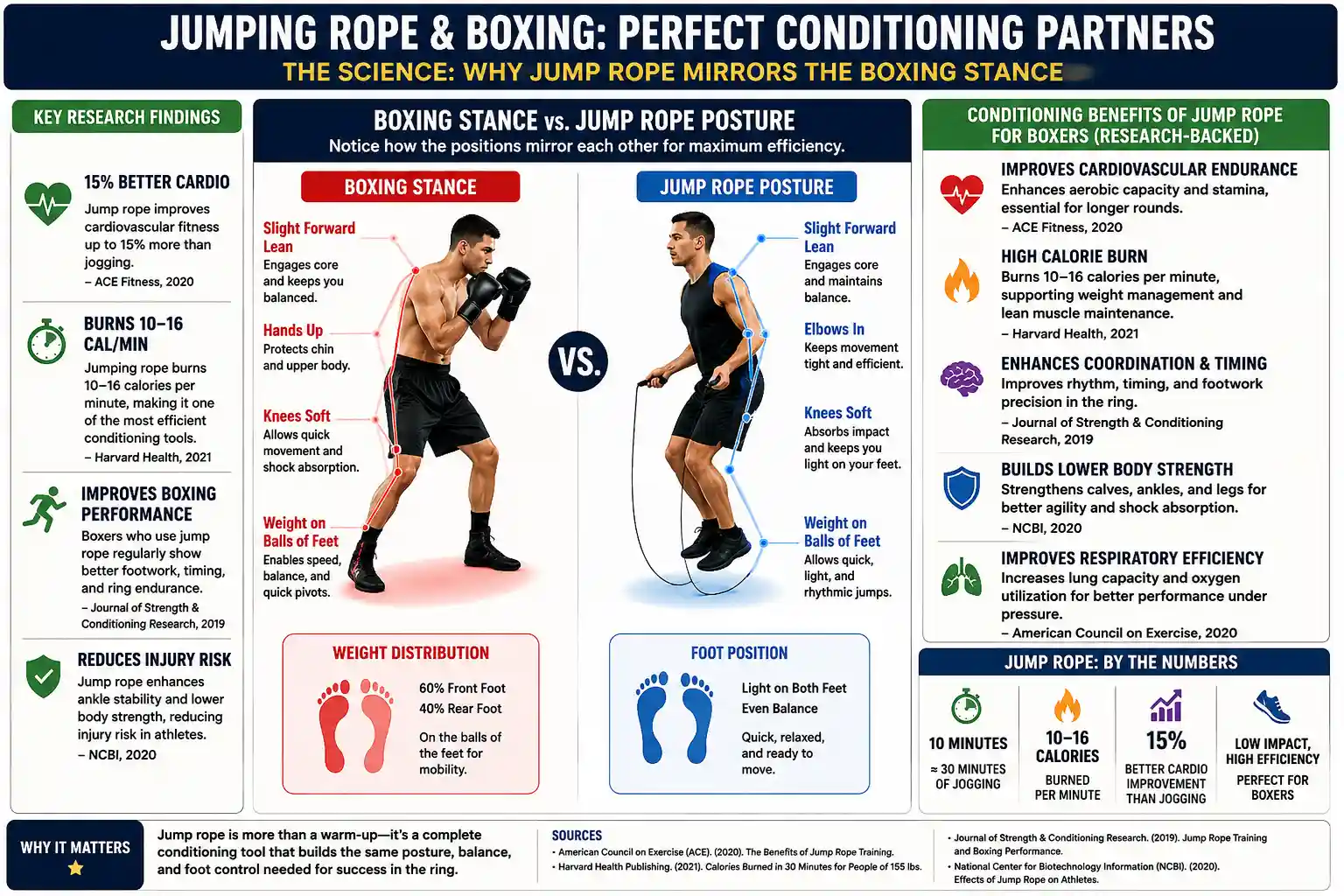
Visual Recommendation: Boxing Stance Weight Distribution vs. Jump Rope Foot Position. A side-by-side diagram showing how the slight forward lean and toe-weight in a boxing stance perfectly mirror the correct posture for jumping rope.
A Realistic Beginner Workout Structure
A frequent mistake in beginner boxing conditioning is trying to jump rope for three-minute rounds right away. Three minutes of continuous jumping is actually quite difficult for someone who has not built the specific coordination required. Most beginners throw hard for thirty seconds on the heavy bag and completely lose rhythm; the same applies to the rope.
Instead of focusing on time, it is usually better to focus on small, manageable intervals. This prevents the frustration of constantly tripping and keeps the heart rate manageable.
| Phase | Activity | Duration / Reps | Focus |
|---|---|---|---|
| Warm-Up | Shadowboxing / Joint Circles | 3-5 Minutes | Loosening the ankles, wrists, and shoulders. |
| Interval 1 | Basic Two-Foot Bounce | 30 Seconds | Keep jumps low. Focus on wrist rotation. |
| Rest | Active Rest (Walk around) | 30 Seconds | Shake out the arms and shoulders. |
| Interval 2 | Basic Two-Foot Bounce | 30 Seconds | Maintain a steady breathing rhythm. |
| Rest | Active Rest | 30 Seconds | Catch your breath. |
| Interval 3 | Boxer’s Skip (Weight Transfer) | 20 Seconds | Shift weight slightly from the left to the right foot. |
| Rest | Active Rest | 40 Seconds | Longer rest as coordination demands increase. |
| Cooldown | Calf and Achilles Stretching | 3-5 Minutes | Prevent lower leg tightness. |
Once the basic two-foot bounce is comfortable, the workout structure needs to evolve to match the demands of actual boxing rounds. A standard amateur bout consists of three rounds of three minutes, with one minute of rest. Conditioning should gradually mirror this timeline.
| Goal | Work Interval | Rest Interval | Footwork Variation |
|---|---|---|---|
| Aerobic Base | 2 Minutes | 1 Minute | Steady Boxer’s Skip |
| Pace Changing | 1 Min Slow / 30 Sec Fast | 1 Minute | Mixing high knees with basic bounce |
| Round Simulation | 3 Minutes | 1 Minute | Incorporating small shifts and pivots |
This progression helps the body adapt to the specific work-to-rest ratios found in actual combat sports, moving beyond general fitness into sport-specific endurance.
Common Pacing and Form Mistakes
When observing beginners in the gym, a few specific errors tend to make jumping rope much harder than it needs to be.
Jumping Too High
Many people try to jump several inches off the ground to ensure the rope clears their feet. This wastes a massive amount of energy and increases the impact on the knees and shins. In reality, the rope is only a few millimeters thick. You only need to clear the ground by about an inch or two. Staying closer to the floor allows for a faster, more efficient turnover and saves the leg muscles from premature exhaustion.
Using the Whole Arm
Another common issue is turning the rope using the entire shoulder and elbow joint. This leads to the shoulder burnout mentioned earlier. The rotation should come almost entirely from the wrists. The elbows should stay relatively tucked in near the ribs, with the forearms doing very little work.
Tensing the Shoulders and Neck
Many beginners tense their shoulders too early and burn energy fast. When people concentrate hard on not tripping, they tend to hike their shoulders up toward their ears. This restricts breathing and causes neck stiffness. A good cue is to periodically check in and consciously drop the shoulder blades down the back.
Looking Down at the Feet
Another highly visible habit among beginners is staring directly at their shoes while skipping. In a boxing stance, dropping your chin to look at your feet is a quick way to get caught with an uppercut or lose sight of your opponent’s shoulders. When you look down, your posture naturally rounds forward, which restricts the diaphragm and makes breathing much more difficult.
A good practice is to pick a spot on the wall or the mirror at eye level and keep your gaze fixed there. It feels awkward at first and increases the likelihood of tripping, but it forces the brain to rely on spatial awareness rather than visual tracking, which is a crucial skill in the ring.
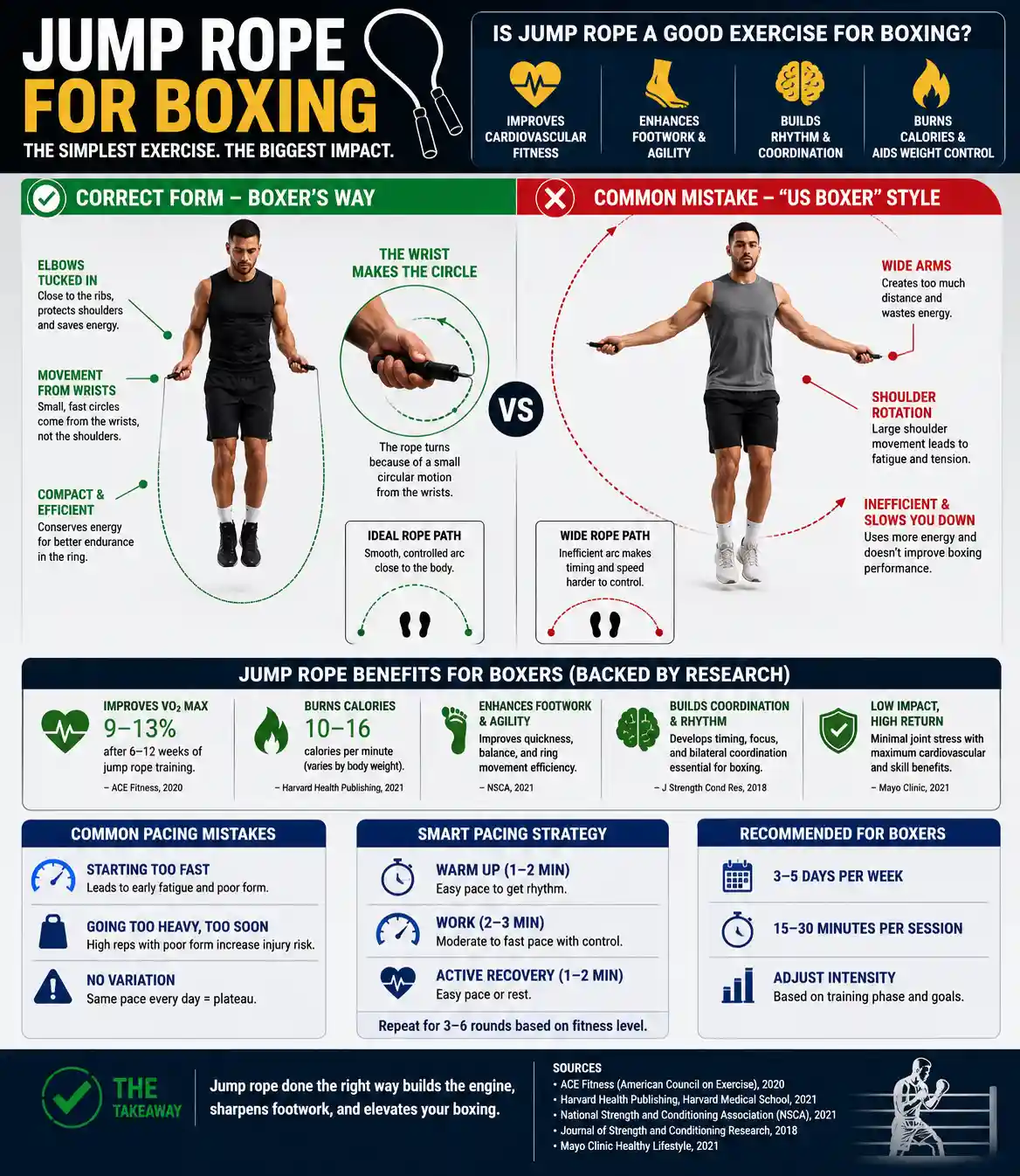
Visual Recommendation: Correct Arm and Wrist Position for Skipping. A close-up graphic highlighting the tucked elbows and the circular motion originating purely from the wrists, contrasted with an “US Boxer” over a wide-arm, shoulder-rotating stance.
Equipment and Surface Choices
You do not need a lot of expensive gear to start, but a few basic choices can make the difference between a good workout and a painful one.
Choosing the Right Rope
For beginners, a simple, lightweight PVC plastic rope is generally the best option. It is cheap, durable, and provides a little bit of air resistance so you can feel where the rope is during the spin. Weighted ropes are often marketed to fitness enthusiasts for building arm strength, but they can alter your timing and place unnecessary strain on the wrists and elbows when you are still learning the basic mechanics. Leather ropes are great for advanced boxers who want speed, but they tend to tangle easily and can hurt more if you whip your legs while learning.
Sizing the Rope
To find a roughly correct length, stand in the middle of the rope with one foot and pull the handles up. For a beginner, the handles should reach somewhere around the armpit or shoulder. As you get better and your jumps become more efficient, you can gradually shorten the rope.
The Surface Matters
Jumping on concrete or tile floors is generally a bad idea. The lack of shock absorption sends the impact straight up through the ankles, knees, and lower back. In a real gym setting, people jump on suspended wooden floors or thick rubber mats. If you are training at home, try to jump on a rubber puzzle mat, a thin carpet, or a piece of plywood. Wearing supportive cross-training shoes with decent forefoot cushioning is also highly recommended over barefoot jumping for beginners.
Recovery and Overuse Concerns
Because jumping rope involves repetitive, low-level impact, the lower legs take the brunt of the conditioning stress. Long periods of poor recovery can make training harder and slow progress.
Achilles and Calf Tightness
The calves are working continuously to lift your body weight. It is very common to wake up the day after a jump rope session with stiff, tight calves. If this tightness is ignored, it can pull on the Achilles tendon and lead to inflammation. Taking the time to stretch the calves against a wall or use a foam roller after the workout is a practical way to manage this.
Plantar Fasciitis and Footwear Transition
The bottom of the foot takes a repetitive beating during jump rope sessions. The plantar fascia, a thick band of tissue running across the arch, can become inflamed if the calves are overly tight or if the athlete suddenly increases their jumping volume. Many beginners try to transition too quickly from heavily cushioned running shoes to minimalist “barefoot-style” training shoes because they see advanced boxers wearing them. While minimalist shoes improve ground feel, they demand significantly more strength from the arches and calves. It is generally safer to stick to supportive cross-trainers while building baseline endurance, and only transition to thinner-soled boxing shoes or minimalist trainers gradually over several weeks. Rolling a frozen water bottle under the arch of the foot after a workout is a common, practical way to soothe inflammation in this area.
Shin Splints and Foot Pain
If a beginner jumps too high, lands too heavily, or trains on concrete, they may develop pain along the front of the lower leg (shin splints) or in the arches of the feet. If this type of pain starts, the most effective response is usually to stop jumping for a few days and switch to low-impact conditioning like cycling or shadowboxing. Pushing through joint or tendon pain rarely ends well.
Rest Days
Sports medicine organizations like ACSM generally recommend balancing intense conditioning with adequate recovery. You do not need to jump rope every single day. Incorporating it two or three times a week, interspersed with heavy bag work or pad work, gives the connective tissues in the feet and ankles time to adapt to the new load.
How to Transition from Jump Rope to Shadowboxing
One of the most practical ways to use the jump rope in a boxing gym is as a direct lead-in to shadowboxing. The transition between the two exercises highlights the true purpose of the rope.
After finishing a three-minute round on the rope, a fighter’s heart rate is elevated, their calves are pumped with blood, and their shoulders are warm. Dropping the rope and immediately picking up a boxing stance requires the athlete to maintain that exact same rhythm and weight distribution, but now with the added complexity of throwing punches.
Beginners often finish their jump rope round, take a long rest, and then start shadowboxing completely cold. By transitioning directly, you force your body to coordinate upper-body punches while the lower body is already experiencing the fatigue of continuous movement. This mimics the feeling of the later rounds in a sparring session. You learn how to keep your footwork active and your balance centered, even when the legs feel heavy. It is a simple, highly effective way to link general conditioning directly to sport-specific mechanics.
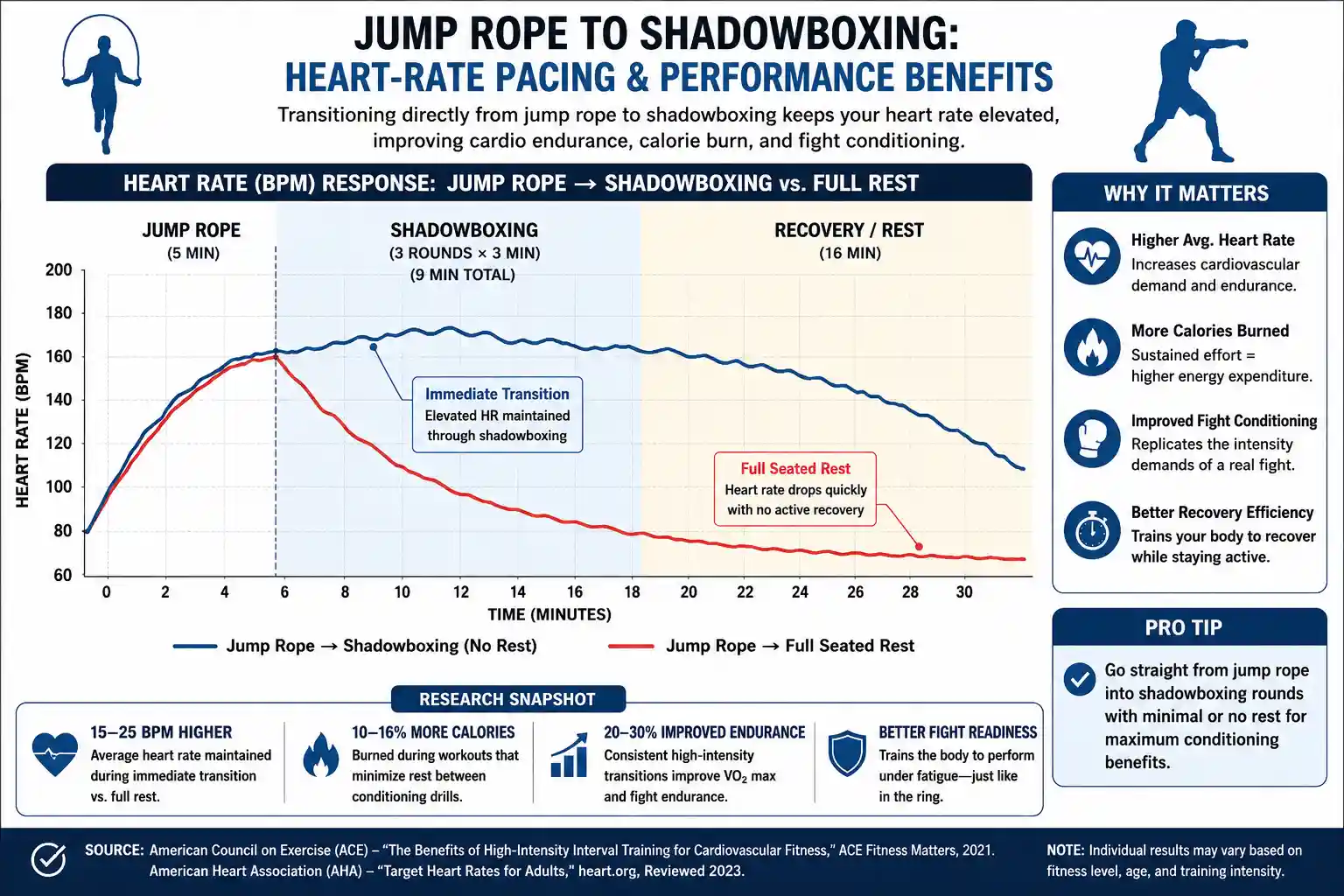
Visual Recommendation: Heart-Rate Pacing from Jump Rope directly into Shadowboxing Rounds. A simple line graph showing the sustained elevated heart rate when transitioning immediately from skipping into shadowboxing, compared to the drop in heart rate during a full seated rest.
Safety and Listening to Your Body
Conditioning should feel tiring, but it should not cause sharp pain. It is important to distinguish between the burning sensation of muscle fatigue and the sharp, localized pain of a joint or tendon issue.
If your lungs are burning and your shoulders are heavy, that is the expected conditioning challenge. If you feel a sharp ache in your knee, a stabbing pain in your heel, or a persistent twinge in your lower back, that is a signal to stop.
Boxing requires healthy joints. Sacrificing your knees or ankles just to finish a ten-minute jump rope circuit is counterproductive. If the impact is too much, modifying the workout by doing shadowboxing with light one-pound dumbbells can provide a similar shoulder and cardiovascular stimulus without the repetitive pounding on the lower legs.
Frequently Asked Questions (FAQ)
Do I need a weighted rope to build arm strength for boxing?
Generally, no. While weighted ropes do make your shoulders burn faster, they can throw off your natural boxing timing and put excessive strain on the elbow joints. Most boxing conditioning relies on holding your actual hands up in a guard position for arm endurance. A standard, lightweight PVC rope is usually much better for developing the speed and rhythm you actually need in the ring.
Why do my shoulders burn out before my legs do?
This is extremely common for beginners. It usually happens because you are using your entire arm and shoulder to turn the rope, rather than just flicking your wrists. It can also happen if you are holding your arms too far away from your body or keeping your shoulders tensed up near your ears. Focus on tucking your elbows in and relaxing your neck.
How long until I stop tripping over the rope?
Most beginners are surprised by how awkward the coordination feels at first. If you practice for just ten to fifteen minutes at the end of your workouts, three times a week, you will generally notice a significant improvement in about three to four weeks. The brain and the feet just need time to sync up.
Can I jump rope every day?
While some advanced fighters do skip daily, it often has too much impact on a beginner’s connective tissues. Calves and Achilles tendons adapt to stress more slowly than muscles do. It is usually safer to start with two or three days a week and monitor your lower legs for stiffness or pain before increasing the frequency.
Is jumping rope enough for fight endurance?
Jumping rope is an excellent piece of the puzzle, but it is rarely enough on its own. Fight endurance also requires the specific anaerobic output of hitting the heavy bag, doing pad work, and eventually sparring. The rope builds the foundation—the footwork rhythm, the calf stamina, and the shoulder endurance—but you still need to practice throwing punches under fatigue to truly prepare for a bout.
About the Author
Neil Stephens is a National Academy of Sports Medicine (NASM) Certified Personal Trainer and a Certified USA Boxing Coach based in Los Angeles. With hands-on experience in boxing training, conditioning, and athletic performance, he focuses on helping readers understand practical boxing techniques, fitness strategies, and combat sports conditioning.
Neil is the author of Boxinges, also known as “Boxinges USA,” where he shares expert-backed content about boxing training, workouts, recovery, and sports performance. His content is built around accuracy, real-world coaching knowledge, and athlete-focused guidance to support beginners and experienced fighters alike.
Final Thoughts
Jumping rope is not a magic shortcut to elite fight conditioning, but it is a highly practical tool when used correctly. It teaches the subtle weight transfers, builds the specific muscular endurance needed to keep your hands up, and forces you to find a rhythm when you are tired.
For beginners, the key is to drop the expectations of speed and complexity. Focus on small jumps, relaxed shoulders, and steady breathing. Accept that you will trip, whip your shins, and get frustrated in the first few weeks. Once the basic coordination clicks, the jump rope transitions from a frustrating chore into one of the most reliable and meditative warm-ups in your boxing routine. Protect your joints, keep the volume manageable, and let the coordination develop over a few weeks.