
Boxing vs Running: Which Actually Burns More Calories Faster? (The Winner!)
Most people stepping into a boxing gym for fitness have the same basic question: Is hitting the heavy bag actually a faster way to burn calories than going for a run? It is a fair question. Running has been the default calorie-burner for decades. But watching a seasoned boxer work the pads makes the sport look incredibly demanding.
The truth is a bit more complicated than just looking at a fitness tracker. While boxing engages more muscle groups, the actual calorie burn depends heavily on your ability to sustain the pace. Beginners often find out very quickly that throwing punches is exhausting in a completely different way than jogging.
Quick Answer
- Workout Focus: Running builds steady-state cardiovascular endurance. Boxing develops stop-and-go anaerobic capacity and full-body coordination.
- Beginner Difficulty: Running is generally easier to sustain for 30+ minutes. Boxing requires complex coordination that causes beginners to fatigue rapidly.
- Conditioning Challenge: Boxing spikes the heart rate faster due to upper-body engagement and rotational torque. Running challenges the lower body and pacing discipline.
- Recovery Importance: Running primarily requires leg recovery. Boxing requires shoulder, wrist, and central nervous system recovery due to the high coordination demand.
- Realistic Timeline: Most beginners notice improved breathing and pacing in both activities within 3 to 4 weeks of consistent practice.
Educational Disclaimer: This article is for educational boxing and fitness information only and should not replace professional coaching, medical advice, or supervised combat sports training.
The Calorie Math: Steady State vs. Stop-and-Go
When you look strictly at the numbers, boxing can technically burn more calories per minute than running. A fast-paced heavy bag session or pad work requires you to move your entire body weight with almost every punch. You are twisting your torso, driving off your legs, and snapping your shoulders. That level of full-body engagement demands a lot of oxygen and energy.
Running, on the other hand, is mostly lower-body. It is highly efficient. A general rule of thumb in the fitness community is that running burns roughly 100 calories per mile, depending on your weight and pace. If you run a 10-minute mile, you are burning about 10 calories a minute.
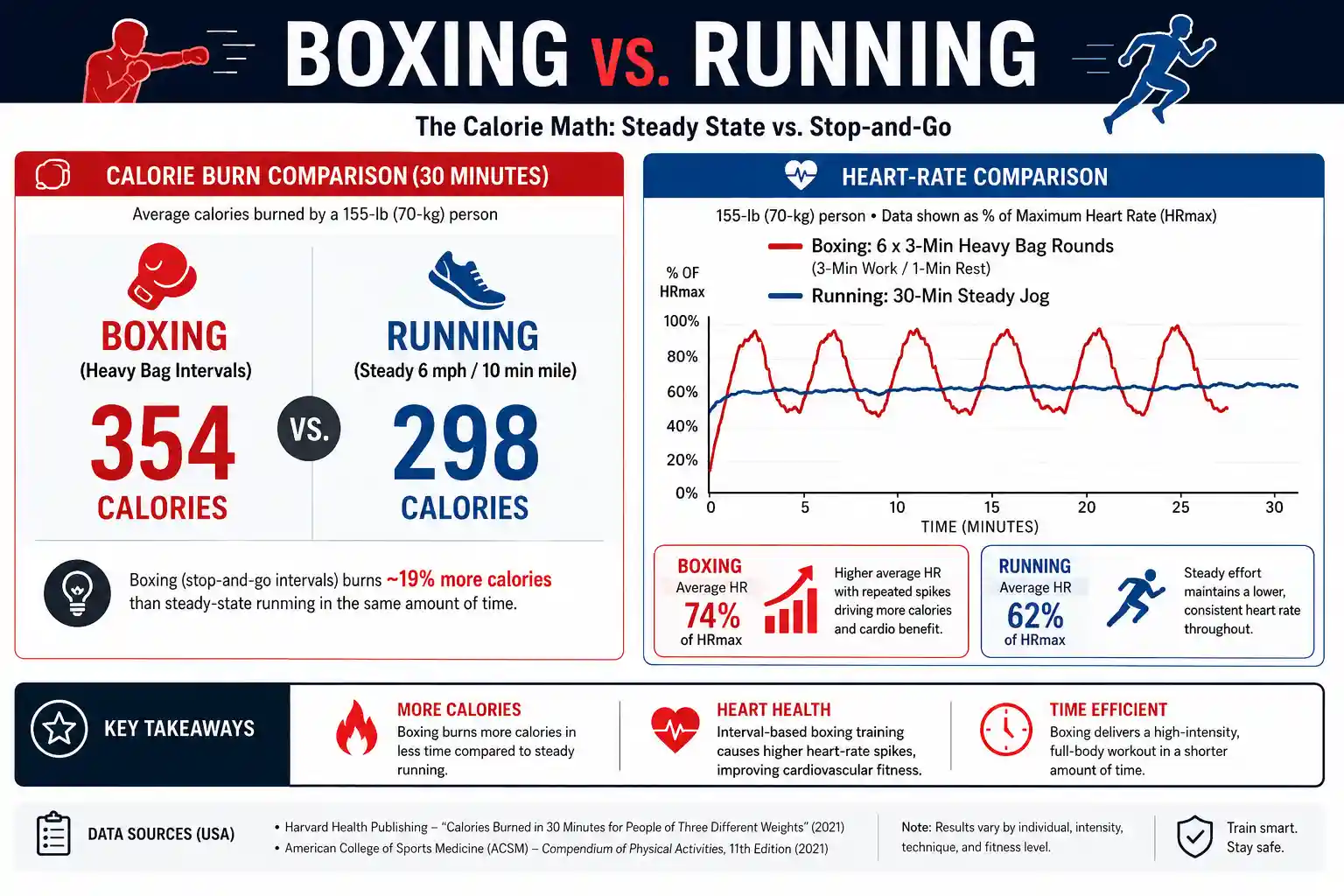
Visual Recommendation: Heart-rate pacing graphic comparing a steady 30-minute jog vs. the spiked heart rate of six 3-minute heavy bag rounds.
Boxing is naturally interval-based. Combat sports conditioning programs rely heavily on interval-style rounds because boxing itself is naturally stop-and-go. You throw a combination, you move, you reset. This causes your heart rate to spike and drop repeatedly. During a high-output round on the heavy bag, a person can easily burn 13 to 15 calories a minute.
But here is where the math gets tricky for the average person. Burning 15 calories a minute only matters if you can actually keep moving for the duration of the workout. And for most people just starting out, that is the hardest part.
Why Beginners Usually Burn More Running (At First)
If you put a beginner on a treadmill and a beginner on a heavy bag for 30 minutes, the runner will almost always burn more total calories. The reason has very little to do with the exercises themselves and everything to do with fatigue management.
Running is simple. You put one foot in front of the other. You can slow down to a walk, catch your breath, and start jogging again without breaking the fundamental mechanics of the exercise.
Boxing is highly technical. Most beginners are surprised by how quickly boxing conditioning becomes exhausting. When someone new steps up to the heavy bag, they usually throw hard for thirty seconds and completely lose rhythm. Many beginners tense their shoulders too early and burn energy fast. You can usually spot exhaustion in the footwork before punches slow down. The feet stop moving, the hips stop turning, and the person starts arm-punching the bag.
Once the form breaks down, the workout stops being a high-calorie-burning full-body exercise. It just becomes a very tiring upper-body isolation movement. People usually forget to breathe properly once combinations speed up, which spikes the heart rate artificially and leads to a quick burnout. Because of this, a beginner might only get 10 minutes of actual high-output work during a 45-minute boxing class, whereas they could easily jog at a moderate pace for 35 minutes of that same 45-minute window.
As coordination improves and the shoulders learn to stay relaxed, the calorie burn in boxing catches up to—and often surpasses—running. But it takes time to build that specific type of endurance.
Workout Structure
To understand how these two activities compare in a real gym or on the road, it helps to look at how a standard session is actually structured. Both can be adapted, but they generally follow different patterns.
| Component | Typical 45-Minute Run | Typical 45-Minute Boxing Session |
|---|---|---|
| Warm-up | 5 mins of light jogging or dynamic leg swings. | 10 mins of jump rope and shadowboxing to warm up shoulders and hips. |
| Main Work | 35 mins of steady-state running at a conversational pace. | 6 x 3-minute rounds on the heavy bag with 1-minute active rest periods. |
| Pacing | Consistent. Heart rate stays in a single zone. | Fluctuating. High spikes during combinations, drops during footwork resets. |
| Cool Down | 5 mins of walking and calf stretching. | 5 mins of light shadowboxing and shoulder/wrist stretches. |
Visual Recommendation: Boxing circuit diagram showing the transition from jump rope to shadowboxing to heavy bag work, highlighting the changing physical demands.
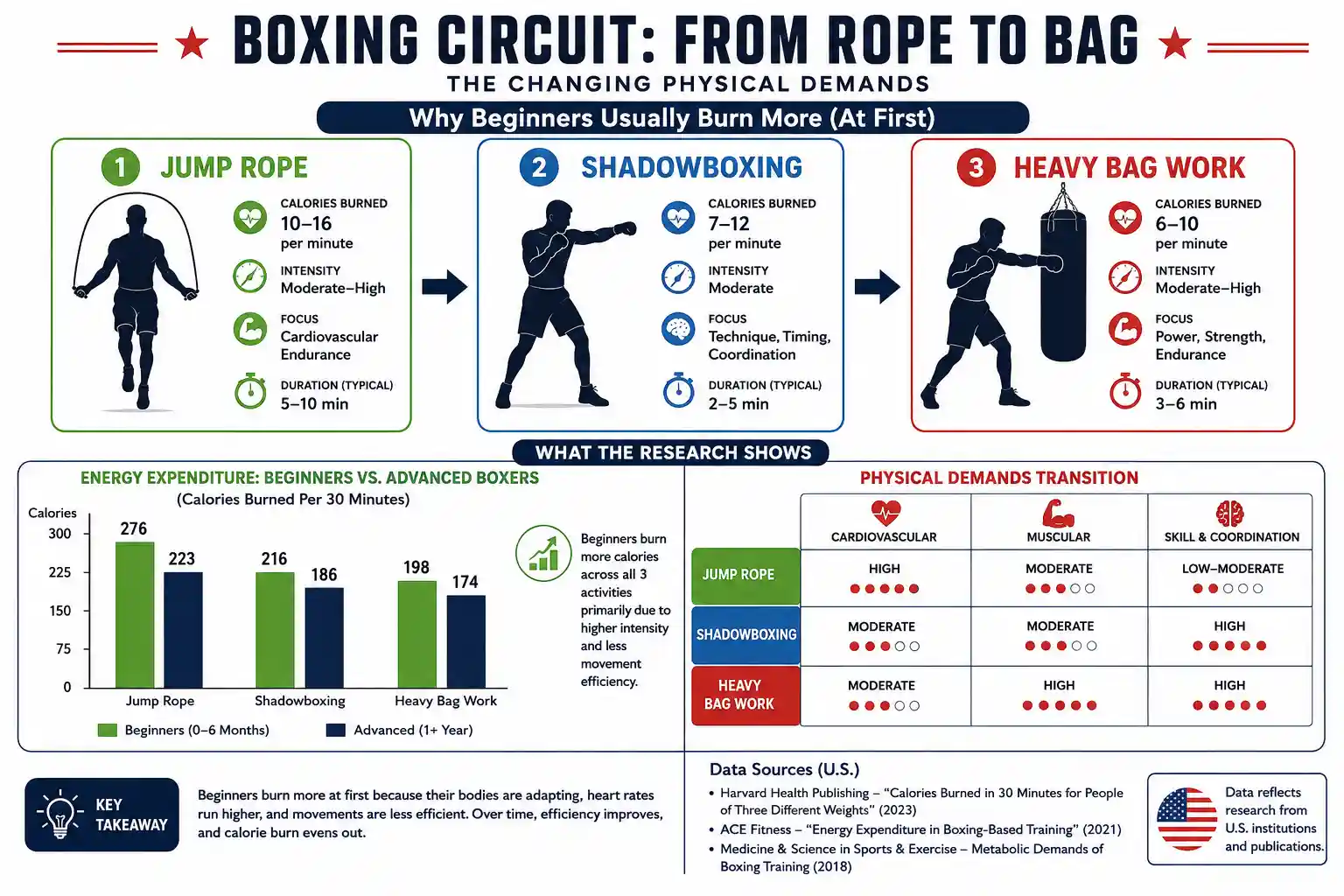
In the running structure, the main challenge is mental boredom and joint repetition. In the boxing structure, the main challenge is managing the 1-minute rest periods. Beginners often sit down during that minute, letting their heart rate drop too low, and their muscles stiffen up, making the next 3-minute round feel impossibly heavy.
Conditioning Mistakes
Whether you are logging miles or wrapping your hands, inefficiencies will kill your calorie burn and make the workout feel much harder than it needs to be. Here are the most common pacing and physical mistakes observed in both activities.
Boxing Mistakes
Holding the Breath: It is incredibly common for beginners to exhale on the first two punches of a four-punch combination and then hold their breath for the last two. This deprives the muscles of oxygen and causes immediate shoulder fatigue.
Pushing the Bag: Instead of snapping punches and pulling them back quickly, many people lean their body weight into the heavy bag and push it. This swings the bag wildly and forces the person to chase it, wasting energy on footwork rather than punch output.
Dropping the Guard: As the shoulders burn, the hands drop to chest level. This usually happens around round three. It is a clear sign of localized muscle fatigue.
Running Mistakes
Starting Too Fast: The first mile often feels easy, so people run faster than their aerobic base allows. By mile two, they are gasping and forced to walk, ruining the steady-state calorie burn.
Over-striding: Reaching the foot out too far in front of the body acts as a braking mechanism. It wastes energy and sends unnecessary shock up the shins and knees.
Ignoring Upper Body Tension: Just like in boxing, runners often clench their fists and hike their shoulders up to their ears when they get tired, wasting calories on unnecessary tension.
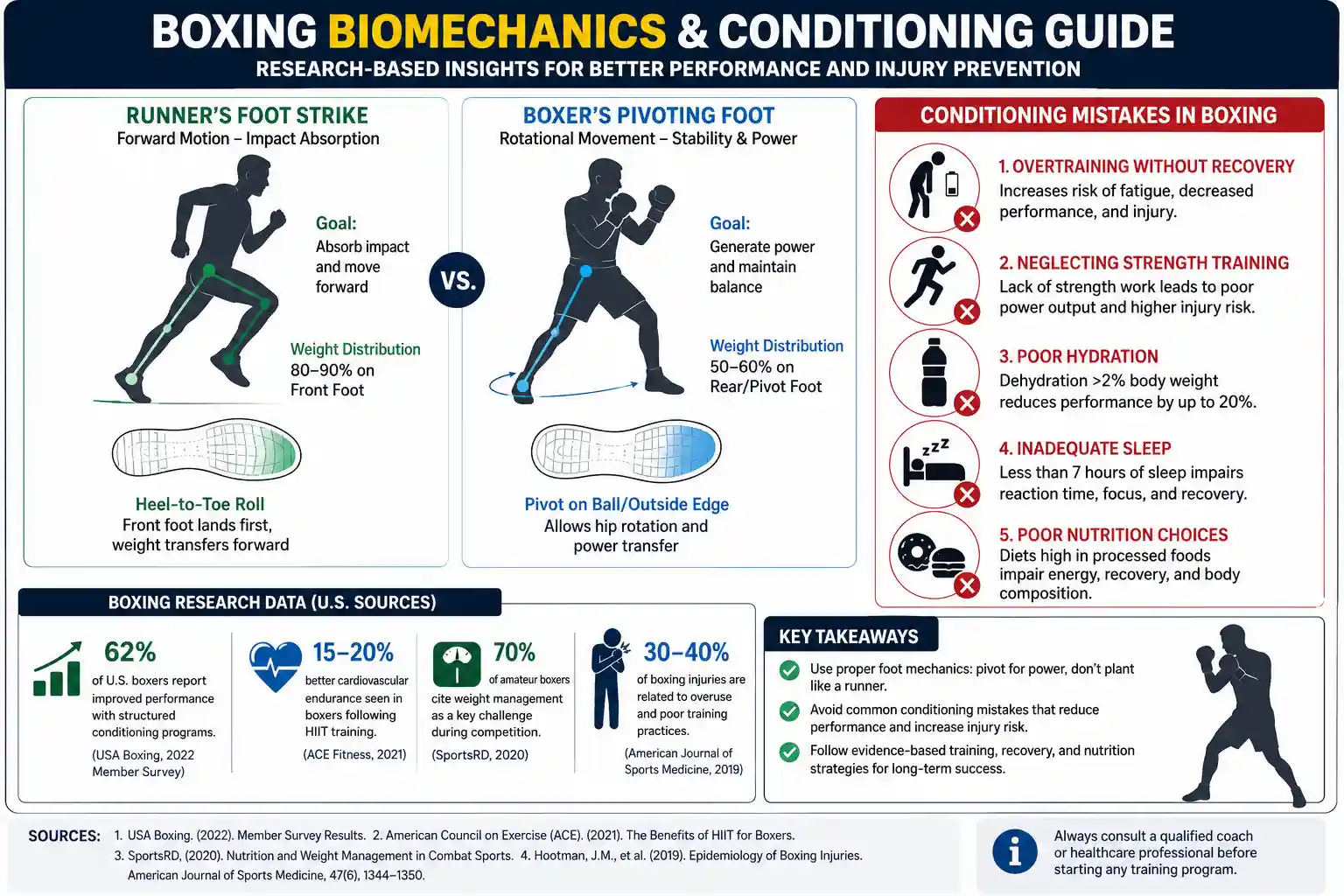
Visual Recommendation: Stance-position visuals showing the correct weight distribution for a runner’s foot strike versus a boxer’s pivoting foot to illustrate proper biomechanics.
Recovery Section
The way your body feels the day after a long run is very different from how it feels after a hard boxing session. Understanding this helps in planning a realistic weekly schedule.
Running is highly repetitive. The impact is entirely on the lower body. You can expect tight calves, stiff hamstrings, and potentially sore knees or hips. The cardiovascular system recovers relatively quickly, but the joints and connective tissues take a beating from the repetitive pavement pounding.
Boxing fatigue is more systemic. Because you are constantly twisting your torso to generate power, your core and lower back often feel tight the next day. The shoulders and forearms accumulate lactic acid from keeping your guard up and snapping punches. Long periods of poor recovery can make training harder and slow progress, especially when your wrists start to ache from improper punching alignment.
Sports medicine organizations like the American College of Sports Medicine (ACSM) generally recommend balancing intense conditioning with adequate recovery. For a beginner, this usually means not doing heavy bag work and long-distance running on consecutive days. The central nervous system needs a break from the high coordination demands of boxing, while the joints need a break from the impact of running.
Many people notice their form breaks down when exhaustion hits, which is usually a sign that they need an extra rest day rather than more discipline.
Equipment Section
Accessibility plays a big role in which exercise people actually stick with. The barrier to entry for running is incredibly low, while boxing requires a bit more preparation.
Running Gear
Shoes: A proper pair of running shoes fitted to your gait is the only real requirement. Wearing old, worn-out sneakers is a fast track to shin splints.
Clothing: Moisture-wicking fabrics help, but any comfortable athletic wear works.
Tracking: A basic watch or smartphone is usually enough to track distance and pace.
Boxing Gear
Hand Wraps: Essential. They protect the small bones in the wrist and hand. Learning to wrap your hands properly takes a few tries and is a mandatory skill before hitting any hard surface.
Gloves: 12oz to 16oz gloves are standard for bag work. They protect your knuckles and the equipment.
The Bag: Access to a heavy bag is required. This usually means a gym membership or a significant investment in home equipment, including proper ceiling mounting.
Jump Rope: A simple speed rope is standard for warm-ups. Expect to trip over it frequently during the first few weeks. It is just part of the process.
Safety Section
Both activities carry inherent risks, mostly related to overuse and repetitive stress. Medical authorities like the Mayo Clinic frequently treat injuries related to both running mechanics and combat sports conditioning.
In running, the most common issues are plantar fasciitis, runner’s knee, and IT band syndrome. These usually stem from doing too much, too soon, on hard surfaces. Increasing mileage by more than 10% a week is a common trigger for these problems.
In boxing, the risks shift to the upper body. Boxer’s knuckle (damage to the extensor tendons) and wrist sprains happen when punches land at bad angles or when people hit the heavy bag without wrapping their hands. There is also a risk of shoulder impingement from throwing thousands of punches with internally rotated shoulders without doing enough pulling or stretching exercises to balance the posture.
USA Boxing recommends beginners prioritize defensive fundamentals and proper punching mechanics before engaging in intense sparring or high-volume heavy bag work. Getting the technique right at a slow pace prevents the bad habits that lead to joint pain later on.
FAQ Section
Will boxing make my shoulders too bulky to run efficiently?
For the vast majority of people doing boxing fitness classes, no. Boxing builds lean, endurance-based muscle in the shoulders and back. It does not typically add the kind of heavy mass that would negatively impact your running economy. You might feel stiff if you do not stretch, but you will not become too heavy to run.
Why do I feel completely out of breath after just one round on the heavy bag?
Most beginners are surprised by how exhausting even short heavy bag rounds feel. This happens because you are likely holding your breath, tensing your neck and shoulders, and throwing with maximum effort rather than pacing yourself. It is an anaerobic spike. As you learn to relax your upper body and breathe rhythmically with your punches, your cardio will improve rapidly.
Is it better to run before or after boxing?
It depends on your primary goal, but generally, it is better to separate them. If you must do them on the same day, do the one that requires the most technical skill first while you are fresh. For most, that means boxing first. Running on exhausted, shaky legs after a hard boxing session can alter your running stride and increase the risk of tripping or twisting an ankle.
Can I just shadowbox instead of running to get my cardio in?
You can, but shadowboxing requires a high level of self-discipline to maintain intensity. Without a heavy bag to provide resistance or a coach yelling at you to keep your hands up, it is very easy to slow down and just go through the motions. Running provides a more objective measure of effort.
How long does it take to stop feeling sore in the forearms and neck?
Usually, about three to four weeks of consistent training. The muscles in the neck and forearms are working isometrically to keep your guard up and your wrists straight. Once they adapt to the specific demand of holding 12oz gloves for several rounds, the deep soreness fades into a normal, manageable fatigue.
Do I need to run long distances to get “fight shape” endurance?
Not necessarily. While traditional roadwork (long, slow distance running) has been a staple in boxing camps for decades, modern conditioning often favors interval sprints and high-intensity bag work. Boxing matches are essentially a series of high-output bursts followed by brief rests. Shorter, faster runs often mimic the energy demands of a fight better than a slow five-mile jog.
Author Bio
Neil Stephens is a National Academy of Sports Medicine (NASM) Certified Personal Trainer and a Certified USA Boxing Coach based in Los Angeles. With hands-on experience in boxing training, conditioning, and athletic performance, he focuses on helping readers understand practical boxing techniques, fitness strategies, and combat sports conditioning.
Neil is the author of Boxinges, also known as “Boxinges USA,” where he shares expert-backed content about boxing training, workouts, recovery, and sports performance. His content is built around accuracy, real-world coaching knowledge, and athlete-focused guidance to support beginners and experienced fighters alike.
Final Thoughts
When deciding between boxing and running for calorie burn, the most effective choice is usually the one you will actually do consistently. Running offers a highly predictable, easy-to-track way to burn calories and build a baseline of cardiovascular health. It requires very little technical skill to get started, which makes it easier to sustain for longer periods.
Boxing offers a more dynamic, full-body workout that can burn calories at a very high rate, provided you have the coordination and pacing to keep moving. It challenges the mind as much as the lungs, requiring you to think about footwork, distance, and breathing all at once.
For beginners, the frustration of gassing out on the heavy bag is a normal part of the process. Your shoulders will burn, your timing will feel awkward, and you will probably trip over the jump rope. That is just how the sport works. If you focus on relaxing your shoulders, breathing out on your punches, and pacing your rounds, the conditioning will follow. Whether you choose the pavement or the canvas, consistency and realistic pacing will always yield better results than trying to force an exhausting workout every single day.